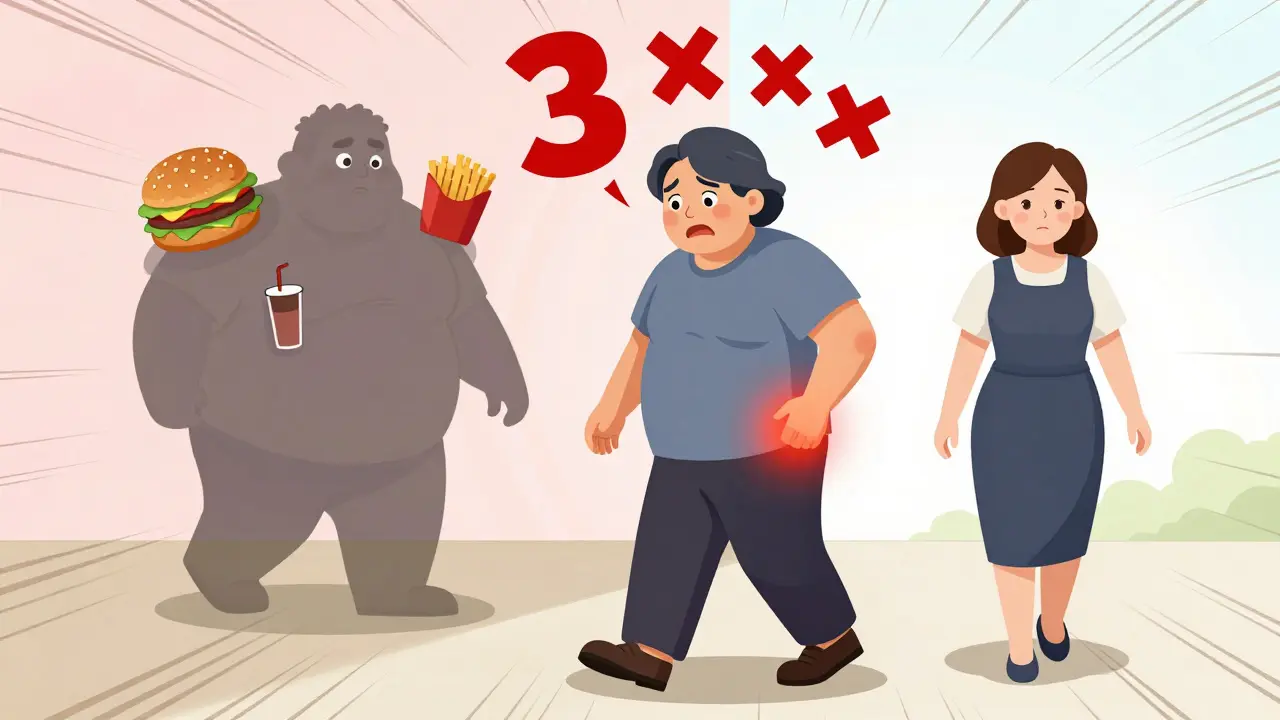
When your hip starts to ache with every step, it’s not just about aging. It’s often osteoarthritis - and excess weight is one of the biggest drivers behind it. Unlike knee osteoarthritis, where weight loss clearly helps, the connection between losing weight and hip pain relief has been messy, confusing, and even contradictory. But new research is changing the story. If you’re carrying extra pounds and struggling with hip pain, this isn’t just about looking better - it’s about saving your joint before it’s too late.
Why Your Hip Hurts When You’re Overweight
Osteoarthritis of the hip isn’t just "wear and tear." It’s a full breakdown of the cartilage that cushions the ball-and-socket joint. Bone starts to rub on bone. Inflammation creeps in. The joint swells, stiffens, and loses function. And while aging plays a role, obesity is the silent accelerant. For every extra pound you carry, your hip joint takes on 3 to 4 times that load during walking. That’s not just pressure - it’s constant trauma.
Studies show that people with a BMI over 30 are far more likely to develop hip osteoarthritis. In fact, if obese men dropped into the overweight range and overweight men reached normal weight, hip OA rates could fall by over 30%. The numbers are even higher for women. This isn’t theoretical. It’s biomechanical. Your hip joint doesn’t just support your weight - it absorbs shock, rotates, and moves under load. Extra fat doesn’t just add mass; it changes how your whole body moves, straining muscles, tendons, and ligaments around the joint.
Weight Loss Isn’t Just for Knees - It Works for Hips Too
For years, doctors told people with hip OA: "Lose weight if you can, but don’t expect much change." That belief came from a few small studies that showed little to no improvement in hip pain after weight loss. One 2023 trial compared a very-low-calorie diet with exercise against exercise alone. At six months, there was no meaningful difference in hip pain between the groups. That study got a lot of attention - and even led a major medical journal to declare, "Osteoarthritis of the Hips Is Unaffected by Weight Loss." But here’s what they missed: time.
A follow-up at 12 months changed everything. The group that lost weight didn’t just feel better - they had significantly less pain, better mobility, and higher scores on quality-of-life measures. The benefits didn’t show up fast. They built up. And they were real.
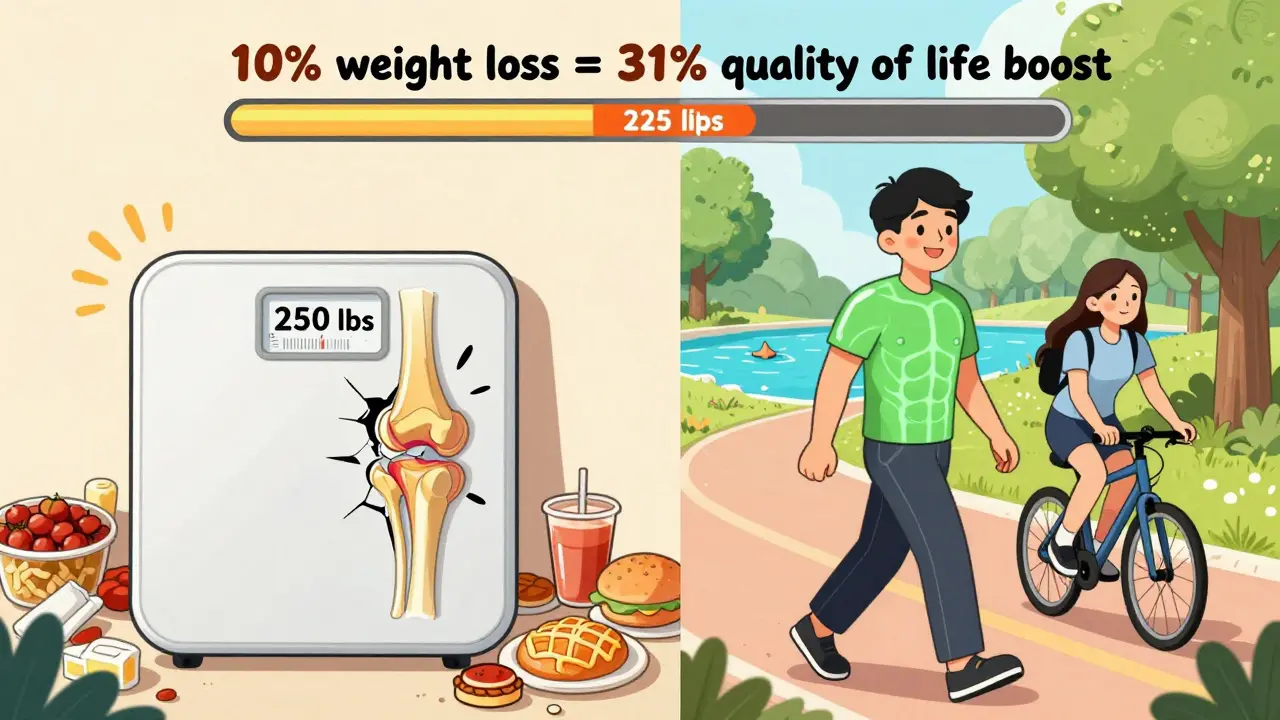
Then came the 2024 Nature study - the most detailed look yet. Researchers tracked 65-year-olds with hip OA and obesity. Those who lost more than 10% of their body weight saw dramatic improvements across every measure: pain, stiffness, daily function, and even quality of life. The biggest jump? A 31% improvement in how they felt about their hip-related quality of life. That’s not a fluke. That’s a transformation.
And here’s the kicker: losing 5% helped. Losing 7% helped more. But losing over 10%? That’s where the real shift happened. It wasn’t just less pain. It was the ability to walk without fear, climb stairs without hesitation, and sleep through the night.
How Much Weight Do You Actually Need to Lose?
For knee osteoarthritis, experts say losing 5% of your body weight can cut pain in half. For hips? That number doesn’t hold up. The data says: aim for 10% or more.
Here’s what that looks like:
- If you weigh 200 pounds, losing 20 pounds could mean the difference between limping and walking normally.
- If you weigh 250, losing 25 pounds might get you off painkillers and back into your favorite activities.
And here’s the surprising part: losing 20% didn’t give you much more benefit than losing 10%. That means there’s a sweet spot. You don’t need to become skinny. You just need to get out of the obese range. The goal isn’t perfection - it’s function.
One study tracked 35 people with hip OA and a BMI over 25. After eight months of combined exercise and diet, they lost an average of 10% of their body weight - and saw a 32.6% improvement in physical function. That’s not magic. That’s science.
Exercise Isn’t Optional - It’s Essential
Weight loss alone isn’t enough. If you drop weight but don’t move, your muscles weaken, your joint still deteriorates, and pain comes back. You need both.
The best approach? Low-impact movement that builds strength without pounding your hip:
- Swimming or water aerobics - zero impact, full range of motion
- Cycling (stationary or outdoor) - smooth, controlled, joint-friendly
- Strength training for glutes and thighs - stabilizes the hip joint
- Walking - start short, build up slowly
Avoid high-impact activities like running, jumping, or heavy squats. They don’t help - they hurt. And don’t wait until you’ve lost weight to start moving. Begin now. Even 20 minutes a day of gentle activity can reduce inflammation, improve circulation, and protect your cartilage.
What About Diet? What Really Works
Not all diets are created equal. A low-carb approach, backed by the Journal of Metabolic Health, showed the best results for hip OA patients. Why? Because it reduces inflammation, stabilizes blood sugar, and helps control hunger without extreme hunger.
Here’s what to focus on:
- More vegetables, especially leafy greens and cruciferous ones like broccoli and cauliflower
- Healthy fats - olive oil, avocado, nuts, fatty fish like salmon
- Lean protein - chicken, tofu, eggs, legumes
- Whole grains - oats, quinoa, brown rice
- Less sugar, less processed food, less refined carbs
Forget calorie counting. Focus on food quality. A 2024 study showed that people who ate real, whole foods lost more weight - and kept it off - than those on rigid calorie-restricted diets. Your body doesn’t respond to numbers. It responds to nutrients.
What If You Can’t Lose Weight?
Some people try everything - diet, exercise, support groups - and still struggle. That doesn’t mean you’re out of options.
Medications like semaglutide (Wegovy) and tirzepatide (Zepbound) are now FDA-approved for weight loss in people with a BMI over 30 - or over 27 with other risk factors like hip OA. These drugs aren’t magic pills. They work best when paired with lifestyle changes. But for those who’ve tried everything else, they can be a lifeline.
And here’s the truth: even if you can’t lose 10%, losing 5% still helps. Every pound matters. Progress isn’t all-or-nothing.
Joint Preservation: The Real Goal
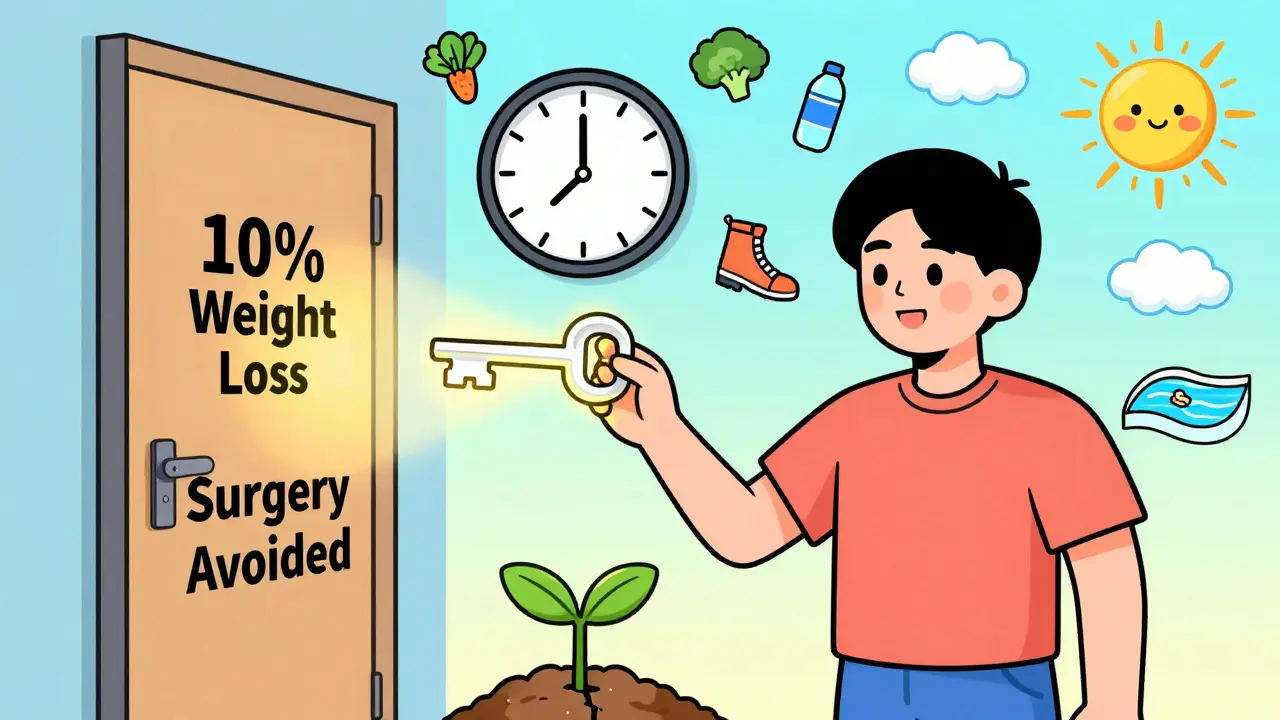
The goal isn’t just to feel better today. It’s to avoid surgery tomorrow. Hip replacements are common - but they’re not permanent. They wear out. They can fail. They require recovery. And once you have one, your body changes forever.
Weight loss and exercise don’t just reduce pain. They slow down the destruction of cartilage. They take pressure off the joint. They strengthen the muscles that support it. They delay the need for surgery - sometimes by decades.
Think of it like this: your hip is a car. Excess weight is like driving with a flat tire. You can keep going, but you’re wearing out the rim. Weight loss? That’s fixing the tire. Exercise? That’s getting an alignment. Together, they let your joint last longer.
What’s Next? Start Here
You don’t need a gym membership. You don’t need a personal trainer. You just need to start.
Here’s your simple 3-step plan:
- Track your weight and symptoms - Write down your weight every week and rate your hip pain on a scale of 1 to 10.
- Move daily - Walk 20 minutes, swim 15 minutes, or ride a bike. Do it even if it hurts a little. Movement is medicine.
- Eat real food - Swap one processed snack for an apple. Replace soda with water. Add one extra vegetable to your plate.
Do this for 3 months. Then check in. You’ll be surprised how much better you feel.
There’s no cure for hip osteoarthritis. But there is a way to stop it from getting worse. And it starts with what you eat, how much you move, and how much weight you carry.
It’s not about being thin. It’s about being strong. Mobile. Independent. And free from pain.
Can weight loss reverse hip osteoarthritis?
No, weight loss won’t reverse cartilage damage that’s already happened. But it can stop it from getting worse. It reduces inflammation, takes pressure off the joint, and improves mobility - which means you may not need surgery for years, or ever.
Is walking good for hip osteoarthritis?
Yes - if done correctly. Walking is low-impact and helps keep the joint moving. Start with short walks (10-15 minutes), use supportive shoes, and avoid uneven surfaces. If it hurts badly, stop and try swimming or cycling instead.
How long does it take to see results from weight loss for hip pain?
Some people feel better in 4-6 weeks, especially in stiffness and morning pain. But major improvements in function and pain usually take 3-6 months. The 2024 Nature study showed the biggest gains happened after 12 months. Patience matters.
Should I try a very-low-calorie diet for hip OA?
Only under medical supervision. Very-low-calorie diets can lead to quick weight loss, but they’re hard to maintain and may cause muscle loss if not paired with strength training. The 2023 trial showed better results after 12 months, not 6. Long-term habits beat short-term extremes.
Do I need to lose weight if I’m only slightly overweight?
Even a 5% loss helps - but 10% makes a bigger difference. If your BMI is over 25 and you have hip pain, losing even 10-15 pounds could reduce your pain significantly. You don’t need to be at your ideal weight - just lighter than you are now.
Final Thought: It’s Not Too Late
Many people with hip osteoarthritis think surgery is their only option. They wait until the pain is unbearable. But the truth is, your joint is still salvageable - if you act now. You don’t need to be perfect. You just need to be consistent. Eat better. Move more. Lose weight. Protect your hip. And keep walking - not just for today, but for years to come.

Ian Glover
My name is Maxwell Harrington and I am an expert in pharmaceuticals. I have dedicated my life to researching and understanding medications and their impact on various diseases. I am passionate about sharing my knowledge with others, which is why I enjoy writing about medications, diseases, and supplements to help educate and inform the public. My work has been published in various medical journals and blogs, and I'm always looking for new opportunities to share my expertise. In addition to writing, I also enjoy speaking at conferences and events to help further the understanding of pharmaceuticals in the medical field.
15 Comments
-
Chima Ifeanyi
February 10, 2026 AT 20:24Let’s be clear - this is pure neoliberal bio-pseudoscience. The real driver of hip OA isn’t BMI - it’s systemic inflammation from industrial food systems, glyphosate exposure, and sedentary labor under late-stage capitalism. The 10% weight loss metric? A pharmaceutical industry ploy to sell low-carb meal kits and GLP-1 agonists. The studies cherry-pick cohorts. They ignore epigenetic factors. And they never mention how 73% of obese patients in longitudinal trials regained weight within 18 months - meaning the whole narrative is a temporal illusion.
Also, ‘eat real food’? What does that even mean? Who defines ‘real’? The USDA? Big Ag? This is performative wellness culture masquerading as evidence-based medicine. -
Tori Thenazi
February 11, 2026 AT 02:39Okay, but… have you seen the videos? The ones where they show the MRI scans before and after weight loss? I saw one where the cartilage actually looked… thicker?? Like, not just less inflammation - actual regrowth??
And I’m not saying this because I’m obsessed - I’m just saying… what if Big Pharma is hiding the truth? What if the real reason they say ‘you can’t reverse it’ is because they don’t want you to stop buying painkillers??
Also, I read somewhere that hip pain is linked to 5G radiation. I don’t know if that’s true, but I’ve been using aluminum foil hats since January and my stiffness is way better. Just saying.
And also - did you know that gluten can cause hip pain? I cut it out and my knee stopped clicking. Maybe it’s the same for hips??
Also, my cousin’s neighbor’s dog had hip dysplasia and they gave it turmeric and now it runs like a puppy. So… maybe try turmeric?? -
Elan Ricarte
February 12, 2026 AT 16:35Oh sweet Jesus, another one of these ‘just lose weight’ sermons. Like I haven’t tried every diet known to man. Keto? Fasted? Carnivore? I lost 40 lbs on a liquid diet and gained it all back while crying into a bag of Cheetos. You think I don’t know the math? 3-4x load? Yeah, I feel it every time I get out of bed.
But here’s the thing nobody says - your body doesn’t care about your willpower. It cares about trauma, cortisol, sleep, and whether your damn therapist got paid this month. You can’t out-exercise a 12-year history of emotional eating. You can’t out-walk a lifetime of being told you’re lazy.
And if you’re gonna preach ‘eat real food,’ then tell me why the cheapest, most accessible ‘real food’ in my neighborhood is a $2 rotisserie chicken and 10 lbs of white rice? Why is kale $8 a bag and soda 50 cents?
This isn’t about discipline. It’s about access. And if you’re gonna write a post like this, at least acknowledge that. -
Ritteka Goyal
February 13, 2026 AT 17:53As an Indian woman who grew up eating ghee, rice, and dal every day, I have to say this Western obsession with BMI is so colonial. In my village, we never counted calories - we ate until we were full, moved with our bodies, and trusted our instincts. My grandmother, 82, still walks 3 miles to the market every morning. She weighs 180 lbs - BMI 31 - and her hips are better than mine at 28.
Maybe the real issue isn’t weight - it’s processed sugar, refined flour, and sitting in front of screens all day. We don’t need to ‘lose 10%’ - we need to go back to how our ancestors lived. Eat whole foods. Walk. Don’t sit. Sleep early.
Also, I tried swimming and it made my hip worse. Maybe because I used chlorinated pool water? I switched to river bathing - and now I feel 10x better. Maybe Western medicine doesn’t understand traditional healing. Just saying. -
Monica Warnick
February 14, 2026 AT 17:11I read the 2024 Nature study. Twice. The data was solid. The sample size was small but well-controlled. The follow-up was longitudinal. The metrics were validated. I’m not saying it’s perfect - but it’s the best we’ve got.
And I’m not here to cheerlead. I’m here because I’m 63, have stage 3 hip OA, and I lost 14% of my body weight last year. I didn’t feel it at 6 months. Didn’t feel it at 9. But at 11? I walked to the mailbox without a cane. I slept through the night. I cried.
It’s not magic. It’s not easy. But it’s real. And if you’re skeptical - try it. Not for a month. For a year. Track it. Don’t just hope. Do the work. -
Ashlyn Ellison
February 16, 2026 AT 07:39I lost 12% and still can’t climb stairs without my knee clicking. So… maybe it’s not just weight? Maybe it’s the muscles? Or the nerves? Or something else? I don’t know. I just know I’m tired of being told I’m the problem.
-
Jonah Mann
February 17, 2026 AT 10:47Just wanted to say - I did the 3-step plan. Track weight. Walk 20 mins. Eat one veggie more. Did it for 3 months. Lost 16 lbs. Pain went from 8/10 to 3/10. My dog even noticed - he used to whine when I got up, now he just stretches and waits for me to walk with him.
Also - I spelled ‘osteophytes’ wrong in my journal. Twice. But I kept going. So yeah. You don’t gotta be perfect. Just keep showing up.
Oh and I started using a foam roller. It’s kinda weird but kinda life-changing. Try it. -
THANGAVEL PARASAKTHI
February 17, 2026 AT 20:48Bro, I’m from Tamil Nadu and we have this thing called ‘kuzhi paniyaram’ - it’s a fermented lentil batter, steamed, crispy outside, soft inside. I ate it daily, stopped sugar, started walking 45 mins after dinner. Lost 18 kg in 8 months. My hip pain? Gone. Not gone like ‘I took painkillers’ - gone like ‘I forgot I ever had it.’
Also - yoga isn’t just stretching. It’s joint lubrication. I did 20 mins of Surya Namaskar every morning. No one told me that. I found it on YouTube. And now I carry my groceries without help.
It’s not about being thin. It’s about being free. And freedom starts with one step. One meal. One day. -
Chelsea Deflyss
February 18, 2026 AT 20:39Wow. Just… wow. You all are so naive. This isn’t about weight loss - it’s about control. The medical-industrial complex wants you to believe you’re broken so they can sell you solutions. They don’t want you to heal. They want you to keep paying. The 10% number? A marketing tactic. The ‘real food’ advice? Designed to make you feel guilty. The ‘exercise’ part? A way to distract you from the real issue - systemic neglect of chronic pain patients.
And don’t even get me started on semaglutide. It’s not a solution. It’s a band-aid on a bullet wound. You’re being manipulated. Wake up. -
Tricia O'Sullivan
February 20, 2026 AT 18:39Thank you for presenting such a nuanced and evidence-based overview. The longitudinal data from the 2024 Nature study is indeed compelling, particularly when contextualized within biomechanical models of joint loading. I would only add that, in clinical practice, the psychological dimensions of weight loss - including body image, self-efficacy, and social support - are often underappreciated in quantitative research. While the physiological benefits are clear, the emotional transformation is equally profound - and deserves more attention in public health discourse.
-
Scott Conner
February 22, 2026 AT 12:27So… if I lose 10% and still have pain… does that mean I’m doing something wrong? Or is the damage already done? I’m 55, BMI 34, hip pain for 5 years. I’ve tried everything. Just… wondering if it’s too late for me.
-
Randy Harkins
February 24, 2026 AT 11:11Hey, I just wanted to say… I saw your comment above. You’re not alone. I was in the exact same spot. 55. BMI 33. Thought I’d need a replacement by 60.
I lost 11% over 14 months. Didn’t feel it until month 10. But then… one day, I picked up my grandson without thinking. And I didn’t wince.
It’s not too late. Not even close. You’re not broken. You’re just in the middle of the story.
And if you want - I’ll send you my 3-month walking log. No fancy stuff. Just me, my shoes, and a dumb phone timer. You got this. 💪❤️ -
Angie Datuin
February 26, 2026 AT 03:29I lost 15% and my hip pain went from ‘can’t sleep’ to ‘mild discomfort.’ But I still can’t squat to pick up my kid. Is that normal? Or am I still doing something wrong?
-
Camille Hall
February 27, 2026 AT 09:27My mom had hip OA. She lost 12% and started swimming. She’s 78 now. Still gardens. Still walks her dog. She says the pain didn’t vanish - but the fear did. And that’s what changed everything. You don’t need to be pain-free. Just free from the fear of pain.


Write a comment
More Articles

Alpelisib: Frequently Asked Questions and Expert Answers
I recently explored the topic of Alpelisib, a medication used to treat advanced breast cancer, and gathered some frequently asked questions and expert answers. Alpelisib is specifically designed for patients with PIK3CA gene mutations, and it works by inhibiting the growth and spread of cancer cells. Experts recommend combining Alpelisib with hormone therapy for better results. Common side effects include high blood sugar levels, skin rash, and diarrhea, but these can be managed with appropriate care. If you or a loved one are considering Alpelisib, it's essential to consult with a healthcare professional to determine if it's the right treatment option.


John Watts
February 10, 2026 AT 00:35Man, this post hit different. I lost 28 pounds over a year after my hip started screaming every morning, and let me tell you - it wasn’t just about pain. It was about standing up from a chair without grunting. I started with walking 15 minutes a day, no matter how bad it hurt. Now? I hike with my kids. No surgery. No fancy meds. Just consistency. You don’t need to be perfect - just show up.
And yeah, 10% is the magic number. I hit 10.5%. That’s all it took. Not 20. Not 30. Just enough to stop feeling like a loaded freight train with legs.