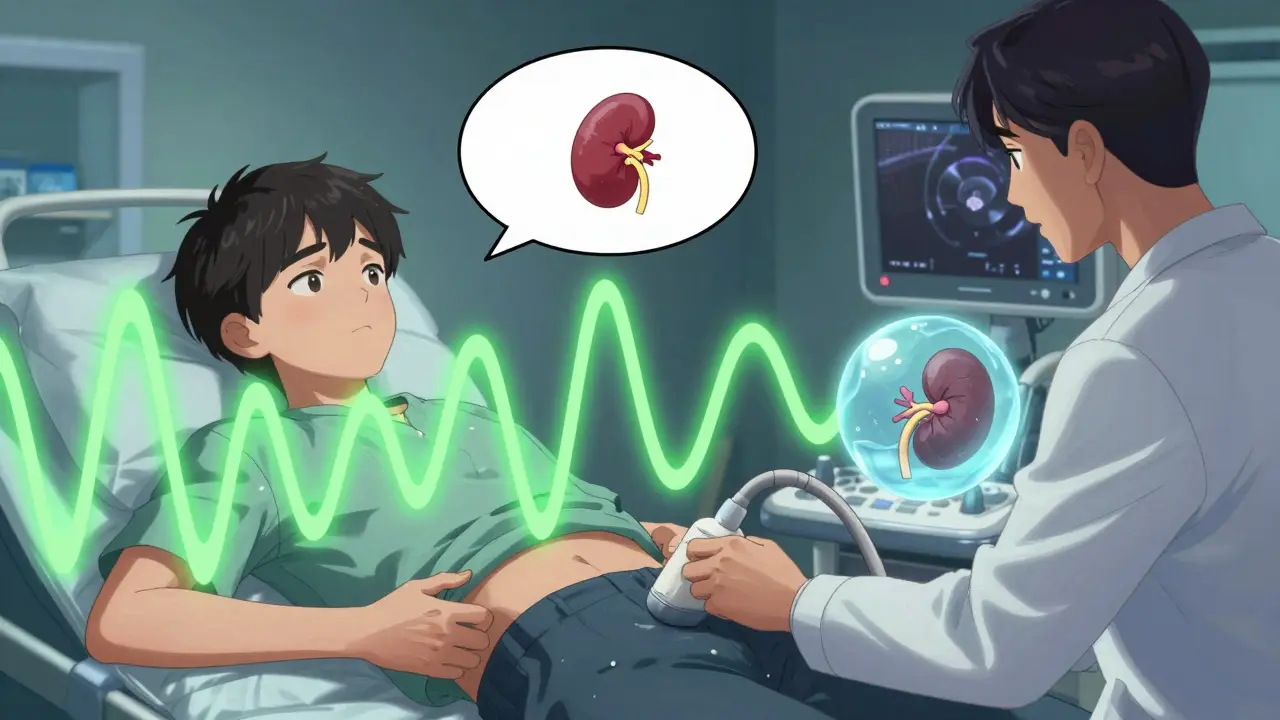
When your doctor suspects something is wrong with your kidneys, they don’t always jump to a CT scan or MRI. More often than not, they start with something simple, safe, and surprisingly powerful: renal ultrasound. It’s not flashy, but it’s the workhorse of kidney imaging - especially when checking for blockages or measuring kidney size. In emergency rooms, outpatient clinics, and even at the bedside, this tool gives doctors immediate answers without radiation, contrast dye, or long waits.
Why Ultrasound First?
Imagine you’re in the ER with sharp pain in your side. You’ve been told it might be a kidney stone. The first question the team asks isn’t "What’s the size?" or "Where exactly?" - it’s "Is there swelling?" That’s where ultrasound comes in. It can spot hydronephrosis - the swelling of the kidney caused by backed-up urine - within minutes. This isn’t just about comfort. If urine can’t drain, pressure builds up, and your kidney can start to shut down. Ultrasound catches that early.
Compared to a CT scan, which delivers about 10 mSv of radiation (equivalent to 3-5 years of natural background exposure), ultrasound uses zero ionizing radiation. That’s why it’s the go-to for pregnant patients, kids, and anyone needing repeated checks. A 2023 study from the Cleveland Clinic found that using ultrasound as the first step cut unnecessary CT scans by nearly 40% in patients with suspected urinary obstruction.
What Does a Renal Ultrasound Actually Measure?
It’s not just a picture. A good renal ultrasound gives you numbers - real, measurable data. Here’s what the technician looks for:
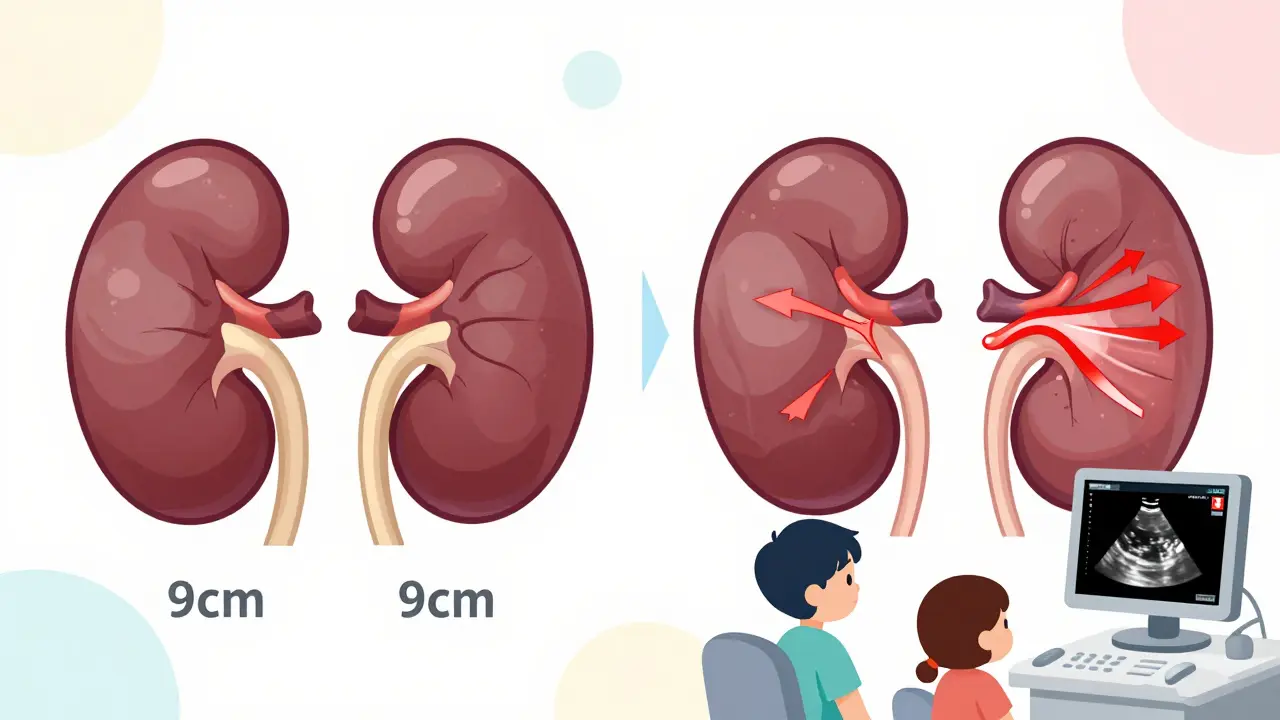
- Kidney length: Normal adult kidneys are 9 to 13 cm long. Anything under 9 cm might mean chronic damage. Over 13 cm? Could signal swelling or an underlying condition.
- Cortical thickness: The outer layer of the kidney (the cortex) should be at least 1 cm thick. If it’s thinner, the kidney may have been under stress for a long time - from high blood pressure, diabetes, or long-standing blockage.
- Renal pelvis diameter: The central part of the kidney where urine collects. A measurement over 7 mm in adults suggests possible obstruction. In kids, even 5 mm can be a red flag.
- Resistive Index (RI): This one’s critical. It’s calculated from blood flow in the kidney’s arteries. Normal RI is below 0.70. If it hits 0.70 or higher, there’s a strong chance of obstruction. A 2015 study in the Nigerian Journal of Clinical Practice showed this measurement had 86.7% sensitivity and 90% specificity for detecting obstruction - meaning it’s accurate more than 9 out of 10 times.
These aren’t guesses. They’re based on decades of clinical validation. And they’re why ultrasound isn’t just a first step - it’s often the final answer.
How It Detects Obstruction
Obstruction can come from many places: a kidney stone, a swollen prostate, a tumor pressing on the ureter, or even a congenital twist in the tube connecting the kidney to the bladder (called UPJ obstruction). Ultrasound doesn’t always show the stone itself - especially if it’s small - but it shows what the stone does.
When urine backs up, the kidney swells. The renal pelvis expands. The ureter might bulge. Doppler ultrasound - a special mode that shows blood flow - can reveal changes in how hard the kidney is working. A high resistive index tells you the kidney’s blood vessels are under pressure. In severe cases, the blood flow pattern flattens out, like a car engine struggling to turn over.
For pediatric cases, this is life-saving. A baby with UPJ obstruction might not show symptoms until the kidney is severely damaged. Ultrasound lets doctors monitor the dilation over weeks or months. One urologist in Birmingham told me: "I’ve tracked hydronephrosis in 12 kids over two years using only ultrasound. None needed radiation. All avoided surgery because we caught it early."
Ultrasound vs. Other Imaging
So why not just use CT or MRI every time? Because each tool has limits.
| Modality | Strengths | Limits | Cost (USD) | Radiation |
|---|---|---|---|---|
| Renal Ultrasound | Fast, no radiation, measures size and hydronephrosis, good for kids and pregnant patients, repeatable | Misses small stones (<3 mm), unreliable in obese patients, operator-dependent | $200-$500 | None |
| CT Urography (CTU) | Gold standard for stone detection, shows exact location, 3D mapping of urinary tract | High radiation (10 mSv), needs contrast dye, expensive, not ideal for repeat use | $1,200-$2,000 | Yes |
| MRI Urography (MRU) | No radiation, excellent soft tissue detail, good for complex anatomy | Very expensive, poor for stone detection, long scan time, not widely available | $1,500-$2,500 | None |
| Nuclear Renal Scan | Measures kidney function (GFR), shows drainage rate | Uses radioactive tracer, poor anatomical detail, slow, limited availability | $800-$1,500 | Yes |
Ultrasound doesn’t win every category - but it wins the most important one: safety. When you’re trying to decide whether to send someone home or rush them to surgery, knowing the kidney is swollen and the blood flow is abnormal? That’s enough to act.
Where Ultrasound Falls Short
It’s not perfect. In patients with BMI over 35, sound waves struggle to get through fat tissue. The image gets blurry. That’s why some hospitals require a CT scan for obese patients - not because ultrasound is wrong, but because it’s unreliable.
Another issue? Skill. A 2018 study in Radiology found that inexperienced sonographers could mismeasure kidney length by up to 20%. That’s not a small error - it could mean missing a shrunken kidney or overestimating obstruction. The American College of Radiology says you need at least 50 supervised scans to become competent. In emergency rooms, where time is tight, this gap matters.
And yes - bowel gas can block the view. If your intestines are full of air (which they usually are), it can hide the kidney. That’s why patients are sometimes asked to drink water before the scan - to fill the bladder and push gas out of the way.
What’s Next? The Future of Kidney Ultrasound
Ultrasound isn’t standing still. New tech is turning it into a precision tool.
Shear-wave elastography is one breakthrough. It measures how stiff the kidney tissue is. When urine backs up, the tissue gets harder - like a balloon overinflated. Studies from 2013 show this stiffness increases linearly with pressure. Now, some hospitals are using this to grade obstruction severity without needing a catheter or scan.
Then there’s super-resolution ultrasound. It’s still experimental, but it can map tiny blood vessels in the kidney - the ones that get damaged before kidney function drops. Imagine detecting early kidney disease before a patient even feels sick.
And AI? It’s coming fast. Mayo Clinic is testing software that automatically grades hydronephrosis. One algorithm now matches expert radiologists 94% of the time. That means less variation between scans and fewer missed cases.
What You Need to Know Before the Scan
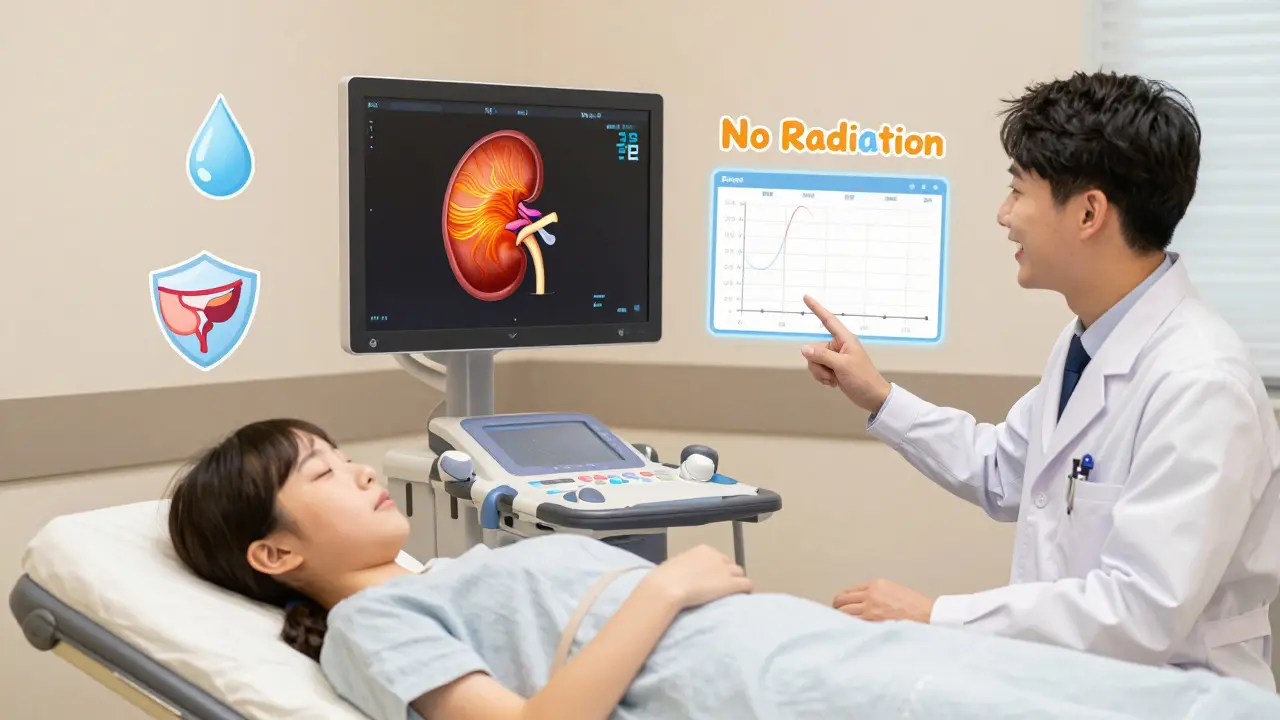
There’s no fasting. No needles. No fasting. Just drink a glass of water 30 minutes before - enough to fill your bladder. That helps push the intestines out of the way and gives a clearer view of the kidneys.
The scan takes 15 to 30 minutes. You’ll lie on your back or side. A gel is applied to your skin. A probe is moved over your flank and back. You might feel pressure, but not pain. No noise. No buzz. Just quiet, steady scanning.
Results come fast. In an emergency, the doctor gets the findings within minutes. In clinics, you’ll usually get them the same day.
Final Takeaway
Renal ultrasound isn’t about replacing CT or MRI. It’s about doing the right thing first. It answers the most urgent questions: Is the kidney swollen? Is the blood flow abnormal? Is the size normal? And it does it without risk, without cost, without delay.
For patients with recurrent kidney stones, chronic pain, or children with congenital issues, this is the tool that changes outcomes. It’s not glamorous. But it’s essential.
Can renal ultrasound detect kidney stones?
Yes, but not always. Ultrasound detects about 80% of kidney stones larger than 3 mm. Smaller stones, especially those in the ureter, are often missed. CT scans are better for pinpointing tiny stones, but ultrasound is still preferred as the first test because it avoids radiation and can show if the stone is causing a blockage - which is often more important than the stone’s exact size.
Is renal ultrasound safe during pregnancy?
Absolutely. Ultrasound uses sound waves, not radiation, making it the safest imaging option for pregnant women. It’s routinely used to evaluate kidney obstruction, hydronephrosis, and urinary tract infections during pregnancy. No contrast agents or radiation exposure means no risk to the fetus.
What is hydronephrosis, and why does it matter?
Hydronephrosis is the swelling of the kidney caused by urine buildup due to blockage. It’s not a disease itself - it’s a sign of something blocking urine flow. Left untreated, it can permanently damage kidney tissue. Ultrasound is the best way to detect and grade hydronephrosis, helping doctors decide if intervention (like a stent or surgery) is needed.
Why is the resistive index important in renal ultrasound?
The resistive index (RI) measures how much resistance there is to blood flow in the kidney’s arteries. A normal RI is below 0.70. If it rises to 0.70 or higher, it suggests increased pressure inside the kidney - often due to obstruction. Studies show an RI ≥0.70 has over 85% accuracy in detecting urinary blockage. It’s one of the most reliable indicators that the kidney is under stress.
Can ultrasound tell if a kidney is permanently damaged?
It can give strong clues. A kidney that’s shorter than 9 cm, with a cortex thinner than 1 cm, likely has long-term damage from chronic disease or obstruction. When combined with other findings like reduced blood flow or increased stiffness (via elastography), ultrasound helps predict whether the damage is reversible. But for full assessment of kidney function, blood tests (like creatinine and eGFR) are still needed.
How often can someone have a renal ultrasound?
As often as needed. Since it uses no radiation, there’s no limit. Patients with recurrent kidney stones, post-surgical obstructions, or congenital conditions often get ultrasounds every few weeks or months to monitor changes. One urologist in Birmingham said he’s tracked hydronephrosis in a child for three years using only ultrasound - no CTs, no MRIs, no radiation.
Who performs a renal ultrasound?
It’s usually done by a trained sonographer - a technician certified in ultrasound imaging. In emergency settings, doctors with point-of-care ultrasound training (like emergency physicians) may perform it themselves. Radiologists interpret the images. Training standards require at least 40 supervised exams for certification, and competency improves with experience - especially in measuring the resistive index and grading hydronephrosis.
Are there any preparations needed before a renal ultrasound?
Minimal. You’re usually asked to drink about 16 ounces of water 30 minutes before the scan to fill your bladder. This helps push bowel gas out of the way and gives a clearer view of the kidneys. No fasting, no medications to stop, no needles. It’s one of the easiest imaging tests to prepare for.

Ian Glover
My name is Maxwell Harrington and I am an expert in pharmaceuticals. I have dedicated my life to researching and understanding medications and their impact on various diseases. I am passionate about sharing my knowledge with others, which is why I enjoy writing about medications, diseases, and supplements to help educate and inform the public. My work has been published in various medical journals and blogs, and I'm always looking for new opportunities to share my expertise. In addition to writing, I also enjoy speaking at conferences and events to help further the understanding of pharmaceuticals in the medical field.
13 Comments
-
Nina Catherine
February 21, 2026 AT 22:53i just had a renal us done last month and honestly? it was way less scary than i thought. the gel was cold but the tech was super chill and explained everything. i thought i’d be in there for an hour but it was 15 mins. now i get why docs start here - it’s quick, quiet, and doesn’t make you feel like a lab rat.
-
Taylor Mead
February 23, 2026 AT 12:06This is why I love medicine - the simple stuff often does the most. I used to think fancy scans = better care. Then I watched a resident use ultrasound to rule out obstruction in a 7-year-old with flank pain. No contrast, no wait, no anxiety. Just a quick scan and a relieved parent. Sometimes the answer’s right under your probe.
-
Laura B
February 25, 2026 AT 01:42I’m a nurse in an ER and I’ve seen this play out too many times. A patient comes in with suspected stone, gets a CT right away… only to find out later it was a mild hydronephrosis that would’ve resolved with hydration and time. Ultrasound as first-line isn’t just cost-effective - it’s ethically necessary. We’re over-imaging. We’re scaring people with radiation when a gentle scan would’ve been enough.
-
Greg Scott
February 26, 2026 AT 08:38I’m a med student and this post made me want to go shadow the ultrasound team. I didn’t realize how much you could read from just a few measurements. The resistive index thing blew my mind - 0.70 as a cutoff? That’s almost poetic. Like the kidney’s own alarm system.
-
Amrit N
February 26, 2026 AT 22:50used to work in a hospital in bangalore where we had 1 us machine for 300 patients a day. learned to read kidneys fast. if the pelvis is >7mm and cortex is thin? don’t wait for the CT. start fluids, call nephro, and monitor. most cases resolve. no one needs a scan for every twinge.
-
aine power
February 28, 2026 AT 08:05Ultrasound is the poor man’s MRI. Elegant, yes. But incomplete.
-
Freddy King
March 1, 2026 AT 20:53Let’s be real - the resistive index is a glorified guess wrapped in Doppler jargon. It’s sensitive? Sure. But specificity? Depends on the operator’s coffee intake. I’ve seen RI values swing 0.15 based on probe pressure alone. And cortical thickness? Some kidneys are just naturally skinny. You’re treating numbers like gospel when they’re really just noisy signals in a noisy system.
-
Robert Shiu
March 2, 2026 AT 07:30I had a cousin who was misdiagnosed for months because they skipped ultrasound and went straight to CT. Turns out, she had a congenital UPJ obstruction - the kind that sneaks up on you. If they’d used ultrasound first, they’d have caught it during her annual checkup. This isn’t just clinical practice - it’s prevention. And prevention is care.
-
Courtney Hain
March 3, 2026 AT 10:57I’ve been following this for years. The real reason they push ultrasound? It’s cheaper. And it’s not just about cost - it’s about control. Who owns the data? Who decides when you need a CT? If you’re a patient, you’re being steered into a system where you’re not supposed to question why you didn’t get the ‘real’ scan. I’ve seen cases where patients were denied CTs for years because of ‘protocol’ - even when they had persistent pain. Ultrasound is convenient. But convenience doesn’t always mean correct.
-
Jana Eiffel
March 3, 2026 AT 13:26The epistemological humility of ultrasound is profoundly instructive. It does not pretend to reveal the totality of renal pathology; rather, it offers a phenomenological glimpse - a shadow on the screen that invites further inquiry, not closure. In an age of algorithmic certainty, this modality reclaims the Socratic method: we know less than we think, and that is precisely why we begin here. The kidney, like the soul, resists total visualization - and perhaps, it should.
-
Jayanta Boruah
March 4, 2026 AT 22:08While the clinical utility of renal ultrasound is undeniable, one must consider the sociopolitical implications of its widespread adoption. In under-resourced settings, it functions as a tool of medical triage - not merely diagnostic, but gatekeeping. The very efficiency that makes it ideal for low-income regions simultaneously reinforces structural inequities: those who can afford CTs receive comprehensive care, while others are confined to the limitations of acoustic imaging. This is not a neutral technology - it is a mirror of global health disparities.
-
John Cena
March 4, 2026 AT 22:56I’ve been a radiologist for 22 years. I’ve seen CTs miss things ultrasound caught. I’ve seen ultrasounds miss things CTs caught. But the beauty of ultrasound is that it’s repeatable. You can do it tomorrow. And the day after. You don’t have to wait for a slot. You don’t have to convince an insurance company. You just... look. And sometimes, that’s enough. The best part? You can do it with the patient sitting up, holding their baby, sipping water. Medicine doesn’t get more human than that.


Write a comment
More Articles

Fiber Supplements and Medications: When to Take Them to Avoid Absorption Problems
Fiber supplements can block the absorption of key medications like thyroid pills, blood thinners, and antibiotics. Learn the safe timing rules to avoid dangerous interactions and keep your meds working properly.

Clomid: Understanding Its Uses, Benefits, and Potential Risks
Clomid, also known by its generic name Clomiphene, is a medication commonly used to treat infertility in women by stimulating ovulation. It's crucial for users to understand both its medical benefits and potential side effects, as well as interactions with other drugs. By discussing proper dosages and recommendations, individuals can make informed decisions about its use. This article provides comprehensive insights into Clomid, offering valuable tips and information for those considering it.

Hariom Sharma
February 21, 2026 AT 08:51I work in a rural clinic in India where we don't always have CT machines. Renal ultrasound is our lifeline. One kid came in with fever and vomiting - no pain, no symptoms you'd expect. Ultrasound showed hydronephrosis. Turned out to be a tiny stone blocking the ureter. We started fluids, monitored for a week, and it passed on its own. No radiation, no hospital stay. This tech saves lives where resources are thin.