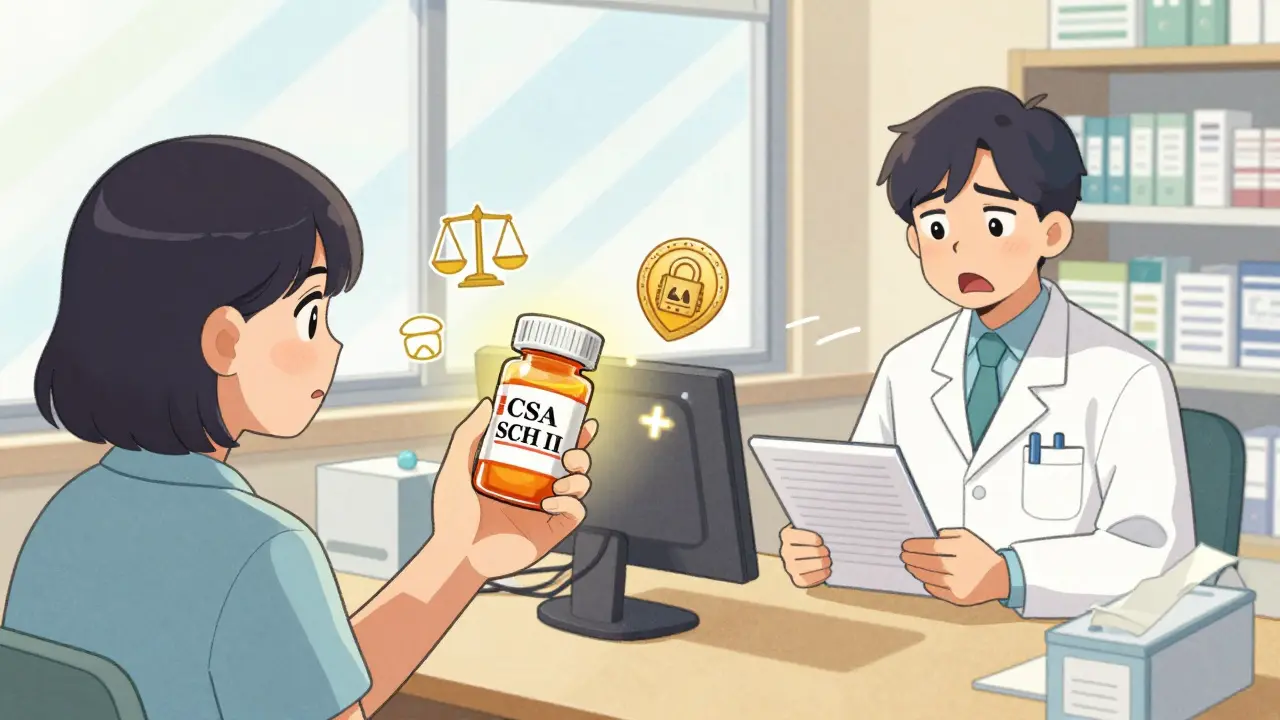
When you pick up a prescription at the pharmacy, the label might look like any other - name, dosage, instructions. But if it’s a controlled substance, there’s more going on behind the scenes. The controlled substance labels you see are the visible part of a complex federal system designed to track, limit, and control how powerful medications are distributed. This system isn’t just bureaucracy; it’s a safety net meant to prevent abuse, diversion, and overdose. But it’s also full of contradictions, inconsistencies, and real-world headaches for patients and providers alike.
What Are Controlled Substances?
Not every prescription drug is controlled. Aspirin, metformin, and blood pressure pills don’t fall under this system. Controlled substances are drugs the U.S. government has flagged because they carry a risk of abuse, dependence, or both. These include opioids like oxycodone, sedatives like Xanax, stimulants like Adderall, and even some cough syrups with codeine. The classification isn’t random. It’s based on three main things: how likely the drug is to be abused, whether it has any accepted medical use, and how dangerous it is physically or psychologically when misused.The legal backbone of this system is the Controlled Substances Act (CSA), passed in 1970. It created five categories - called schedules - that rank drugs from most dangerous to least. Each schedule comes with its own set of rules for prescribing, dispensing, and recording. The Drug Enforcement Administration (DEA) manages this system, assigning each drug a unique code number and enforcing compliance. Pharmacies, doctors, and manufacturers all need DEA registration to handle these drugs. Skip the paperwork, and you’re breaking federal law.
The Five Schedules Explained
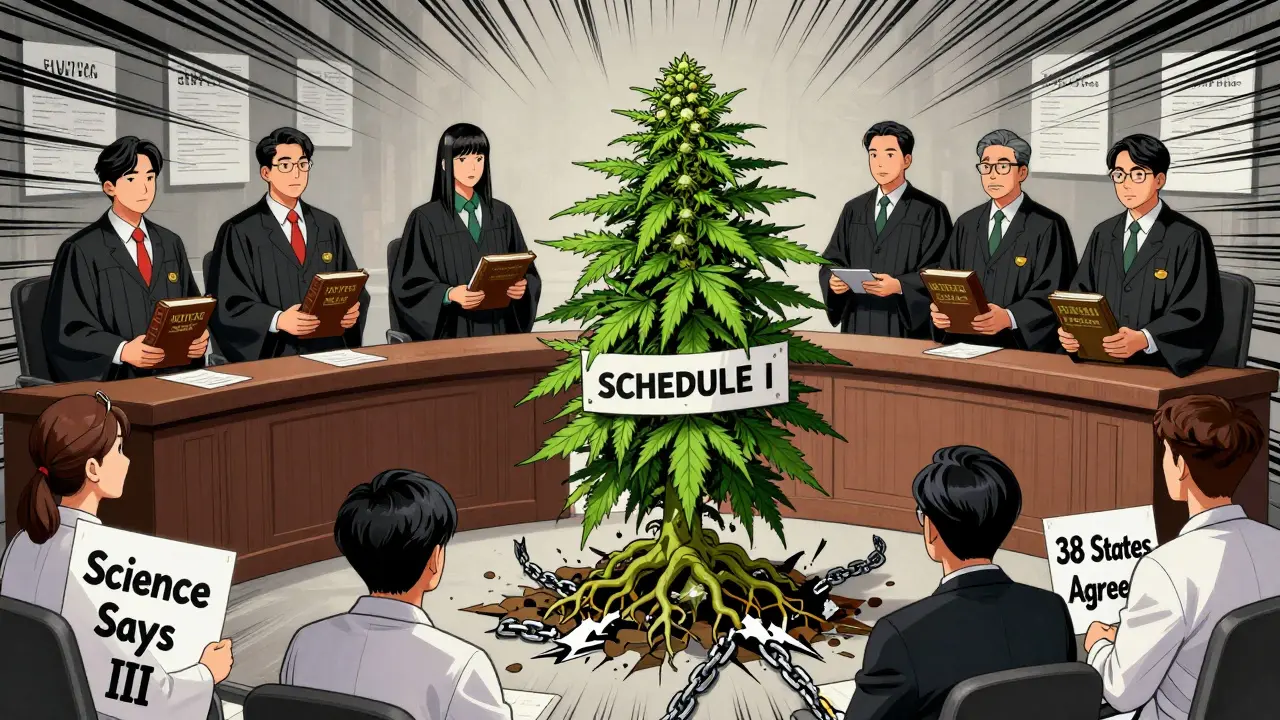
The schedules aren’t just labels - they’re legal boundaries. Here’s what each one means in practice:- Schedule I: No medical use. High abuse potential. Examples: heroin, LSD, marijuana (under federal law). These drugs can’t be prescribed, sold, or legally possessed. Despite medical marijuana being legal in 38 states, federal law still classifies cannabis as Schedule I - creating a legal gray zone for patients and doctors.
- Schedule II: High abuse potential, but accepted medical use. These are the heavy hitters: oxycodone, fentanyl, morphine, Adderall, and methadone. Prescriptions can’t be refilled. You need a new paper script every time - and in most states, it must be handwritten on tamper-resistant paper. Electronic prescriptions are allowed in some cases, but the rules are strict. A single Schedule II prescription can take 15 extra minutes to process for pharmacists because of the documentation.
- Schedule III: Moderate to low abuse potential. Includes drugs like hydrocodone with acetaminophen (Vicodin), ketamine, and some anabolic steroids. Refills are allowed - up to five times in six months. Electronic prescriptions are fine. This is the most commonly dispensed controlled substance category, making up nearly half of all controlled prescriptions.
- Schedule IV: Low abuse potential. Benzodiazepines like Xanax, Valium, and sleep aids like Ambien fall here. Refills allowed up to five times in six months. Electronic prescriptions standard. These are often the drugs patients are told to “use sparingly,” but the system treats them as low-risk.
- Schedule V: Minimal abuse potential. Includes cough syrups with tiny amounts of codeine (under 200 mg per 100 ml) and antidiarrheal meds with diphenoxylate. In some states, you can buy these over-the-counter with pharmacist approval. No DEA prescription needed. They’re treated more like cold medicine than controlled drugs.
One drug can appear in multiple schedules depending on its form. Codeine is the perfect example: pure codeine is Schedule II, codeine with acetaminophen is Schedule III, and a weak cough syrup version is Schedule V. The same molecule, different rules.
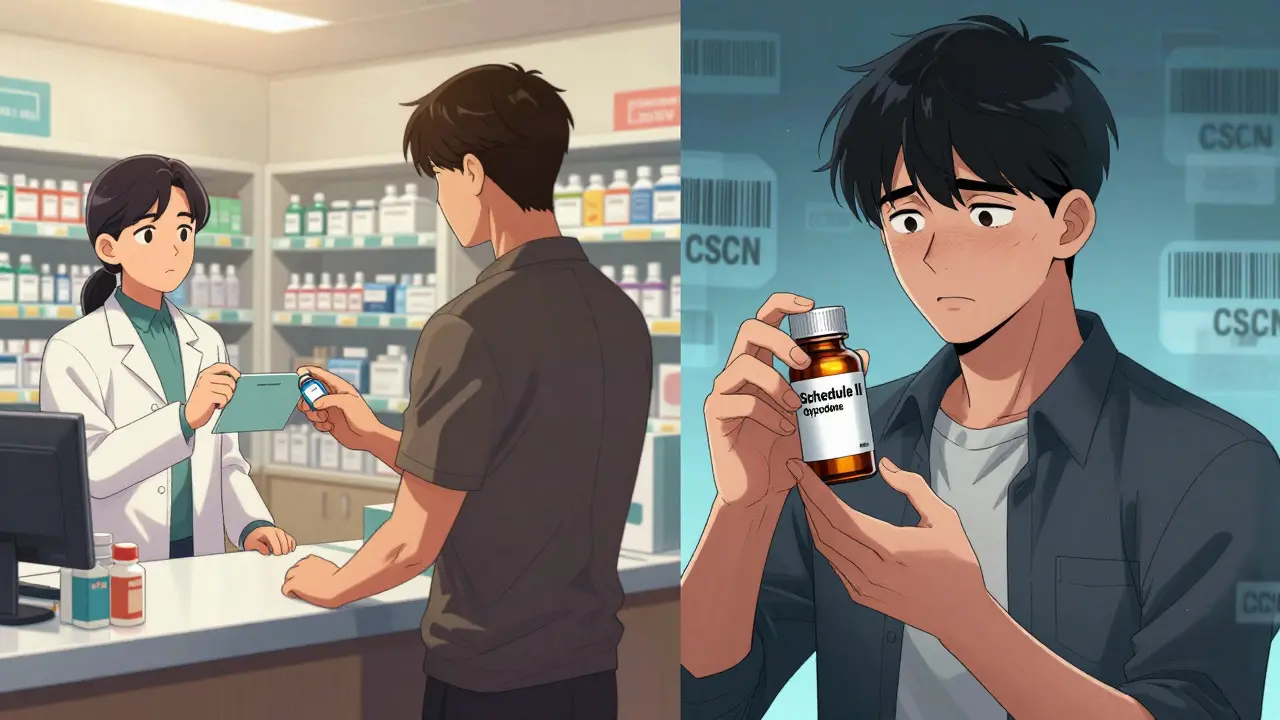
What’s on the Label - And What’s Not
The label you get at the pharmacy will usually show the drug name, strength, dosage instructions, and prescriber info. But hidden in plain sight are clues about the schedule. The DEA requires certain identifiers on controlled substance labels, though they’re not always obvious to patients.Pharmacies use internal codes like “CSA SCH II” or “NARC” on inventory systems. The DEA’s Controlled Substance Code Number (CSCN) is a six- or seven-digit identifier assigned to each drug formulation. For example, oxycodone 5 mg tablets have a specific code different from oxycodone 10 mg. These numbers help track shipments and prevent diversion. You won’t see them on your pill bottle, but the pharmacy’s system does - and if audited, they must produce them.
Some labels include warnings like “Federal law prohibits the transfer of this medication to anyone other than the patient” or “Do not use while operating machinery.” These aren’t just nice reminders - they’re legally required for Schedule II and III drugs. The language is standardized to reduce liability and ensure patients understand the risks.
Why the System Is Broken - And Who Says So
The scheduling system was designed in 1970. Science has moved on. Cannabis remains Schedule I despite overwhelming evidence of medical benefit and legal use in most states. Meanwhile, drugs like benzodiazepines (Schedule IV) carry a high risk of addiction and withdrawal, yet are easier to get than a Schedule III opioid. Experts call it a mess.Pharmacists report spending hours on paperwork for Schedule II prescriptions. A 2022 survey found that 78% of pharmacists believe the current system creates unnecessary barriers to care. One nurse on an oncology forum wrote: “I’ve had patients wait three hours because the pharmacy had to call the doctor to verify a Schedule II script.”
At the same time, addiction specialists say the system helps patients understand risk. “When I tell someone their painkiller is Schedule II, they get it - this isn’t just a pill,” says a clinic director in Ohio. “They know it’s powerful.”
The biggest criticism? The system doesn’t match the science. A 2022 Rand Corporation survey found that 82% of experts believe the U.S. will eventually move to a six- or seven-schedule system to better reflect real-world risk. The DEA itself is trying to speed things up - aiming to cut the average scheduling review from 24 months to 12 by 2025.
What’s Changing Right Now
The most significant change on the horizon is the potential rescheduling of cannabis. In August 2023, the Department of Health and Human Services recommended moving marijuana from Schedule I to Schedule III. If approved, it would be the first major shift since the law was written. That would mean doctors could legally prescribe it, pharmacies could stock it, and insurance might cover it - all while still keeping it under federal control.Other changes are already happening. In 2022 and 2023, the DEA emergency-scheduled 17 new synthetic drugs - like fentanyl analogs and designer stimulants - into Schedule I because they were flooding the streets and causing overdoses. The system can move fast when there’s a crisis.
Industry spending reflects the burden: pharmaceutical companies spend $2.3 billion a year just to comply with controlled substance rules. That’s not just paperwork - it’s software, training, audits, and security systems.
What This Means for You
If you’re prescribed a controlled substance, you’re in the middle of a legal system that’s outdated, inconsistent, and sometimes frustrating. But it’s also the only thing keeping dangerous drugs from being sold like candy.Here’s what you need to know:
- If your script says “no refills,” it’s Schedule II - don’t ask for more. You’ll need a new prescription.
- If you’re getting a refill on a Schedule III or IV drug, the pharmacy will check your history. They’re required to track how many you’ve gotten in the last six months.
- If you’re traveling with controlled substances, keep them in the original bottle with your name on it. Carrying pills in a pill organizer without the label can get you in trouble, even if they’re legal.
- Don’t share your meds. It’s not just dangerous - it’s a federal crime, even if you’re helping a friend.
The system isn’t perfect. But it’s the one we have. Understanding the schedule on your label helps you know why your doctor can’t just call in a refill, why the pharmacy is asking so many questions, and why some drugs are harder to get than others. It’s not about punishment - it’s about control. And right now, control is the only thing standing between these drugs and widespread abuse.
What does it mean if my prescription is Schedule II?
Schedule II means the drug has a high potential for abuse and can lead to severe physical or psychological dependence, but it has accepted medical uses. Examples include oxycodone, fentanyl, and Adderall. You cannot get refills - each prescription is valid only once. In most states, it must be written on paper with a signature and cannot be called in or emailed. Pharmacies must keep special records, and the DEA tracks these prescriptions closely.
Can I get a Schedule III drug refilled?
Yes, but only up to five times within six months from the date the prescription was written. After that, you need a new prescription. Schedule III drugs like hydrocodone with acetaminophen (Vicodin) and ketamine can be prescribed electronically, and partial fills are allowed. This gives more flexibility than Schedule II but still keeps the drug under federal control.
Why is marijuana still Schedule I if it’s legal in my state?
Federal law still classifies marijuana as Schedule I - meaning no accepted medical use and high abuse potential - even though 38 states have legalized it for medical or recreational use. This creates a conflict between state and federal regulations. Patients can legally use it in their state, but they’re still breaking federal law. The Biden administration has initiated a review to potentially reschedule it to Schedule III, which would allow doctors to prescribe it and pharmacies to dispense it under federal rules.
Can I buy Schedule V drugs without a prescription?
In some states, yes. Schedule V drugs, like certain cough syrups with very low doses of codeine (under 200 mg per 100 ml), may be sold over-the-counter but only under the supervision of a pharmacist. You may need to show ID, sign a logbook, and limit how much you buy. These are the least regulated controlled substances, but they’re still tracked to prevent abuse.
What happens if a pharmacy runs out of a Schedule II drug?
The pharmacy cannot give you a partial fill unless the prescriber specifically allows it - and even then, it’s rare. Most Schedule II prescriptions must be filled in full at once. If they’re out of stock, you’ll need to wait until they get more, or your doctor must issue a new prescription. This is to prevent people from getting multiple fills from different pharmacies. The DEA’s online ordering system lets pharmacies get shipments within 24 hours, so delays are usually short.

Ian Glover
My name is Maxwell Harrington and I am an expert in pharmaceuticals. I have dedicated my life to researching and understanding medications and their impact on various diseases. I am passionate about sharing my knowledge with others, which is why I enjoy writing about medications, diseases, and supplements to help educate and inform the public. My work has been published in various medical journals and blogs, and I'm always looking for new opportunities to share my expertise. In addition to writing, I also enjoy speaking at conferences and events to help further the understanding of pharmaceuticals in the medical field.
13 Comments
-
Darren Pearson
December 31, 2025 AT 12:36It is both lamentable and intellectually incoherent that the Controlled Substances Act, a legislative artifact of the Nixonian era, continues to govern pharmacological policy in a post-genomic, neurochemical-aware society. The arbitrary distinctions between Schedule II and III substances - particularly the differential treatment of hydrocodone formulations - betray a profound epistemological failure in regulatory science.
-
Stewart Smith
January 2, 2026 AT 01:12They say Schedule II drugs are dangerous, but honestly? The real danger is the 45-minute wait at the pharmacy while they verify your script like you’re trying to launch a nuke. Meanwhile, my neighbor buys 12 bottles of cough syrup with codeine like it’s Gatorade. 🤷♂️
-
Retha Dungga
January 3, 2026 AT 23:50so like... if weed is schedule 1 but i can buy it at a dispensary in colorado then is the law just a suggestion?? like what even is reality anymore?? 🤯
-
Jenny Salmingo
January 5, 2026 AT 16:23I love how this post explains things so simply. My grandma just got her first pain med and she was scared to take it. I showed her the label and said, "See this? It means your doctor’s trying to keep you safe." She cried. It’s not about fear - it’s about care.
-
Lawver Stanton
January 7, 2026 AT 05:11Okay but let’s be real - this whole system is a circus. You can’t refill an oxycodone script but you can walk into CVS and buy 3 bottles of NyQuil with codeine? And the pharmacist doesn’t even ask if you’re driving? And then you get pulled over for DUI and they test your blood and it’s all legal? This isn’t regulation - it’s a glitch in the matrix. I’ve seen people get arrested for having a single Vicodin pill in a Ziploc bag while the guy next to them is chugging cough syrup like it’s a smoothie. The DEA doesn’t care about safety - they care about paperwork. And we’re all just pawns in a bureaucratic game where the rules change every Tuesday.
-
Sara Stinnett
January 7, 2026 AT 21:34How is it that a substance like benzodiazepines - known to induce cognitive decline, dependency, and withdrawal seizures - is deemed "low abuse potential" while cannabis, which has zero recorded fatal overdoses in human history, remains a Schedule I drug? This isn’t science. It’s moral panic dressed in regulatory robes. The DEA is a relic. The American public is being gaslit by outdated statutes written by men who thought LSD was a communist plot. Wake up.
-
linda permata sari
January 8, 2026 AT 18:15I’m from Indonesia and I just found out my cousin in California gets Adderall like it’s candy. Here, even aspirin needs a prescription sometimes. The way you guys handle meds is so… chaotic. But also kinda cool? Like, you have rules, but they’re weird rules. I’m fascinated.
-
Brandon Boyd
January 10, 2026 AT 15:04Big shoutout to pharmacists - you’re the real MVPs. You’re the ones juggling paperwork, DEA audits, angry patients, and scared grandparents all while smiling and saying "Have a great day!" You’re not just filling scripts - you’re keeping people alive. Thank you.
-
Branden Temew
January 10, 2026 AT 20:19So if a drug’s schedule is based on "abuse potential," why is alcohol not scheduled at all? Or nicotine? Or caffeine? We’ve got a national addiction to three legal substances that kill more people than all controlled drugs combined - but we’re terrified of oxycodone? The real problem isn’t the drugs. It’s the hypocrisy.
-
Frank SSS
January 11, 2026 AT 15:18Okay, I get the system’s flawed, but let’s not romanticize it. I’ve seen people turn into monsters on Schedule II meds. I’ve watched friends lose jobs, families, dignity. Yeah, the rules are annoying. But if you’ve ever sat in a hospital room while someone overdoses because they got one extra pill from a friend… you don’t want to be the reason someone dies because you thought "it’s just a pill." The system’s broken? Sure. But sometimes broken systems are the only thing holding back the tide.
-
Kayla Kliphardt
January 11, 2026 AT 23:20Thanks for explaining the CSCN codes. I never realized pharmacies track each dosage separately. That’s actually kind of reassuring. I didn’t know they were that precise.
-
Urvi Patel
January 12, 2026 AT 17:53Let me tell you something - this whole thing is just a money grab. Pharma companies pay the DEA to keep certain drugs classified so they can charge more. Schedule II drugs are expensive because they’re rare. If cannabis were Schedule III, generics would crash the price. That’s why they won’t change it. It’s not about safety - it’s about profit


Write a comment
More Articles

How Drinking Water Helps You Lose Weight by Curbing Appetite and Boosting Performance
Drinking water before meals can reduce appetite, lower calorie intake, and slightly boost metabolism-helping you lose weight naturally. Science shows it’s more effective than diet drinks and works without side effects.
Chandreson Chandreas
December 31, 2025 AT 05:22Man, I just got my script for tramadol the other day and saw "CSA SCH III" on the receipt. Thought it was a typo at first 😅 Turns out I’ve been living under a rock. This whole system is wild - like, why’s coffee not regulated but my pain meds are? 🤔