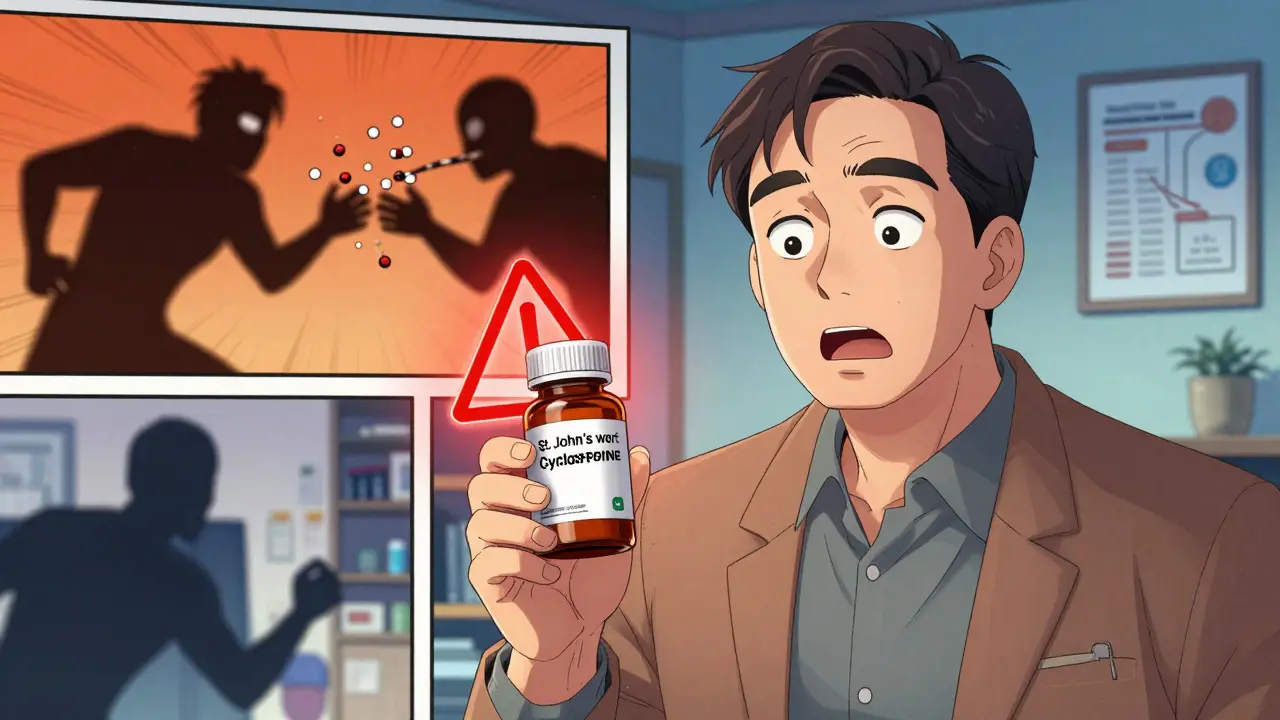
Every year, millions of people in the U.S. take dietary supplements-vitamins, herbs, minerals, amino acids-thinking they’re harmless. After all, they’re sold over the counter, labeled as "natural," and often promoted as safe for daily use. But here’s the truth: dietary supplement-drug interactions are a silent, growing threat. And most people have no idea they’re at risk.
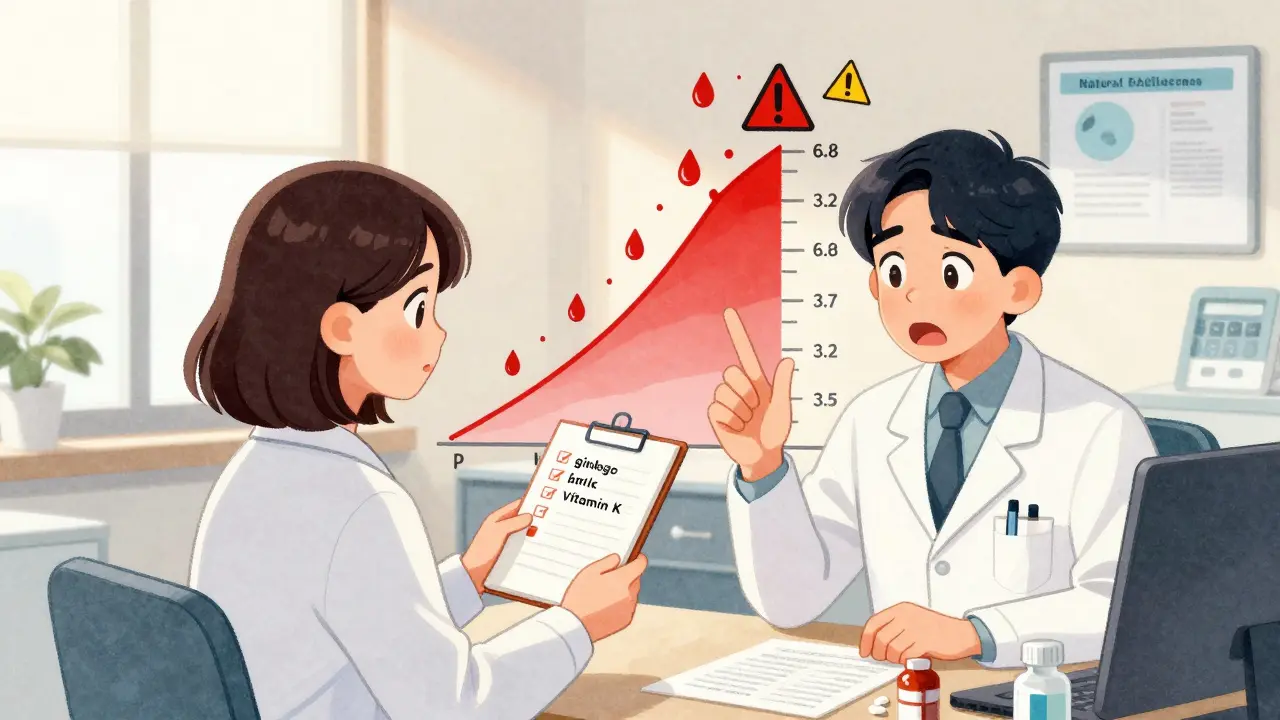
Take warfarin, a common blood thinner. If you’re on it and start taking ginkgo biloba or even high-dose vitamin E, your risk of dangerous bleeding skyrockets. One case study showed a patient’s INR (a measure of blood clotting) jumping from 3.2 to 6.8 after adding ginkgo-enough to cause internal bleeding. Or consider St. John’s wort, a popular herb for mood support. It can slash the blood levels of cyclosporine by nearly 60%, making organ transplant patients vulnerable to rejection. It drops levels of birth control pills, antidepressants, and even HIV meds to the point they stop working.
These aren’t rare anomalies. They’re predictable, documented, and preventable. Yet, fewer than one in three people tell their doctor they’re taking supplements. Why? Because most assume their doctor doesn’t care-or doesn’t know enough to ask. But here’s the problem: your doctor might not know either. A 2020 study found only 32% of pharmacists could correctly identify major supplement-drug interactions. That’s not a patient issue-it’s a system failure.
How Supplements Interfere With Your Medications
Dietary supplements don’t just sit quietly beside your pills. They actively change how your body handles them. There are two main ways this happens.
The first is through pharmacokinetics-how your body absorbs, breaks down, or gets rid of a drug. St. John’s wort, for example, cranks up the activity of liver enzymes called CYP3A4 and P-glycoprotein. These enzymes are like trash compactors in your liver. When they’re overworked, they break down drugs like cyclosporine, tacrolimus, and indinavir too fast. The result? The drug doesn’t stick around long enough to work. Your transplant gets rejected. Your HIV rebounds. Your depression worsens.
The second way is through pharmacodynamics-how drugs and supplements affect your body’s systems directly. Vitamin K, found in green tea extract and some multivitamins, directly opposes warfarin. Warfarin works by blocking vitamin K’s role in clotting. Add more vitamin K, and you’re fighting your own medication. That’s why patients on warfarin are told to keep their vitamin K intake steady-not to avoid it, but not to suddenly boost it.
Then there’s magnesium. Found in antacids and some mineral supplements. It binds to antibiotics like ciprofloxacin and levofloxacin in your gut, blocking up to 90% of absorption. You take your antibiotic, feel fine, but the infection doesn’t go away because your body never got the full dose.
High-Risk Supplements and the Drugs They Clash With
Not all supplements are equal when it comes to danger. Some are low-risk. Others? They’re ticking time bombs.
- St. John’s wort: Interacts with over 70 medications. Highest risk with antidepressants (SSRIs), immunosuppressants, birth control, and antivirals. Reduces drug levels by 30-60%.
- Ginkgo biloba: Increases bleeding risk with warfarin, aspirin, NSAIDs. Case reports show INR spikes beyond 6.0-life-threatening.
- Garlic, ginger, ginseng: All can thin blood. When mixed with anticoagulants, they raise bleeding risk during surgery or injury.
- Vitamin K: Neutralizes warfarin. Even small increases from supplements or diet (kale, spinach) can cause clotting.
- Calcium and iron supplements: Block absorption of thyroid meds like levothyroxine. One study showed a 40% drop in drug levels when taken together.
- CBD oil: Slows down liver enzymes that break down clobazam, citalopram, and statins. Can cause toxic buildup. One study found clobazam levels jumped 500%.
- Goldenseal: Inhibits liver enzymes, raising levels of drugs like cyclosporine and metformin-risking toxicity.
Herbal supplements make up only 15% of supplement sales-but 65% of serious interactions reported to the FDA. Why? Because they’re potent. Unlike synthetic drugs, herbs contain dozens of active compounds. Their effects are harder to predict, and manufacturers rarely test them for interactions.
Why This Problem Is Getting Worse
The supplement market is booming. In 2022, Americans spent over $52 billion on vitamins and herbs. By 2028, that’s expected to hit $83 billion. And the people buying them? Most are older adults. One in two adults over 60 takes four or more prescription drugs. Add three supplements on top? That’s seven substances interacting in your body every day.
But here’s the kicker: the system isn’t built to catch this. Under the Dietary Supplement Health and Education Act (DSHEA) of 1994, supplements don’t need FDA approval before sale. The FDA can only act after harm happens. That’s like letting a car roll off the assembly line without brakes-and only stepping in after someone crashes.
And the labeling? Often useless. A 2019 study found 20% of supplements contained ingredients not listed on the label. One popular red yeast rice supplement was found to contain lovastatin-a prescription cholesterol drug-without warning. Patients taking it with another statin or fibrate ended up in the hospital with rhabdomyolysis, a muscle-destroying condition.
Meanwhile, only 0.5% of supplements have formal interaction studies published in peer-reviewed journals. The Natural Medicines Database tracks over 1,800 supplement-drug interactions-but most are based on case reports, not controlled trials. We’re flying blind.
What You Can Do to Stay Safe
You don’t have to quit supplements. But you do need to be smarter about them.
- Make a full list. Write down every pill, capsule, powder, or tea you take-even if you think it’s "just a vitamin." Include brand names and doses.
- Ask your doctor. Don’t wait for them to ask. Say: "I’m taking [name] for [reason]. Is this safe with my other meds?" Be specific. "I take ashwagandha" is better than "I take some herbs."
- Use trusted resources. Check the NIH’s LiverTox database or the Natural Medicines Database. They’re free, evidence-based, and updated regularly.
- Time your doses. If you take calcium and levothyroxine, space them at least four hours apart. Same with antibiotics and magnesium.
- Watch for signs. Unexplained bruising, dizziness, confusion, muscle pain, or worsening symptoms could mean an interaction. Don’t ignore them.
Doctors who routinely ask about supplements prevent 73% of potential problems, according to a 2022 survey. That’s not magic-it’s just asking the question.
The Bigger Picture: Why Regulation Isn’t Keeping Up
The FDA reports 20,000 to 30,000 adverse events linked to supplements each year. But experts believe that’s less than 1% of actual cases. Most people never report them. They assume their headache or nausea is just a side effect-or they don’t connect it to what they took.
Meanwhile, the industry resists change. Only 12% of major supplement manufacturers conduct formal interaction testing. Why? Because it’s expensive. And under current law, they don’t have to.
There are signs of progress. In 2023, a bill was introduced in Congress to require warning labels on supplements with known drug interactions. The NCCIH has committed $15.7 million to research by 2025. But until supplements are held to the same safety standards as drugs, the risk will keep growing.
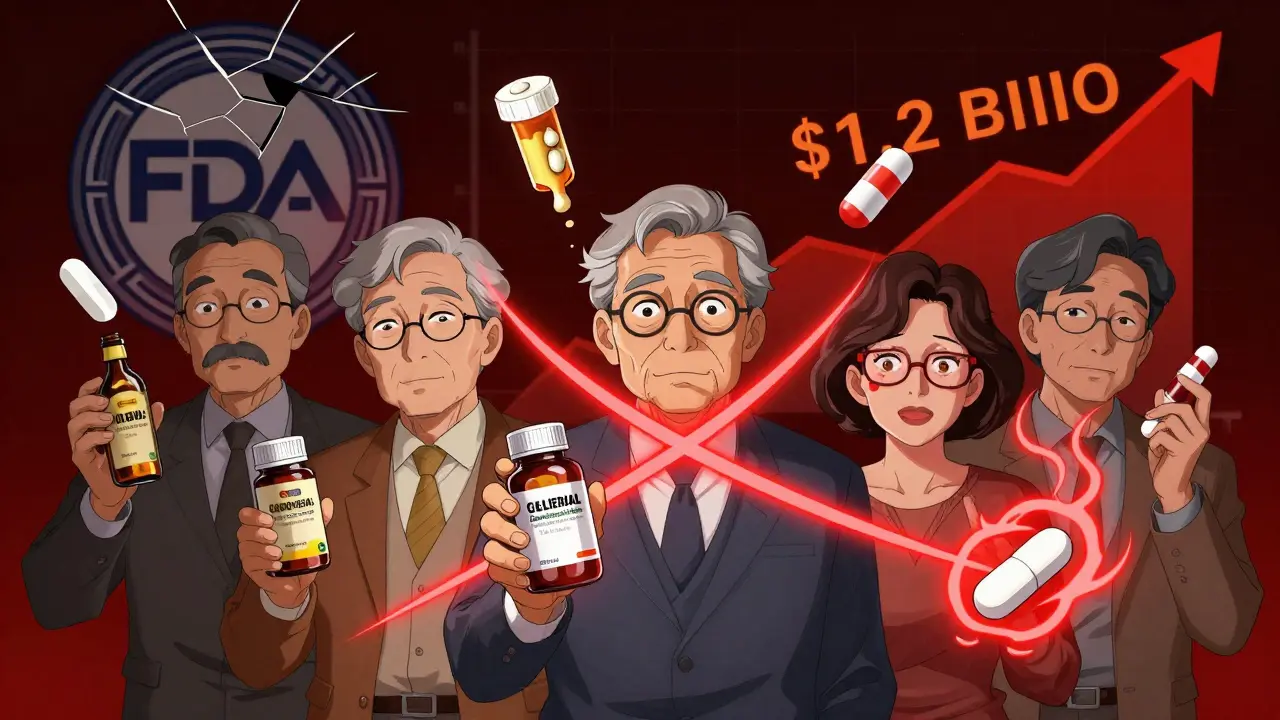
And the cost? It’s not just medical bills. It’s lost workdays, ER visits, hospitalizations, and sometimes, lives. The Congressional Budget Office estimates preventable supplement-drug interactions will cost the U.S. healthcare system $1.2 billion annually by 2028.
Final Thoughts: Knowledge Is Your Best Defense
Supplements aren’t the enemy. But treating them like harmless candy is dangerous. Your body doesn’t care if something is "natural" or "organic." It responds to chemistry. And when you mix supplements with drugs, you’re playing with fire.
The good news? You have control. You can ask questions. You can track what you take. You can choose not to add a new supplement without checking first. You can insist your doctor take your supplement use seriously.
That’s the real safety net-not a law, not a label, not a government agency. It’s you. Being informed. Speaking up. And refusing to assume something is safe just because it’s sold on a shelf.
Can I take vitamin D with my blood pressure medication?
Yes, vitamin D generally doesn’t interfere with common blood pressure medications like ACE inhibitors, beta-blockers, or calcium channel blockers. However, if you’re taking thiazide diuretics (like hydrochlorothiazide), high doses of vitamin D can raise calcium levels too much, increasing the risk of kidney stones. Stick to standard doses (600-800 IU/day) unless your doctor recommends more.
Is it safe to take melatonin with antidepressants?
Melatonin is usually safe with most antidepressants, but it can increase drowsiness when combined with SSRIs like sertraline or tricyclics like amitriptyline. In rare cases, it may worsen symptoms of depression or cause nightmares. If you’re on antidepressants and want to try melatonin, start with a low dose (0.5-1 mg) and monitor how you feel. Always tell your doctor.
Why does my doctor ask about supplements if they’re "just vitamins"?
Because "just vitamins" can be dangerous. St. John’s wort can make your birth control fail. Garlic can cause bleeding during surgery. Calcium can block your thyroid medicine. Many supplements have potent biological effects. Your doctor isn’t being extra cautious-they’re trying to prevent a serious reaction you didn’t even know was possible.
Can I trust supplement labels that say "drug-free" or "no interactions"?
No. These claims are unregulated. The FDA doesn’t review supplement labels for accuracy. A product labeled "drug-free" could still contain herbs that interfere with medications. A 2019 study found 20% of supplements had unlisted ingredients. Always check independent databases like Natural Medicines or NIH LiverTox-not the label.
What should I do if I think a supplement is interacting with my medication?
Stop taking the supplement immediately and contact your doctor or pharmacist. Don’t wait for symptoms to get worse. Keep the bottle and note when you started the supplement, what you’re taking with it, and what symptoms you’re experiencing. Report the event to the FDA through MedWatch. Your report could help prevent harm to others.
If you’re taking more than one medication, especially if you’re over 60, assume you’re at risk. Don’t wait for a crisis. Start today: write down everything you take. Ask your doctor. Check a reliable source. Your safety doesn’t depend on regulation-it depends on you.

Ian Glover
My name is Maxwell Harrington and I am an expert in pharmaceuticals. I have dedicated my life to researching and understanding medications and their impact on various diseases. I am passionate about sharing my knowledge with others, which is why I enjoy writing about medications, diseases, and supplements to help educate and inform the public. My work has been published in various medical journals and blogs, and I'm always looking for new opportunities to share my expertise. In addition to writing, I also enjoy speaking at conferences and events to help further the understanding of pharmaceuticals in the medical field.
8 Comments
-
josue robert figueroa salazar
December 27, 2025 AT 14:38supplements are just snake oil with fancy packaging and a yoga pose on the label
-
Jody Kennedy
December 29, 2025 AT 02:07if you take anything besides water and a multivitamin you owe it to yourself to check interactions. seriously. your life could depend on it
-
jesse chen
December 30, 2025 AT 02:22my grandma takes 12 different pills and 7 supplements... she told her doctor about 3 of them. i had to step in. she almost got hospitalized because of garlic + warfarin. please, just write it all down. and tell your doctor. please.
-
christian ebongue
December 30, 2025 AT 19:04the fact that the fda can't regulate this until someone dies is insane. also, why does st. john's wort get a whole paragraph but caffeine doesn't even get a footnote? you can't even drink coffee with some meds
-
Joanne Smith
December 31, 2025 AT 00:02the supplement industry is basically the wild west, except the cowboys are selling fake dragon blood extract and calling it "ancient wisdom". also, i once bought a "pure" ashwagandha that had hidden sildenafil. yes, like viagra. in a bottle labeled "stress relief". i'm not even mad. just impressed by the audacity
-
Prasanthi Kontemukkala
January 1, 2026 AT 23:48i live in india and we use ayurvedic herbs daily. many elders swear by them. but i always check with my pharmacist before mixing with western meds. knowledge is power, not tradition alone. small steps save lives
-
Bryan Woods
January 2, 2026 AT 19:26the most alarming part isn't the interactions themselves-it's how little the medical community does to educate patients. i've had three different pharmacists ask me about supplements in the last five years. one of them was my own primary care physician. if your provider doesn't ask, ask them. it's not your job to assume they know. it's your job to protect yourself.


Write a comment
More Articles

Bepotastine for Latex Allergy: Effectiveness, Dosage, and Alternatives
Explore whether bepotastine works for latex allergy, its mechanism, dosage, safety profile, and how it compares to other antihistamines.
Patient Information vs Healthcare Provider Information: How Label Differences Affect Care
Patient and provider information often use completely different language, leading to confusion, fear, and missed care. Learn how medical labels differ, why it matters, and what’s being done to fix it.
Why Everyone Should Be Talking About Stone Root: A Revolutionary Dietary Supplement
I recently came across a revolutionary dietary supplement called Stone Root, and I think everyone should be talking about it. It's a natural herb with numerous health benefits, such as improving digestion, reducing inflammation, and even helping with kidney stones. Many people are unaware of this amazing supplement and its potential to improve our overall health. As a blogger, I feel it's my duty to spread the word about this incredible discovery. So, let's get the conversation started and explore the wonders of Stone Root together!
Ellie Stretshberry
December 26, 2025 AT 18:03ive been taking turmeric for my knees and didnt even think it could mess with my blood thinner