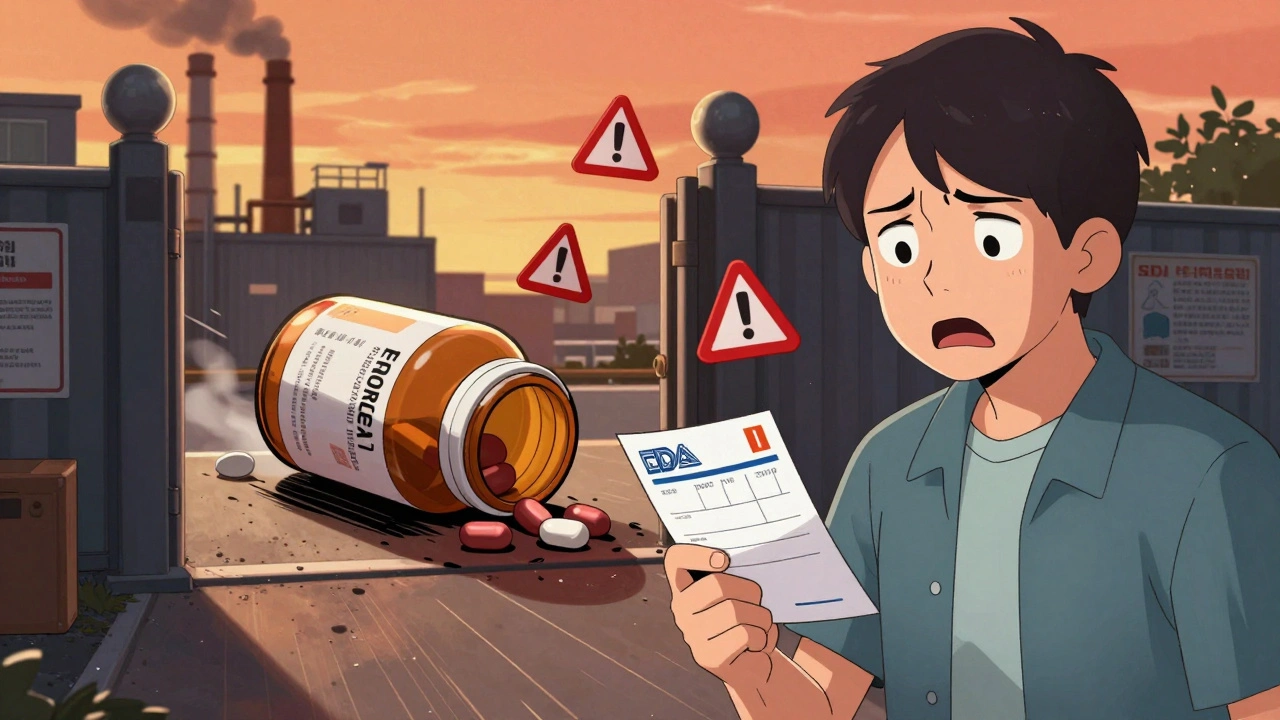
When you buy a pill, a medical device, or even a simple health product, you assume it’s safe. But what if the factory that made it didn’t follow the same rules as your country’s standards? That’s not a hypothetical. In 2024, foreign manufacturing quality failures caused 37% of all drug shortages in the U.S., according to FDA data. And it’s getting worse.
Why Overseas Production Is Riskier Than Ever
For years, companies moved production overseas to save money. Labor costs in China, India, and Vietnam were a third of what they were in the U.S. or Europe. But the savings came with hidden dangers. What looked like a cost-cutting move turned into a ticking time bomb. In 2025, the situation isn’t just about bad batches or sloppy workers. It’s about systemic breakdowns. A factory in Wuhu, China, was caught in February 2025 for letting impurities in pharmaceuticals that violated U.S. standards. The FDA issued a warning letter - but that’s not rare. Nearly half of all Chinese drug manufacturing sites received FDA Form 483 notices in 2024 - the official red flag for violations. In comparison, only 29% of U.S. sites did. The problem isn’t just China. Indian facilities accounted for 34% of all FDA drug import alerts in 2024, even though they only make up 25% of foreign production. Meanwhile, Vietnamese factories have improved - up 18% in quality metrics since 2022 - but they’re still catching up. And here’s the kicker: most inspections in China are announced in advance. The FDA tells the factory when they’re coming. That means companies have time to clean up, hide problems, or even swap out bad batches. In the U.S., 95% of inspections are unannounced. In China? Only 22% were in 2024. That’s not oversight - it’s a loophole.The Hidden Costs of Bad Quality
You think you’re saving money by making things overseas? Think again. When a batch of pills is contaminated, or a medical device fails in the field, the real cost explodes. Rework. Recalls. Legal fees. Lost trust. FDA fines. A single recall can cost millions. Harris Sliwoski’s analysis shows unaddressed quality issues add 15-25% to total manufacturing costs - more than the labor savings you thought you were getting. One company in Minnesota learned this the hard way. They imported a line of medical devices from Shenzhen. The supplier claimed they used medical-grade silicone. They didn’t. They used industrial-grade material - cheaper, but toxic when implanted. 12,000 units were recalled. The company lost $2.3 million. They also lost their reputation. Patients stopped trusting their brand. And it’s not just financial. In 2024, 62% of all drug recalls in the U.S. came from foreign facilities - even though those facilities only produced 43% of the total volume. That means foreign-made drugs are more than 40% more likely to be pulled from shelves than U.S.-made ones.What’s Going Wrong Inside the Factories
It’s not always fraud. Sometimes it’s just bad systems. The most common failures? Material substitution. That’s when a factory swaps out expensive, regulated materials for cheaper, unapproved ones. Brookings found this happens in 68% of inspected Chinese facilities. In one case, a supplier replaced sterile packaging with non-sterile - and no one noticed until patients got infections. Then there’s inadequate process validation. That’s when a factory doesn’t prove their process consistently produces safe products. It happened in 42% of non-compliant sites. They just guess it works. And falsified documentation? That’s the most dangerous. 29% of inspected sites were caught lying on reports - changing test results, forging signatures, or inventing quality checks that never happened. One factory in India was found to have backdated batch records for six months. The FDA didn’t catch it until a whistleblower came forward.
Why AI Isn’t Fixing It - Yet
You’d think technology would solve this. AI-powered visual inspection systems can spot defects with 99.2% accuracy - better than any human. But only 22% of Chinese manufacturers use them. Why? Because it’s expensive. And many factories are barely surviving. When margins are thin, investing in AI feels like a luxury. Instead, they cut corners. They hire undertrained staff. They skip calibration. They ignore maintenance logs. Deloitte’s 2025 report found that companies with full digital quality ecosystems - AI, IoT sensors, blockchain traceability - have 33% fewer defects. But those companies are the exception. Most are still using clipboards and handwritten logs.What Works: The Few That Got It Right
There are success stories. But they’re rare - and they didn’t happen by accident. One medical device company in Minnesota fixed their quality problems with a “China-specific quality triad.” First, they hired a full-time quality manager in Shenzhen - not a middleman, not a translator, but someone with real authority. Second, they used blockchain to track every component from raw material to final product. Third, they hired an independent third-party auditor to show up unannounced every month. Result? Defects dropped from 12.7% to 0.8% in two years. Another company in Germany started requiring mandatory pre-shipment testing - not just at the factory, but at a certified lab in Germany before the goods even left China. It added $15 per unit to cost. But it stopped three major recalls in 18 months. These companies didn’t rely on trust. They built systems that couldn’t be fooled.The Regulatory Shift: What’s Changing in 2025
The FDA is finally catching up. In May 2025, Commissioner Marty Makary announced a major shift: unannounced inspections will rise to 40% of all foreign inspections by the end of 2025 - and hit 75% by 2027. That’s huge. No more warning calls. No more cleaning up before inspectors arrive. It’s a direct response to the “double standard” that let bad actors hide for years. President Trump’s May 2025 executive order also raised user fees for foreign manufacturers. Compliance costs are expected to jump 18-25%. That will push out the weakest suppliers - the ones cutting corners just to survive. Meanwhile, the EU’s Qualified Person (QP) system is getting attention. In Europe, every batch of medicine must be signed off by a certified professional who takes personal legal responsibility. That’s not a formality - it’s a liability. And it’s working. EU-manufactured drugs have 22% fewer quality failures than imports from non-EU countries. Experts like Dr. Jessica Rose from White & Case are pushing for a similar U.S. system. One person, with a license, accountable for every batch. No more hiding behind “the supplier did it.”
What You Need to Do Now
If you’re importing products - especially medicines, medical devices, or health-related goods - here’s what you must do:- Don’t trust certifications alone. ISO 9001 doesn’t guarantee quality. It guarantees paperwork. Verify with on-site audits.
- Insist on unannounced audits. Make it a contract requirement. No exceptions.
- Hire local quality staff. Not agents. Not middlemen. Someone on the ground with real authority and access to the production line.
- Test before shipment. Use a third-party lab in your country to test random batches. Don’t rely on the factory’s lab.
- Use blockchain or digital traceability. Even basic systems that track raw material sources and batch numbers cut fraud by 60%.
- Train your team. Spend $18,500 per year per facility on quality training. It’s not an expense - it’s insurance.
The Bigger Picture: Friend-Shoring and the New Supply Chain
More companies are moving production to allied countries - Mexico, Poland, India, Vietnam. It’s called “friend-shoring.” But it’s not a magic fix. New suppliers mean new risks. New regulations. New quality gaps. Many of these countries don’t have the infrastructure to handle high-volume, high-precision manufacturing yet. China’s share of global manufacturing dropped from 33.2% in 2022 to 31.6% in 2025. But that doesn’t mean it’s safer. The market is splitting. On one side, high-end “Made in China 2025” factories are investing in automation and AI. On the other, thousands of small suppliers are collapsing under debt, cutting corners just to stay open. The risk isn’t going away. It’s just changing shape.Final Reality Check
Overseas manufacturing isn’t evil. It’s not inherently dangerous. But it’s not safe either. It’s a system that rewards speed and cost - not quality or transparency. The companies that survive 2025 and beyond aren’t the ones who saved the most on labor. They’re the ones who invested the most in control. If you’re still relying on trust, you’re already behind. If you’re still using vague contracts with “reasonable quality” as a standard, you’re asking for trouble. Harris Sliwoski found 58% of recoverable losses came from vague quality clauses. The next recall, the next lawsuit, the next patient injury - it won’t be an accident. It’ll be the result of a decision you made months or years ago. You can’t outsource quality. You can only manage it - with systems, not hope.
Ian Glover
My name is Maxwell Harrington and I am an expert in pharmaceuticals. I have dedicated my life to researching and understanding medications and their impact on various diseases. I am passionate about sharing my knowledge with others, which is why I enjoy writing about medications, diseases, and supplements to help educate and inform the public. My work has been published in various medical journals and blogs, and I'm always looking for new opportunities to share my expertise. In addition to writing, I also enjoy speaking at conferences and events to help further the understanding of pharmaceuticals in the medical field.
14 Comments
-
Palanivelu Sivanathan
December 5, 2025 AT 05:26Ohhhhh, so now we’re blaming China??!!??!!??
Let me remind you, my friend, that the same capitalist machine that outsourced jobs to Bangalore is now screaming about quality because the profit margins are shrinking!!
It’s not the factories - it’s the greed!! The insatiable, ravenous, soul-sucking greed of Wall Street!!
They want cheap pills, cheap devices, cheap labor, cheap ethics - and now they’re shocked when the whole house of cards collapses??
Wake up, people!! This isn’t a ‘supply chain issue’ - it’s a moral bankruptcy!!
And don’t even get me started on the ‘friend-shoring’ nonsense - Mexico? Poland? Same game, different neighborhood!!
Until we stop treating human life like a line item on a spreadsheet - we’re all just dancing on the edge of a cliff!! -
Adrianna Alfano
December 5, 2025 AT 10:00I’m a nurse in rural Ohio and I’ve seen what happens when a batch of blood pressure meds turns toxic. Patients don’t care if it was made in Shenzhen or Chicago - they just want to live.
One woman came in with a rash after taking a generic from India. Her doctor assumed it was allergies. It wasn’t. It was a chemical substitute. Took three weeks to trace it back. By then, two other people had been hospitalized.
And the worst part? The company didn’t even notify the FDA until a patient’s family filed a lawsuit. That’s not a mistake. That’s a cover-up.
I’m so tired of hearing ‘cost savings.’ What’s the cost of a child’s life? What’s the cost of trust? You can’t put a price tag on that - but corporations sure try.
And yes, I know the FDA’s underfunded. But we’re not asking for miracles. Just a little accountability.
Someone needs to go to jail for this. Not just pay a fine. Jail. -
Casey Lyn Keller
December 6, 2025 AT 02:58So let me get this straight - we’re supposed to believe that every factory in Asia is a corrupt nightmare, but every American plant is a temple of purity? Come on.
I’ve toured U.S. facilities too. One had a broken air filter that hadn’t been replaced in 14 months. The auditor just signed off because the paperwork looked good.
And let’s not pretend the FDA is some heroic watchdog. They inspect 2% of imported drugs. Two percent. That’s not oversight - that’s a lottery.
Yes, there are bad actors overseas. But there are also bad actors here. And the system rewards both equally: silence and paperwork.
Blaming China is easier than fixing our own broken inspection regime.
Also, Trump’s executive order? More fees won’t fix a culture of corruption. It’ll just make smaller suppliers disappear - and the big ones will just absorb the cost and raise prices. You’re not fixing the problem. You’re just making it more expensive. -
Jessica Ainscough
December 7, 2025 AT 13:27I appreciate how thorough this post is. It’s scary, but also really useful.
I work in a small medical supply company and we’ve started doing unannounced audits with a local firm in Vietnam. It cost us 20% more upfront - but our return rate dropped from 11% to 1.3%.
It’s not about being anti-overseas. It’s about being pro-safety.
The blockchain thing sounds expensive, but we’re using a simple QR code system that logs every batch. It’s not fancy, but it’s honest. And our customers notice. They’re asking for the traceability now.
Small steps, but they matter.
Also - training your team? Totally worth it. We spent $15k last year. Saved $200k in avoided recalls. It’s not an expense. It’s insurance.
Thanks for the clarity. I’m sharing this with our whole team. -
May .
December 8, 2025 AT 23:42Factories lie. Inspectors get paid off. The FDA is understaffed. The system is broken. End of story.
-
Sara Larson
December 10, 2025 AT 17:44YES YES YES!! This is so important!! 🙌
I just started a small wellness brand and I was about to sign a deal with a supplier in India because their price was 40% lower. Then I read this and I paused. Like… actually paused.
I hired a local QA rep in Mumbai. Paid her out of pocket. She’s not a middleman - she lives there, speaks the language, and shows up unannounced. She’s already caught two material swaps.
It’s not cheap. But my customers are moms and grandmas who take my supplements for sleep and anxiety. I can’t risk their trust.
Also - blockchain? We’re using a free Google Sheets tracker for now. It’s not fancy, but it’s transparent. And that’s what matters.
Thank you for this. I’m crying a little. Not because it’s sad - because I finally feel like I’m doing the right thing. 💪❤️ -
dan koz
December 11, 2025 AT 12:24You Americans always act like you’re the only ones who care about quality. In Nigeria, we’ve been dealing with fake drugs for decades - expired antibiotics, chalk-filled malaria pills, fake insulin.
But here’s the difference - we don’t have a FDA. We don’t have inspectors. We don’t have blockchain.
We have mothers who drive 80km to find a pharmacy that doesn’t sell poison.
So when you cry about Chinese factories, remember - your problem is a luxury. Our problem is survival.
Maybe instead of blaming the Global South, you should fix your own supply chain before preaching to the rest of the world. -
Kevin Estrada
December 12, 2025 AT 05:16Ohhhhh here we go - the ‘trust the system’ crowd again.
Let me tell you what’s REALLY happening: The FDA, Big Pharma, and the Chinese government have a cozy little arrangement. The FDA gets its budget increases by ‘exposing’ foreign violations - but only after they’ve been quietly warned for years.
And the Chinese? They let the small factories get nailed so the big ones - the ones owned by state-linked conglomerates - stay untouched.
It’s all theater.
And now they want to raise fees? That’s just a tax on the little guys so the big ones can buy their way out.
Meanwhile, the real solution? Ban all imports. Bring it all back to the U.S. Build new plants. Pay workers a living wage. Stop pretending you can outsource your conscience.
This isn’t a quality issue. It’s a power issue.
And the people who profit? They’re the same ones writing the regulations. -
Katey Korzenietz
December 14, 2025 AT 04:59Unannounced inspections? 75% by 2027? Pfft. That’s too little, too late. And why only China and India? What about Bangladesh? Cambodia? Pakistan? You’re cherry-picking villains to make the U.S. look righteous.
And ‘friend-shoring’? Please. Mexico’s FDA equivalent is a joke. Their inspectors get bribed with tacos and beer.
Also - blockchain? That’s not a solution, it’s a buzzword. You think a QR code stops someone from swapping materials? You’re delusional.
Real solution? Jail the CEOs. Not the factory workers. The people who signed the checks. The ones who knew and didn’t care.
And stop calling it ‘quality control.’ It’s called ‘profit over people.’ Say it like you mean it. -
Ethan McIvor
December 15, 2025 AT 05:17This reminds me of the old Greek concept of ‘techne’ - skill with moral purpose.
Today’s manufacturing isn’t about techne. It’s about ‘kairos’ - the right moment to cut costs, to delay, to ignore.
We’ve lost the idea that making something well is a sacred act. Now it’s a transaction.
The factories aren’t broken. We are.
We’ve outsourced not just labor, but responsibility.
And now we’re surprised when the world we built crumbles?
It’s not a supply chain problem.
It’s a soul problem. -
Michael Bene
December 15, 2025 AT 08:09Let’s be real - this isn’t about China or India. It’s about capitalism on steroids.
You think the FDA’s gonna fix this? Nah. They’re funded by the same corporations that profit from these overseas deals.
And ‘friend-shoring’? That’s just colonialism with a LinkedIn profile.
Poland? Mexico? They’re not safer - they’re just cheaper than China now.
Meanwhile, the real winners? The consultants. The auditors. The blockchain startups selling $50k software to companies that can’t read a spreadsheet.
And the losers? The patients. The nurses. The families who find out their grandma’s heart pill was made in a shed with no ventilation.
So yeah - hire local QA staff. Use blockchain. Do the ‘right thing.’
But don’t pretend you’re changing the system.
You’re just decorating the dumpster. -
dylan dowsett
December 16, 2025 AT 19:39Anyone who still trusts a ‘certified’ factory in Asia is either naive or complicit.
ISO 9001? That’s a certificate you can buy for $2,000. It doesn’t mean a single pill is safe.
I’ve seen factories with ‘Quality Control’ signs posted over the trash pile where they dump rejected batches.
And the ‘unannounced audits’? They’re a joke. The factory calls you the moment the inspector lands - and by the time you get there, it’s a showroom.
Only solution? Ban all imports unless they’re made under U.S. law, with U.S. inspectors, on U.S. soil.
Otherwise, you’re just gambling with people’s lives.
And if you’re okay with that - you’re not a consumer. You’re a criminal. -
Gerald Nauschnegg
December 17, 2025 AT 21:08Wait - you think the FDA’s unannounced inspections are going to fix this? That’s cute.
I’ve been in rooms where the FDA inspector’s hotel was paid for by the factory. Their meals. Their rides.
And you think they’re going to go hard on the big players? Nah.
The real change? When a whistleblower gets a $10M payout and the CEO goes to prison. Not when some bureaucrat writes a report.
Until then? This is just theater for the media.
And the companies that are doing it right? They’re the exception. The rest? They’re just waiting for the next scandal to blow over.


Write a comment
More Articles

Lithium Carbonate Generics: What You Need to Know About Serum Levels
Lithium carbonate generics require careful serum level monitoring due to narrow therapeutic windows. Differences in absorption between brands can cause toxicity or relapse. Learn how to safely manage lithium therapy with regular blood tests and awareness of formulation changes.
Diabetic Gastroparesis: How to Cope with Nausea and Vomiting
Diabetic Gastroparesis can be a challenging condition to deal with, as it often causes nausea and vomiting. To cope with these symptoms, I've found that eating smaller, more frequent meals throughout the day helps prevent overloading my stomach. Additionally, sticking to easily digestible foods and avoiding high-fat or high-fiber options has made a noticeable difference. Drinking plenty of water and staying hydrated is also essential in managing symptoms. Lastly, consulting with my healthcare provider about medication options has been beneficial in reducing nausea and improving my overall quality of life.

Tylophora: The Remarkable Health Benefits and Practical Guide to This Plant Supplement
Curious about why people are searching for Tylophora? This guide cuts right to the chase, breaking down its real-world health benefits and how it's used as a supplement. Expect no fluff, just straightforward facts about how Tylophora can fit into daily life. You'll learn about its science-backed uses, where it shines, and practical tips for making it work for you. Let's make sense of the hype and see if Tylophora deserves a spot in your wellness routine.
Gerald Nauschnegg
December 3, 2025 AT 22:40Let me tell you something - I work in pharma procurement and I’ve seen this firsthand. Factories in China don’t just cut corners, they bulldoze the whole damn building. I had a supplier once swear their sterile packaging met ISO standards. Turned out they reused autoclave bags three times. No one checked until a kid got sepsis from a syringe. That’s not negligence. That’s criminal.
And don’t get me started on the ‘pre-announced inspections.’ It’s like letting a thief clean the house before the police show up. The FDA knows this. They just don’t have the budget to fix it. So we pay the price in recalls and deaths.
And yet, CEOs still sign off on these deals because the quarterly report looks better. Profit over people. Again. Always again.