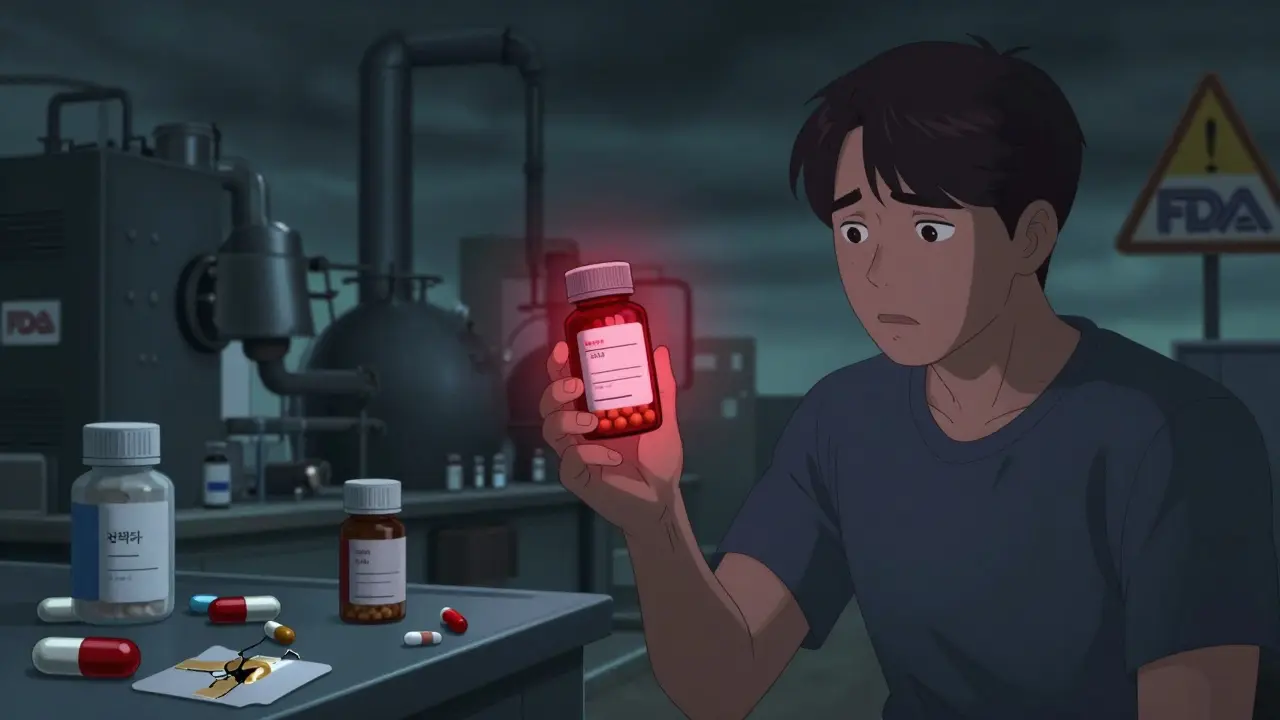
When you pick up a generic pill from the pharmacy, you expect it to work just like the brand-name version. It’s cheaper, sure, but it should also be just as safe. But what happens when that pill doesn’t meet the standards? In 2024 alone, the FDA recorded 323 drug recalls - and nearly half of them involved generic medications. These aren’t rare mistakes. They’re systemic, and they happen more often than most people realize.
Why Do Generic Drugs Get Recalled?
The most common reason? Violation of Current Good Manufacturing Practices (CGMP). This isn’t about fake drugs. It’s about sloppy processes. Think dirty equipment, poorly trained staff, or machines that haven’t been calibrated in months. In April 2025, Glenmark Pharmaceuticals recalled nearly 40 types of generic drugs made in India because of CGMP failures. The affected products? Common meds like acetaminophen and ibuprofen sold at Walmart and Amazon. The FDA labeled it a Class II recall - meaning it could cause temporary or reversible health issues. Not life-threatening, but still dangerous if you’re relying on that medication daily.
Another major issue: failed dissolution specifications. This sounds technical, but it’s simple: the pill doesn’t break down the way it should in your body. If it doesn’t dissolve, you don’t get the medicine. In October 2025, Sun Pharmaceutical recalled lisdexamfetamine (generic Vyvanse) because the capsules didn’t release the drug properly. Same month, Alkem Laboratories recalled over 140,000 bottles of generic Lipitor (atorvastatin). For patients taking this to lower cholesterol, that’s a huge risk. About 47 million Americans rely on statins. If the pill doesn’t dissolve, their heart risk doesn’t go down.
Then there’s contamination. In October 2025, a recall was issued for hydrocodone oral solution after particles were found in the liquid. But the most alarming contamination case? Fentanyl patches. Over 50 million patches were returned because seals leaked. Some delivered too little - leaving patients in pain. Others leaked too much - risking overdose. Dr. Julio Nunes at Yale called it one of the biggest safety failures in recent memory. It wasn’t a labeling error. It was a physical flaw in the patch itself.
Where Are These Drugs Made?
Most generic drugs sold in the U.S. aren’t made here. About 68.3% of all drug recalls between 2015 and 2024 came from facilities in India and China. India alone accounts for 42.7% of those recalls. The FDA inspects foreign factories far less often than U.S. ones. Before 2023, a factory in India might get checked once every 4.7 years. Now, thanks to new rules, it’s every 2.3 years. Still, that’s not enough. With millions of pills shipped daily, a single factory flaw can ripple across the country.
What Should You Do If Your Medication Is Recalled?
First, don’t panic. But also don’t ignore it. Here’s what to do:
- Contact your doctor or pharmacist before stopping. If you’re on a stimulant like Vyvanse, suddenly quitting can cause severe fatigue, depression, or a dangerous rebound of symptoms. For blood pressure or heart meds, stopping cold can be risky too. Your provider will tell you if it’s safe to pause or if you need a temporary replacement.
- Return the medication. Pharmacies like CVS and Walmart now have automated systems that flag recalled lots when you refill. If your bottle’s lot number matches a recall, they’ll offer a free replacement or refund. Don’t flush it or throw it out - return it. Some manufacturers even offer reimbursement if you’ve already used part of the bottle.
- Check the lot number. It’s printed on the bottle or box. If you’re unsure, call the pharmacy or visit the FDA’s recall page. You don’t need to check every bottle - just the ones you’re currently using.
- Report side effects. If you feel unusual symptoms - dizziness, nausea, chest pain - after taking a recalled drug, report it to the FDA’s MedWatch program. These reports help the agency spot patterns and act faster.
Pharmacies are getting better. CVS reported a 92.4% notification rate for Class II recalls in 2024. But not everyone gets the alert. About 18.7% of recall notices still don’t reach patients. That’s why you need to stay proactive.
What’s Being Done to Fix This?
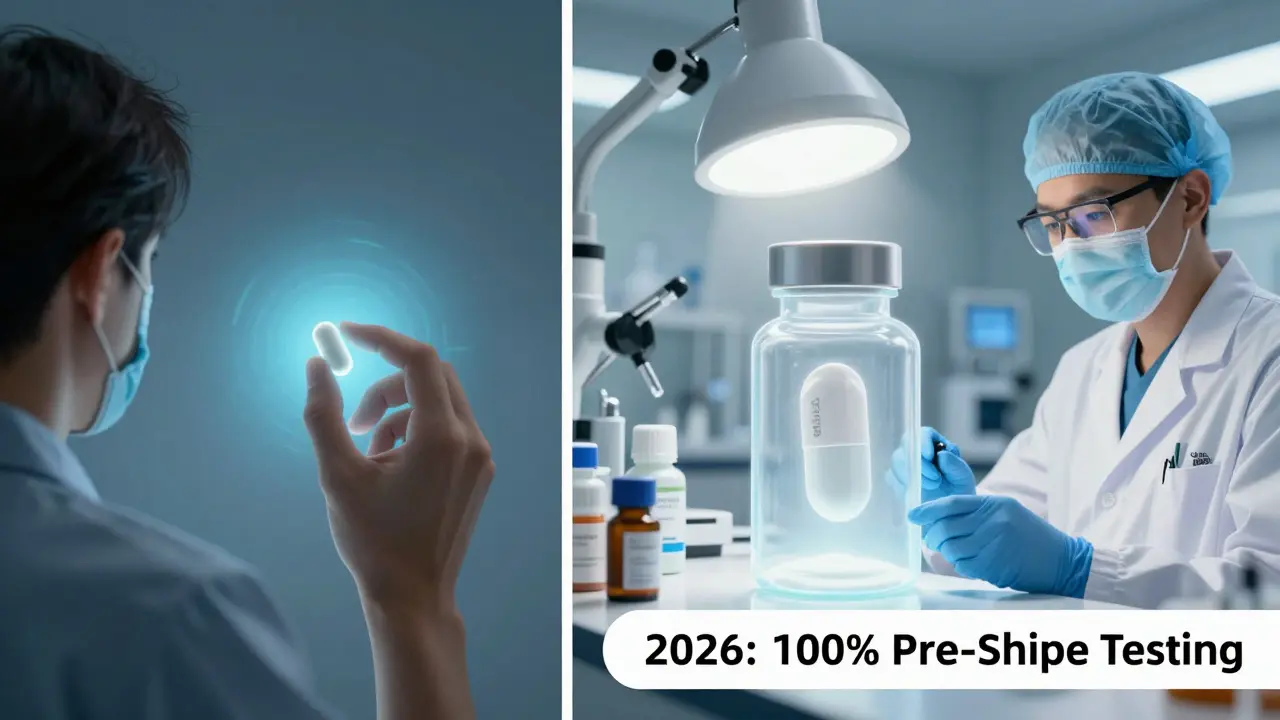
The FDA isn’t sitting still. In 2025, they expanded their PREDICT system - a tool that flags high-risk shipments before they even hit U.S. ports. By 2026, it will cover 100% of imported generic drugs. That’s a big jump from the current 63.8%. They’re also pushing manufacturers to join the Generic Pharmaceutical Quality Consortium, a new group formed in January 2025. Members like Teva, Viatris, and Apotex are investing $285 million to set up independent quality labs in India and China. These labs will test drugs before they’re shipped - not after they’re already in your medicine cabinet.
But money and rules don’t fix everything. The number of recalls keeps rising. From 2023 to 2024, generic drug recalls jumped 22.6%. And when a recall happens, it’s expensive. The average cost per recall? Over $47 million. Glenmark’s stock dropped 14.3% after their 2025 recall. Sun Pharma lost nearly 10% of its value. These aren’t just numbers - they’re signs of deeper problems in how generic drugs are made and monitored.
What This Means for You
Generic drugs are a lifeline. They make life-saving meds affordable. But affordability shouldn’t mean uncertainty. You have the right to safe medication - no matter the brand. Stay informed. Know your lot numbers. Ask questions. If your pharmacy doesn’t mention a recall, ask them. If you’re unsure whether your drug is affected, check the FDA’s website directly. Don’t wait for someone else to tell you.
And if you’re taking a generic version of a critical drug - like blood pressure medicine, insulin, or a heart medication - keep a backup supply on hand. Not because you expect a recall, but because supply chains are fragile. A single factory issue can cause an 8.3-week shortage. That’s longer than most people realize.
Are generic drugs less safe than brand-name drugs?
No, generic drugs are not inherently less safe. They must meet the same FDA standards for strength, quality, and purity as brand-name drugs. The issue isn’t the generic label - it’s manufacturing oversight. Most recalls happen because of poor practices at overseas factories, not because the drug formula is flawed. The same active ingredient is used. The difference is in how it’s made.
Can I get a refund if my drug was recalled?
Yes. Most manufacturers offer full refunds for recalled products. Pharmacies like CVS and Walmart will replace the medication at no cost. If you’ve already used part of the bottle, some companies will reimburse you for unused doses. Contact the pharmacy or check the recall notice - the manufacturer’s website will usually have a form to submit for reimbursement.
How do I find out if my medication is part of a recall?
Check the lot number on your bottle against the FDA’s recall list at fda.gov/safety/recalls. You can also call your pharmacy - many now have automated alerts. If you refill your prescription, they’ll notify you if your specific batch is affected. Don’t rely on news headlines. The most reliable source is the FDA or your pharmacist.
What if I took a recalled drug and felt fine?
Even if you feel fine, you should still return the medication. A recall doesn’t mean everyone got sick - it means the product failed testing. For example, a pill might not dissolve properly, meaning you got less medicine than you needed. That doesn’t always cause immediate symptoms, but over time, it can lead to serious health problems. Better safe than sorry.
Are recalls increasing? Why?
Yes. From 2023 to 2024, generic drug recalls rose by 22.6%. This is partly because more drugs are made overseas, where oversight is harder. It’s also because the FDA is getting better at detecting problems. More inspections, better tracking, and more transparency mean more recalls are being reported - which is actually a good thing. The goal isn’t to scare you - it’s to protect you.

Ian Glover
My name is Maxwell Harrington and I am an expert in pharmaceuticals. I have dedicated my life to researching and understanding medications and their impact on various diseases. I am passionate about sharing my knowledge with others, which is why I enjoy writing about medications, diseases, and supplements to help educate and inform the public. My work has been published in various medical journals and blogs, and I'm always looking for new opportunities to share my expertise. In addition to writing, I also enjoy speaking at conferences and events to help further the understanding of pharmaceuticals in the medical field.
14 Comments
-
Noah Cline
March 1, 2026 AT 19:58The CGMP violations are a direct consequence of cost-driven regulatory arbitrage. The FDA's inspection cadence for foreign facilities remains statistically insufficient to ensure bioequivalence integrity, particularly when batch-to-batch variability exceeds 10% CV. This isn't negligence-it's systemic underfunding of post-market surveillance.
-
Lisa Fremder
March 2, 2026 AT 04:16India and China make the drugs so we can save a few bucks while our kids die from underdosed insulin. We let foreign factories cut corners and now we're surprised when people get sick? Fix the system or stop importing. I'm done pretending this is acceptable.
-
Martin Halpin
March 3, 2026 AT 05:54You know what's wild? I spent three years working in a pharma logistics hub in Dublin. We handled shipments from over 30 manufacturers. One factory in Gujarat had a 37% failure rate on dissolution tests, but they still shipped 2.3 million units because the client demanded volume over quality. The FDA doesn't even know half of what's out there. The system is built on trust, not testing. And trust is broken.
-
Charity Hanson
March 4, 2026 AT 08:02Hey everyone! Just wanted to say you're all doing amazing just by being aware. Knowledge is power, and checking your lot numbers? That's next-level self-care. Keep going-you're protecting not just yourself but your whole community. You got this!
-
Justin Ransburg
March 4, 2026 AT 18:10It is imperative to recognize that the regulatory framework governing generic pharmaceuticals must evolve in tandem with global supply chain complexity. Proactive engagement with manufacturers and increased transparency are not optional-they are ethical imperatives.
-
Sumit Mohan Saxena
March 6, 2026 AT 09:21The dissolution failure rate for atorvastatin in the October 2025 recall was 14.2% according to the FDA's analytical report. This exceeds the USP tolerance of ±5%. The implications for patients on chronic statin therapy are significant, as subtherapeutic exposure increases cardiovascular event risk by approximately 33% over 12 months.
-
Vikas Meshram
March 7, 2026 AT 01:25You people are overreacting. The FDA says generics are bioequivalent. If you're having side effects, maybe it's your body. Also, you're probably using expired meds. I checked my bottle-lot number is fine. Stop panic-buying and get a grip.
-
Sophia Rafiq
March 7, 2026 AT 17:09I didn't even know about the fentanyl patch leak issue until now. I've been on them for 5 years. Just checked my patch box-lot matches. Called my doc. They switched me to a different brand. Scary how easy it is to miss this stuff. Thanks for the heads up.
-
Miranda Anderson
March 8, 2026 AT 01:16I think the real issue here isn't just manufacturing-it's how we've outsourced our healthcare safety to countries with lower labor costs and weaker oversight. We want cheap drugs, so we ignore the human cost of cutting corners. It's not just about pills-it's about values. We say we care about health, but we're willing to gamble with lives to save $15 a month. That's not frugality. That's negligence dressed up as savings.
-
Gigi Valdez
March 9, 2026 AT 07:24The expansion of the PREDICT system represents a necessary step toward risk-based importation screening. However, the effectiveness of this initiative will be contingent upon sustained funding, international collaboration, and real-time data integration with pharmacy dispensing systems.
-
Sneha Mahapatra
March 10, 2026 AT 18:12There's a quiet tragedy here. People take these pills every day without knowing they might be getting half the dose-or too much. We treat medicine like a commodity, not a lifeline. Maybe we need to ask: who benefits from this system? And who pays the price? Not the CEOs. Not the shareholders. The grandmother on insulin. The veteran on blood thinners. The child on ADHD meds. We've forgotten that.
-
Byron Duvall
March 11, 2026 AT 11:43This is all a cover. The real reason for recalls? The government and big pharma are running a scam to push you toward expensive brand-name drugs. They let generics fail on purpose so you'll pay more. And don't tell me about FDA inspections-they're paid off. I saw a video online-some guy in a lab said they just fake the reports. You think your pill is safe? Think again.
-
Brandie Bradshaw
March 12, 2026 AT 04:16The 22.6% increase in recalls? That’s not a failure-it’s progress. Before, these problems were hidden. Now, they’re exposed. That’s transparency. We need more inspections, not fewer. More audits. More whistleblower protections. And yes, more public outrage. If you’re not angry, you’re not paying attention.


Write a comment
More Articles
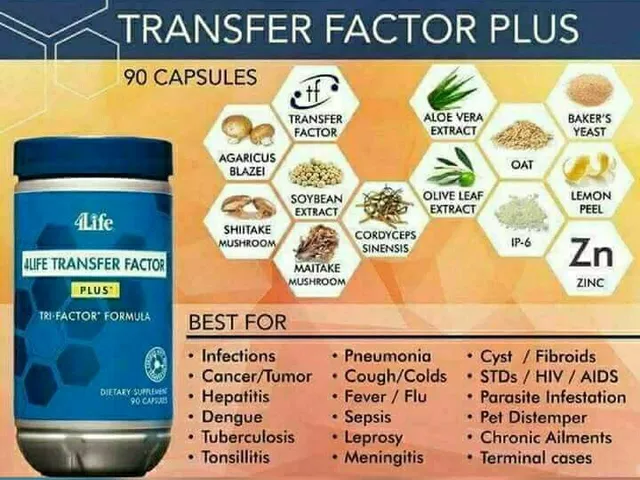
Transfer Factor: The Miracle Molecule for a Stronger Immune System
In my recent research, I've come across an amazing discovery known as Transfer Factor, often referred to as a 'miracle molecule'. This naturally occurring compound is believed to significantly bolster our immune system, providing us with increased defense against diseases. It works by transferring immunity information from one entity to another, hence the name. The health implications of this are immense and could revolutionize how we approach immune health. Personally, I find it incredibly exciting and can't wait to see how this field develops.
Multiple Generics: How Competitors Enter After the First Generic Market Entrant
After the first generic enters the market, a wave of competitors follows, causing prices to plummet. Learn how patent rules, authorized generics, and PBM contracts shape the race to the bottom-and why shortages follow.
Prescriber Attitudes Toward NTI Drugs and Substitution
Prescribers remain cautious about substituting generic versions of narrow therapeutic index (NTI) drugs due to safety concerns, despite FDA assurances. Real-world data, state laws, and clinical experience shape ongoing debates over substitution practices.
Brandon Vasquez
February 27, 2026 AT 22:07I've been on generic blood pressure meds for years. Never had an issue, but after reading this, I checked my bottle. Lot number matched a 2024 recall I didn't know about. Called my pharmacy-they replaced it same day. Don't assume it's fine. Just check.