Ginkgo Biloba & Blood Thinner Interaction Checker
Check Your Medication Risk
If you're taking a blood thinner like warfarin, aspirin, or clopidogrel, and you're also using Ginkgo biloba for memory or circulation, you might be at risk for something serious-internal bleeding. It’s not a myth. It’s not a scare tactic. It’s a documented, real danger that shows up in emergency rooms and operating rooms across the UK and the US. And most people have no idea it’s even a possibility.
What Ginkgo Biloba Actually Does
Ginkgo biloba comes from the leaves of the Ginkgo tree, one of the oldest living tree species on Earth. For decades, it’s been sold as a natural way to boost memory, improve circulation, and even fight dementia. The standard extract used in supplements contains 24% flavonoid glycosides and 6% terpene lactones. Most people take 120-240 mg per day. Over 1.5 million Americans use it regularly. In the UK, it’s widely available in pharmacies and health stores without a prescription.But here’s the catch: Ginkgo biloba interferes with blood clotting. It doesn’t thin your blood like warfarin does. Instead, it slows down the way platelets stick together. That might sound harmless-until you cut yourself, fall, or need surgery. Then, your body can’t form clots fast enough. And that’s when things go wrong.
The Real Risk: Bleeding When You Least Expect It
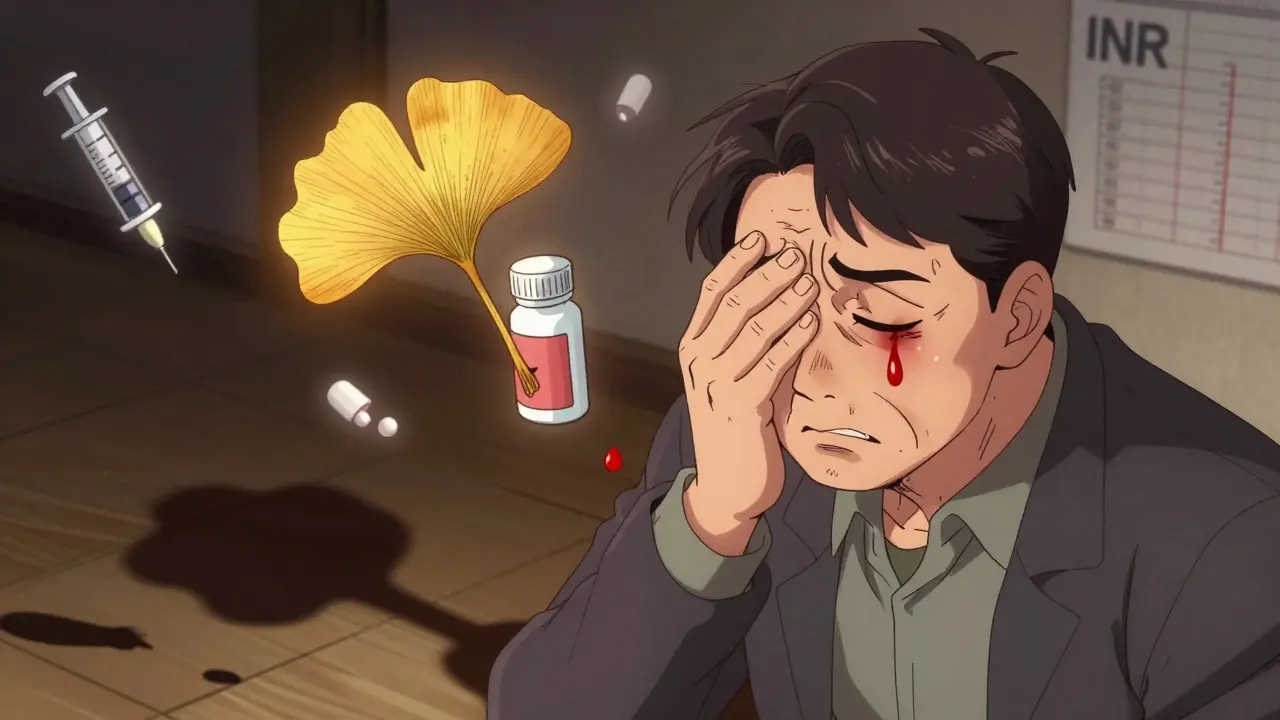
You don’t need to be on multiple blood thinners to be in danger. One case reported by the Consumer Medication Safety Institute involved a man who started taking Ginkgo biloba for memory and low-dose aspirin (80 mg) for heart health. Within a week, he suffered spontaneous bleeding in his right eye. No trauma. No warning. Just bleeding-because the two substances together overwhelmed his body’s ability to stop it.Another case involved a young woman with no other medications. She’d been taking Ginkgo biloba for years. Then, she had a sudden brain bleed. No trauma. No stroke. Just Ginkgo. The same thing happened to others. In fact, a 2023 study in PLOS ONE found that people taking Ginkgo biloba along with common blood thinners had a 49% higher chance of abnormal blood clotting tests-and an 8% higher chance of actual bleeding events.
It’s not just aspirin or warfarin. Ginkgo interacts dangerously with:
- Clopidogrel (Plavix) - used after heart attacks or stents
- Warfarin (Coumadin, Jantoven) - the classic blood thinner
- Ibuprofen (Advil, Motrin) - common OTC painkiller
- Celecoxib (Celebrex) - arthritis medication
- Nifedipine (Procardia) - blood pressure drug
- Omeprazole (Prilosec) - acid reflux pill
Even if you’re only on one of these, Ginkgo can push you over the edge. The problem isn’t always the dose. It’s the combination.
Why the Confusion? Contradictory Studies
You might have heard that Ginkgo doesn’t really affect bleeding. That’s because some studies say it doesn’t. A 2023 trial tested EGb 761-a high-quality Ginkgo extract-on 29 different blood clotting markers. None showed inhibition. So why do we still see bleeding cases?The answer is simple: real people aren’t lab subjects. In controlled trials, participants are healthy, monitored, and take one supplement. In real life, people take Ginkgo with five other meds, have underlying conditions, or take inconsistent doses. One study found that while bleeding incidents didn’t always spike, abnormal blood test results did-meaning your body is struggling, even if you don’t feel it.
Also, not all Ginkgo supplements are the same. The FDA doesn’t regulate herbal products like prescription drugs. Two bottles labeled “Ginkgo biloba 120 mg” can have wildly different amounts of active ingredients. One might be pure. Another might be diluted-or even contaminated. That’s why case reports keep popping up. The product you buy might be riskier than you think.

When Surgery Is Involved: The 2-Week Rule
If you’re scheduled for any surgery-whether it’s a knee replacement, a colonoscopy, or even a simple tooth extraction-your surgeon needs to know about every supplement you take. The American Society of Anesthesiologists says stop Ginkgo biloba 2 to 3 weeks before surgery. Why so long?Because Ginkgo’s effects linger. It doesn’t just leave your system in a day. It changes how your platelets behave for weeks. A 2023 study suggested 36 hours might be enough, but that’s based on pharmacokinetics alone. Real-world bleeding risk doesn’t care about half-lives. It cares about whether your blood can clot when you’re cut open. That’s why doctors stick with the 2-3 week window. It’s the only safe margin.
Don’t assume your doctor knows you’re taking it. Most don’t ask. It’s your job to speak up. Bring your pill bottles. List every supplement. Even if you think it’s “just herbal.”
Who Should Avoid Ginkgo Altogether?
Some people shouldn’t take Ginkgo biloba at all-not even for a day.- People on blood thinners - even low-dose aspirin
- Those with bleeding disorders - like hemophilia or von Willebrand disease
- Pregnant or breastfeeding women - risk of fetal bleeding
- People with epilepsy - Ginkgo may lower seizure threshold
- Anyone over 65 - older adults have slower clotting and more medication interactions
Mayo Clinic explicitly warns these groups to avoid Ginkgo. And they’re not being overly cautious. They’ve seen the outcomes.
What About Other Supplements?
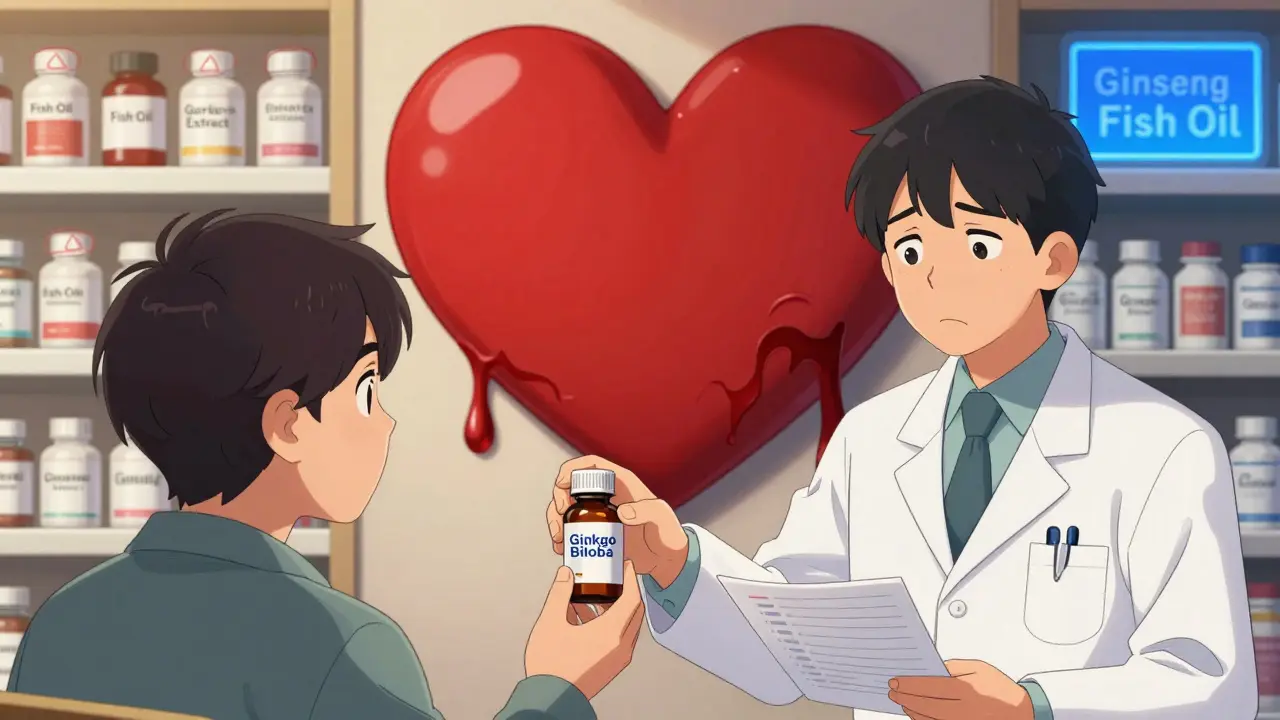
Ginkgo isn’t alone. Garlic, ginger, ginseng, and fish oil also interfere with clotting. But Ginkgo is one of the most common ones people take without realizing the danger. And unlike prescription drugs, you won’t find warnings on the bottle. No red flags. No asterisks. Just a label that says “supports memory.”Here’s the hard truth: if you’re taking any supplement that claims to “improve circulation” or “boost brain function,” assume it might affect your blood. Always check with your pharmacist before adding anything new.
What to Do Right Now
If you’re taking a blood thinner and Ginkgo biloba, here’s what you need to do:- Stop taking Ginkgo immediately-don’t wait. Even if you feel fine.
- Call your doctor or pharmacist-tell them exactly what you’ve been taking and for how long.
- Don’t restart without approval-even if you read online that it’s “safe.”
- Check your other supplements-fish oil, garlic, turmeric? They’re risky too.
- Bring all your meds to every appointment-including vitamins and herbal teas.
There’s no magic dose of Ginkgo that’s “safe” with blood thinners. The risk isn’t linear. It’s cumulative. One pill might not do it. But two weeks of taking it with aspirin? That’s enough to cause a bleed.
Final Reality Check
Ginkgo biloba isn’t evil. It’s not a poison. But it’s not harmless, either. It’s a powerful plant extract that changes how your body works. And when you mix it with medications designed to control life-or-death processes like blood clotting, you’re playing with fire.There’s no strong evidence that Ginkgo improves memory in healthy people. But there’s plenty of evidence that it can cause bleeding-sometimes silently, sometimes catastrophically. If you’re on blood thinners, the safest choice isn’t to find the “right dose.” It’s to skip it entirely.
Your health isn’t worth the gamble. Not when the stakes are internal bleeding, stroke, or death.
Can I take Ginkgo biloba with low-dose aspirin?
No. Even low-dose aspirin (80 mg) increases bleeding risk when combined with Ginkgo biloba. Case reports show spontaneous bleeding-like eye hemorrhages-after just one week of using both. There’s no safe threshold. If you’re on aspirin for heart health, stop Ginkgo.
How long before surgery should I stop Ginkgo biloba?
Stop Ginkgo biloba at least 2 to 3 weeks before any surgery, even minor ones like dental work or colonoscopies. While some studies suggest 36 hours might be enough, the 2-3 week window is the standard recommended by the American Society of Anesthesiologists because Ginkgo’s effects on platelets last longer than its presence in your blood.
Does Ginkgo biloba affect INR levels?
Yes. Multiple case reports show Ginkgo biloba can raise INR levels in people taking warfarin. One patient’s INR jumped from 2.1 to 5.8 after starting Ginkgo-putting them at high risk for bleeding. If you’re on warfarin, regular INR tests won’t catch the interaction unless your doctor knows you’re taking Ginkgo.
Are all Ginkgo biloba supplements the same?
No. The FDA doesn’t regulate herbal supplements like prescription drugs. Two bottles labeled “120 mg Ginkgo” can have wildly different amounts of active ingredients-or even contaminants. Some may be diluted, others over-concentrated. This variability makes it impossible to predict how any single product will interact with your meds.
Can I take Ginkgo biloba if I’m not on any medication?
Even if you’re not on blood thinners, Ginkgo biloba can still pose risks. It may trigger bleeding in people with undiagnosed clotting disorders, or cause complications during unexpected injuries or surgeries. Older adults, pregnant women, and those with epilepsy should avoid it entirely. For most people, the unproven benefits don’t outweigh the risks.

Ian Glover
My name is Maxwell Harrington and I am an expert in pharmaceuticals. I have dedicated my life to researching and understanding medications and their impact on various diseases. I am passionate about sharing my knowledge with others, which is why I enjoy writing about medications, diseases, and supplements to help educate and inform the public. My work has been published in various medical journals and blogs, and I'm always looking for new opportunities to share my expertise. In addition to writing, I also enjoy speaking at conferences and events to help further the understanding of pharmaceuticals in the medical field.
15 Comments
-
Amy Ehinger
January 17, 2026 AT 12:55So I'm 72, on warfarin for AFib, and I've been taking ginkgo for 'brain fog' since 2018. My pharmacist finally asked me about supplements during a routine check-up. I said 'oh that herbal thing?' and she nearly fainted. Got my INR checked that day-it was 5.2. I stopped ginkgo immediately. No more brain fog, but also no more scary bleeding scares. Honestly? I miss the placebo effect more than the actual benefit.
-
Ayush Pareek
January 18, 2026 AT 02:40In India, we call ginkgo 'the memory tree' and people give it to grandparents like candy. No one checks for interactions. My uncle took it with clopidogrel after his stent and ended up in ICU with a GI bleed. We thought it was just 'old age.' Now I carry a printed list of dangerous herb-drug combos in my wallet. If you're on meds, ask your pharmacist before you swallow anything green or leafy.
-
Nilesh Khedekar
January 19, 2026 AT 14:17I'm sorry, but why are we treating a tree leaf like it's a pharmaceutical? You're telling me a supplement that's been around since the Jurassic period is more dangerous than the 200+ FDA-approved drugs we pump into people every day? The real problem is the medical-industrial complex turning natural remedies into villains because they can't patent them. Ginkgo doesn't kill people. Fear and ignorance do.
-
Iona Jane
January 20, 2026 AT 06:28They don't want you to know this but the FDA banned ginkgo in 2019 and buried the report. The real reason? Big Pharma doesn't want you healing yourself with trees. That's why they're pushing this 'bleeding risk' narrative. My cousin had a stroke after stopping ginkgo-coincidence? I think not. Watch what they do to turmeric next.
-
Jan Hess
January 21, 2026 AT 03:42My mom’s on aspirin and started ginkgo for her circulation. I told her to stop. She didn’t listen. Two weeks later she bruised her thigh just by sitting on a hard chair. ER visit. Blood tests. They said ‘this is exactly what we warned you about.’ She’s now off everything except her meds and a daily walk. No more supplements. No more drama. Just life.
-
Vicky Zhang
January 21, 2026 AT 12:25I cried reading this. My grandma died from a brain bleed after taking ginkgo with her blood pressure pill. She thought it was ‘natural so it’s safe.’ No one told her. No one asked. Please, if you’re reading this and you’re on meds-stop. Just stop. Talk to someone. Don’t wait until it’s too late.
-
Nicholas Urmaza
January 21, 2026 AT 14:43Let’s be clear-this isn’t about ginkgo being evil. It’s about people treating medicine like a buffet. You don’t toss random supplements into your body like they’re trail mix. If you’re on anticoagulants, you’re in a high-risk category. Period. No exceptions. No ‘but I only take one pill.’ The science is settled. The risk is real. The question isn’t whether you can afford to take it-it’s whether you can afford not to stop.
-
Nishant Garg
January 22, 2026 AT 12:16Back home in Delhi, my aunt swears by ginkgo. She says it keeps her sharp. But she also takes amlodipine, metformin, and aspirin. No one checks for interactions. No one even knows what ‘platelet aggregation’ means. We need community health workers-not just doctors-to walk door to door and explain this. In the West, you Google it. In places like mine, you just take what your neighbor says works. That’s the real crisis.
-
Nat Young
January 22, 2026 AT 22:21Oh please. 49% higher chance of abnormal clotting tests? That’s not bleeding. That’s a lab anomaly. Where’s the mortality data? Where’s the controlled study with 10,000 subjects? This is fearmongering dressed up as science. People die from statins, SSRIs, and even Tylenol. But nobody’s banning those. Why? Because they’re profitable. Ginkgo is a scapegoat for lazy medicine.
-
Diane Hendriks
January 24, 2026 AT 21:35The notion that ‘natural’ equals ‘safe’ is a dangerous fallacy rooted in Romantic-era pseudoscience. Ginkgo biloba is a bioactive compound with documented pharmacological effects. To assume it’s harmless because it comes from a tree is as irrational as assuming arsenic is safe because it’s naturally occurring in soil. The burden of proof lies with the user-not the regulator. If you can’t demonstrate safety in polypharmacy contexts, you shouldn’t be taking it.
-
Annie Choi
January 25, 2026 AT 09:34As a nurse, I’ve seen this too many times. Patients come in with INRs off the charts, and when I ask about supplements, they say ‘oh, I just take that herbal thing.’ No one thinks it counts as a drug. But it is. And it interacts. I keep a laminated card in my pocket with the top 10 dangerous herb-drug combos. I hand it out like candy. Ginkgo is #1. Always. Don’t be the person who says ‘I didn’t know.’
-
Jaspreet Kaur Chana
January 27, 2026 AT 03:28In Punjab, we use ginkgo leaves in tea for memory. My grandfather drank it daily. He lived to 98. But he never took blood thinners. The problem isn’t the herb-it’s the combination. If you’re on warfarin, stop everything else. If you’re not on meds, maybe it’s fine. But don’t mix. Don’t assume. Don’t be reckless. Your body isn’t a lab experiment.
-
TooAfraid ToSay
January 27, 2026 AT 16:52My brother died from a brain bleed at 42. He took ginkgo, fish oil, and aspirin. The coroner said ‘combination toxicity.’ His wife didn’t even know ginkgo was a supplement. She thought it was a vitamin. That’s the real tragedy-not the herb, but the ignorance. We need public service announcements. Not just Reddit posts.
-
says haze
January 27, 2026 AT 19:43Let’s be honest: if this were a synthetic drug, the FDA would have pulled it off the market in 2010. But because it’s herbal, we get this performative ‘warning’ that does nothing. The system is broken. The regulation is a joke. And people are dying because we treat natural substances like they’re exempt from pharmacology. Ginkgo isn’t the villain. The regulatory void is.


Write a comment
More Articles
Generic Price Wars: How Consumers Save Money on Prescription Drugs
Generic drug price wars can slash prescription costs by over 95%, but middlemen often keep the savings. Learn how to find real discounts, compare cash prices, and beat the system to save money on your meds.
How Dapsone Treats Dermatitis Herpetiformis: Dosage, Side Effects & Alternatives
Learn how dapsone treats dermatitis herpetiformis, from dosing and side‑effects to alternatives and the essential gluten‑free diet.
Can Primidone Help with Anxiety? A Closer Look
In today's blog post, we're taking a closer look at Primidone and its potential to help with anxiety. Primidone is an anticonvulsant medication primarily used to treat epileptic seizures, but some studies suggest it might also have some benefits for anxiety sufferers. However, the evidence is still limited and not completely conclusive. As always, it's important to consult with a medical professional before trying any new treatment. Stay tuned for more updates and insights on this topic in the future!
Sarah Mailloux
January 16, 2026 AT 14:21I took ginkgo for years thinking it was just a chill herb for memory. Then my dad had a nosebleed that wouldn't stop after he started mixing it with his baby aspirin. Turned out he didn't even know it could do that. Now he's off it. Don't be like my dad.