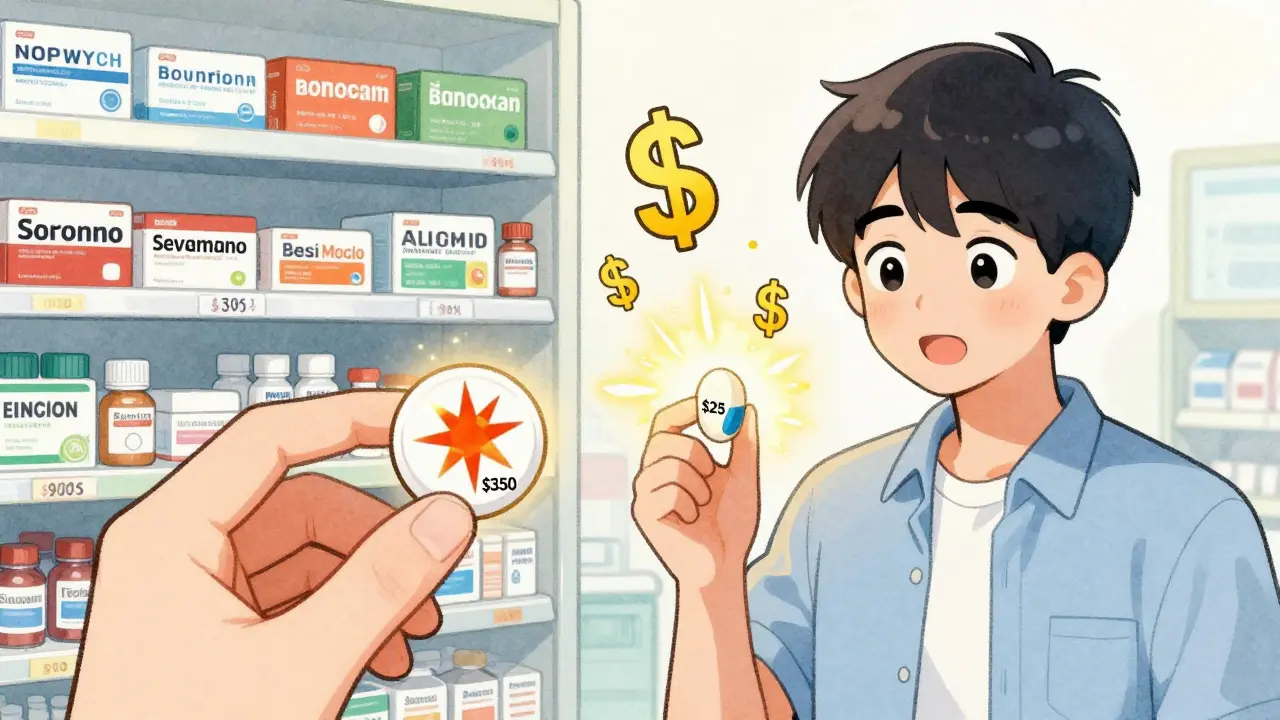
Every year, Americans spend over $650 billion on prescription drugs. That’s more than any other country in the world. But here’s the twist: generics make up 90% of all prescriptions filled, yet they only account for 12% of that total cost. Meanwhile, brand-name drugs, which make up just 10% of prescriptions, eat up 88% of the spending. That’s not a mistake. It’s the power of generics at work.
What Exactly Are Generic Drugs?
Generic drugs aren’t cheap knockoffs. They’re exact copies of brand-name medications - same active ingredient, same strength, same way of taking them. The FDA requires them to meet the same strict standards for safety, purity, and effectiveness. The only differences? The name, the color, the shape, and the price. And sometimes, the inactive ingredients - like fillers or dyes - which can cause minor reactions in rare cases. The legal backbone for generics came from the Hatch-Waxman Act of 1984. Before that, companies had to run full clinical trials to prove a new drug worked - even if it was just copying an existing one. Hatch-Waxman changed that. It let generic makers prove their drug was bioequivalent - meaning it behaves the same way in the body - using smaller, faster, cheaper studies on healthy volunteers. That cut development time from 10-15 years to under a year and slashed costs from $2.6 billion to around $1 million per application.How Much Do Generics Actually Save?
The numbers speak for themselves. In 2024, generics saved the U.S. healthcare system $98 billion in direct spending. That’s not a guess - it’s from the Association for Accessible Medicines. Compare that to brand-name drugs, which cost $700 billion for just 435 million prescriptions. That’s an 80-85% price drop on average. Take insulin, for example. Brand-name Humalog used to cost $350 a month. After generic insulin lispro hit the market, the same dose dropped to $25. One patient on Reddit said switching saved her mom from skipping doses. That’s not just money - it’s health. Even in Medicare, where 98% of plans automatically substitute generics, the savings ripple out. When a generic enters the market, prices for the brand-name version often drop too - sometimes by 90% within a year. The Congressional Budget Office found that generic competition cuts prices far more than Medicare’s new price negotiation program, which only applies to a handful of drugs each year.Why Don’t We Use More Generics?
You’d think with savings like that, everyone would switch. But barriers remain. One big one? Patent games. Brand-name companies file dozens of patents - sometimes over 140 per drug - not to protect innovation, but to delay generics. They tweak the pill’s coating, change the dosage form, or make minor updates just to reset the clock. This tactic, called “product hopping,” can delay generics by 6 to 12 months. Add in lawsuits and “pay-for-delay” deals - where brand companies pay generics to stay off the market - and the average wait for a generic after patent expiry is 28 months. Then there’s the pharmacy benefit managers (PBMs). These middlemen negotiate rebates with drugmakers. But here’s the catch: sometimes, they structure plans so that the generic costs more out-of-pocket than the brand. Why? Because the rebate on the brand is bigger. Express Scripts reported in 2024 that 45% of commercial plans charge higher copays for generics when rebates outweigh the price difference. That’s backwards economics - and it hurts patients.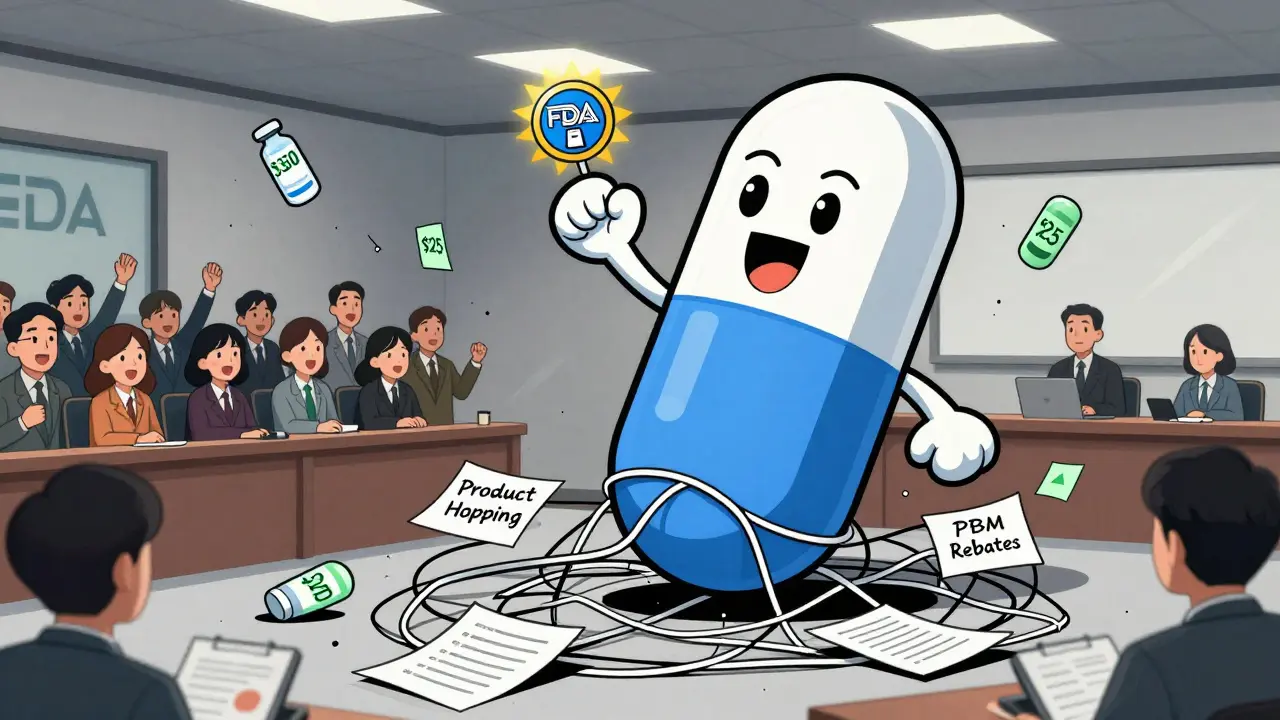
The Biosimilar Gap
Biologic drugs - like those for rheumatoid arthritis, cancer, or Crohn’s disease - are complex molecules made from living cells. They can’t be copied exactly, so their cheaper versions are called biosimilars. They’re not generics, but they’re close: same effect, lower cost. Biosimilars typically cost 15-35% less than the brand. That sounds small compared to generics, but when you’re talking about drugs that cost $100,000 a year, even 20% off means tens of thousands saved. Yet adoption in the U.S. is stuck at 25-30%. In Europe, it’s 70-85%. Why? Rebates again. PBMs and insurers often keep the brand drug on top of the formulary because the rebate is higher. Doctors don’t always know how to switch. And patients fear change - even when studies show biosimilars work just as well. Worse, 90% of biologics losing patent protection in the next 10 years have no biosimilar in development. That’s a looming crisis. The FDA’s Biosimilars Action Plan is trying to fix this, but without policy changes to encourage development - like liability protections or faster approvals - we’ll keep seeing the same pattern: high prices, no competition.What About Safety?
People worry: “Is my generic the same?” The answer is yes - for most drugs. The FDA requires bioequivalence testing. That means the generic must deliver the same amount of drug into the bloodstream within the same time frame as the brand. The acceptable range? 80-125% of the brand’s levels. That’s not a loophole - it’s based on decades of clinical data showing no meaningful difference in outcomes within that range. But there are exceptions. For drugs with a narrow therapeutic index - like warfarin, lithium, or levothyroxine - even tiny changes can matter. Some patients report symptoms returning after switching to a generic version of levothyroxine. The FDA acknowledges this and requires prescribers to specify “dispense as written” on the prescription in those cases. In 12 states, that’s the law. Still, out of 1.2 million patient reviews on Drugs.com, generics scored 4.1 out of 5 for overall satisfaction - almost identical to brands. Efficacy ratings were the same. The only big difference? Affordability. Generics got 4.5 out of 5. Brands? 2.3.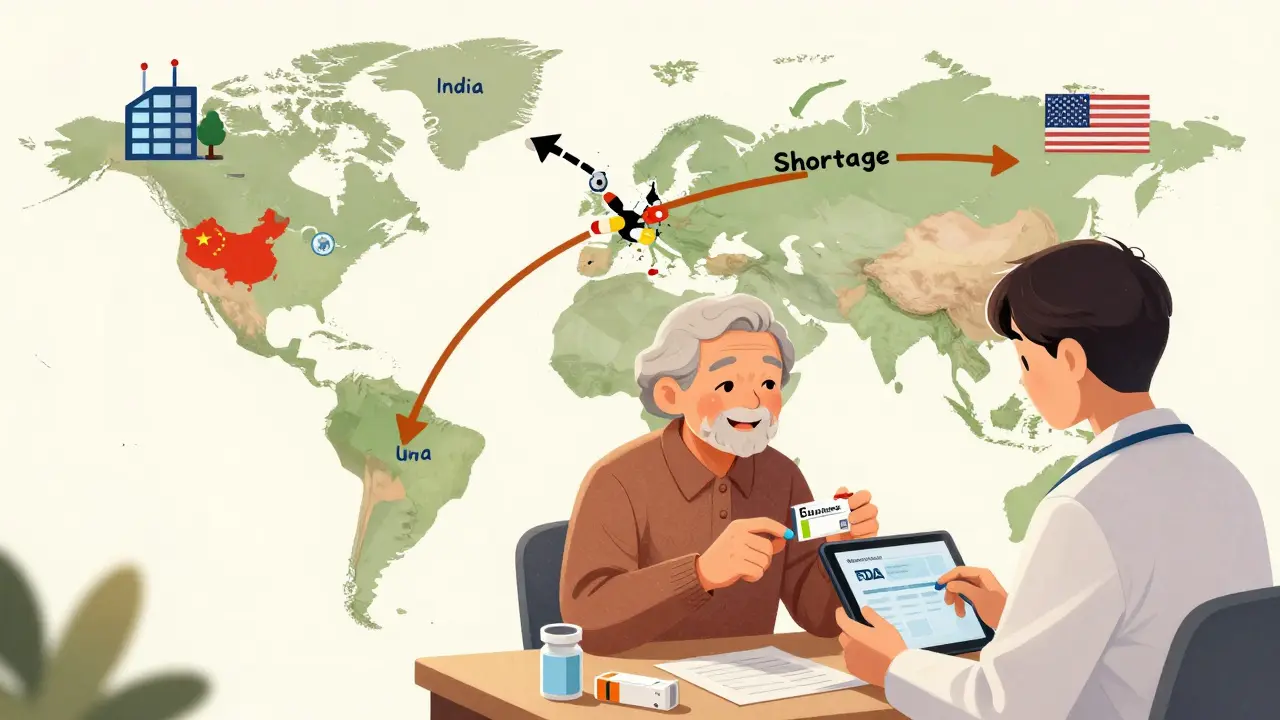
Who Makes These Drugs?
The U.S. doesn’t make most of its generic drugs anymore. Over 80% of the active ingredients come from India and China. That’s efficient - but risky. During the pandemic, supply chain snarls caused over 300 drug shortages, mostly generics. The FDA now tracks 127 drugs at high risk of shortage due to manufacturing issues. The biggest generic makers in the U.S. are Teva, Viatris, and Sandoz. But behind them are hundreds of smaller companies, many in Asia, that produce the raw materials and finished pills. This global network keeps prices low - but also makes the system vulnerable to political or natural disruptions.What’s Next?
The Inflation Reduction Act capped insulin at $35 a month for Medicare patients in 2023. That forced brands like Eli Lilly to slash prices across the board - from $275 to $25. It’s a sign that policy can shift markets. The CBO estimates that if we fix the biosimilar void - by speeding up approvals and banning pay-for-delay - we could save $234 billion over the next decade. That’s bigger than Medicare negotiation alone. But real change needs more than laws. It needs transparency. It needs prescribers who know how to read the FDA’s Orange Book - a database that tells them which generics are interchangeable. Only 37% of doctors can do that without help. It needs pharmacies that don’t charge more for generics. It needs insurers that stop rewarding the most expensive options. And it needs patients who know they have a right to ask for the generic - and that it’s not just cheaper, it’s just as good.Final Thoughts
Generics aren’t a band-aid. They’re the foundation of affordable healthcare. Without them, millions would skip doses, ration pills, or go without treatment. They’re the reason a diabetic can afford insulin, a heart patient can take their statin, and a senior on fixed income can keep their blood pressure under control. The system isn’t perfect. Patent abuse, supply chain risks, and perverse incentives still exist. But the data is clear: when generics enter the market, prices crash, access expands, and lives improve. The next time you pick up a prescription, ask: Is there a generic? If the answer is yes - and your doctor says it’s safe - take it. You’re not saving money. You’re saving the system.Are generic drugs as safe and effective as brand-name drugs?
Yes. The FDA requires generics to have the same active ingredient, strength, dosage form, and route of administration as the brand-name drug. They must also prove bioequivalence - meaning they deliver the same amount of medicine into your bloodstream at the same rate. Over 90% of generics are rated as therapeutically equivalent by the FDA. Patient reviews and clinical studies show no meaningful difference in effectiveness or safety for most drugs.
Why do some people say generics don’t work as well?
A small number of patients report issues after switching to generics, especially with drugs that have a narrow therapeutic index - like levothyroxine or warfarin. These drugs require very precise dosing, and even tiny differences in inactive ingredients can affect absorption in sensitive individuals. In these cases, some patients benefit from staying on the brand. But for 95% of drugs, switching causes no issue. Always talk to your doctor if you notice changes after a switch.
Why is my generic more expensive than the brand-name drug?
It shouldn’t be - but sometimes it is. Pharmacy benefit managers (PBMs) sometimes structure insurance plans so that the brand drug has a lower copay because they get a bigger rebate from the manufacturer. This is called a "generic differential." If your copay is higher for the generic, ask your pharmacist to check if there’s a cheaper option or if your plan can be adjusted. You can also use tools like GoodRx to compare cash prices.
What’s the difference between a generic and a biosimilar?
Generics are exact copies of small-molecule drugs - like pills for high blood pressure or cholesterol. Biosimilars are highly similar versions of complex biologic drugs - like injectables for arthritis or cancer. Because biologics are made from living cells, they can’t be copied exactly. Biosimilars must show they work the same way and have no meaningful difference in safety or effectiveness, but they’re not identical. They’re typically 15-35% cheaper than the brand, compared to 80-85% for generics.
Can I ask my doctor to prescribe a generic?
Absolutely. In fact, most doctors automatically prescribe generics when available. But if yours doesn’t, ask. Say: "Is there a generic version of this?" or "Would a generic work just as well?" Your doctor may not know about the latest generic approvals, or they might be used to prescribing the brand. You have the right to request the most affordable, equally effective option.
How do I know if a generic is approved by the FDA?
Check the FDA’s Orange Book, which lists all approved generic drugs and their therapeutic equivalence ratings. Look for an "A" code - that means the generic is rated as interchangeable with the brand. You can search it online for free. Also, the label on the bottle will say the generic name, and your pharmacist can confirm its approval status.

Ian Glover
My name is Maxwell Harrington and I am an expert in pharmaceuticals. I have dedicated my life to researching and understanding medications and their impact on various diseases. I am passionate about sharing my knowledge with others, which is why I enjoy writing about medications, diseases, and supplements to help educate and inform the public. My work has been published in various medical journals and blogs, and I'm always looking for new opportunities to share my expertise. In addition to writing, I also enjoy speaking at conferences and events to help further the understanding of pharmaceuticals in the medical field.
10 Comments
-
Niamh Trihy
February 1, 2026 AT 19:33Interesting breakdown, but I’m curious about the biosimilar adoption gap in the U.S. versus Europe. Is it really just rebates, or is there a deeper cultural resistance to switching from branded biologics? In Ireland, doctors are trained to prioritize biosimilars from day one-no stigma, no hesitation. Here, it feels like patients and providers are both waiting for someone else to take the first step. Is that a trust issue? A liability fear? Or just inertia?
Also, the fact that 90% of expiring biologics have no biosimilar in development is terrifying. That’s not market failure-that’s a policy vacuum. Who’s responsible for filling it? The FDA? Congress? Pharma itself? The answer should be all of them, but right now, it’s nobody. -
Beth Cooper
February 3, 2026 AT 18:26Let me guess-this is all part of the Great Generic Conspiracy. You know, the one where Big Pharma, the FDA, and the WHO all secretly agree to make generics so good that people stop buying $10,000-a-pill drugs? Yeah right.
Here’s the truth: generics are made in China and India by factories that don’t even have clean rooms. I’ve seen the reports. Contaminants. Inconsistent dosing. Fake certifications. The FDA inspects maybe 2% of overseas plants. That’s not oversight-it’s a gamble with your life.
And don’t get me started on the ‘bioequivalence’ loophole. 80-125%? That’s a 45% swing! You think your thyroid meds are doing the same thing? Try switching and see how fast your heart starts racing. I did. I ended up in the ER. The brand worked fine. The generic? It was a Russian roulette pill.
And yeah, PBMs are shady-but at least the brand name has a name you can sue. Who do you sue when your generic turns your kidneys to dust? The guy in Bangalore who stamped the bottle? -
Blair Kelly
February 4, 2026 AT 03:37Stop. Just stop. You’re all talking like this is some noble public health victory. It’s not. It’s corporate engineering. The FDA didn’t ‘save’ us with Hatch-Waxman-it enabled a legal loophole for generic manufacturers to ride on the coattails of billion-dollar R&D investments. Then they turned around and let those same companies patent every trivial variation to delay competition. That’s not innovation. That’s legal fraud.
And don’t pretend the 80-125% bioequivalence range is scientific. It’s a political compromise written by lobbyists. You think a patient on lithium doesn’t notice a 15% variance in plasma concentration? Of course they do. They feel it. They get sick. They get hospitalized. And then you blame them for not ‘adapting’.
Meanwhile, the real villains? The PBMs. They’re not middlemen-they’re parasitic middlemen. They get paid based on the *difference* between what the brand charges and what the patient pays. So they incentivize higher brand prices. That’s not capitalism. That’s a rigged game. And you’re all just cheering while the system burns.
And yes, I know generics are cheaper. But if your life depends on precision dosing, ‘cheaper’ is the worst kind of lie. -
Rohit Kumar
February 5, 2026 AT 01:28In India, generics are the backbone of healthcare. We don’t have insurance. We don’t have subsidies. We have generics. And we’ve had them for decades. The idea that they’re ‘unsafe’ or ‘less effective’ is a Western myth sold by companies that profit from fear.
Yes, some Indian manufacturers cut corners. But so do some U.S. ones. The difference? In India, we don’t have the luxury of choosing brand over generic. So we’ve learned to trust the system-and we’ve built rigorous quality control into our supply chains. The WHO prequalifies Indian generics for global use. If they’re safe enough for Africa and Southeast Asia, why are we still doubting them here?
And let’s be honest: the U.S. healthcare system doesn’t hate generics because they’re unsafe. It hates them because they’re cheap. And cheap things don’t generate enough profit for the people running the show.
It’s not about science. It’s about economics. And until we admit that, we’ll keep pretending patients are choosing between efficacy and affordability. They’re not. They’re choosing between dignity and despair. -
Lily Steele
February 5, 2026 AT 05:23My grandma switched to generic levothyroxine last year and her TSH went nuts. She was fine on the brand. Her doctor didn’t even know the switch happened until she showed up with her pill bottle. We had to fight the pharmacy to get her back on the brand. No one warned us.
But here’s the thing-I didn’t know I could ask for the brand. No one ever told me. I thought generics were just ‘the default.’ Turns out, if you say ‘dispense as written’ on the script, they can’t swap it. That’s not common knowledge. It should be.
And yeah, I saved $40 a month on the generic. But when your mom’s energy crashes and she can’t get out of bed, $40 doesn’t matter. I wish someone had just told me to ask. Not ‘is there a generic?’ but ‘can I stay on the brand if it works better?’
It’s not about trust. It’s about communication. And that’s what’s broken. -
Jodi Olson
February 7, 2026 AT 00:05The assertion that generics are universally equivalent to brand-name drugs is statistically valid but clinically reductive. The FDA’s bioequivalence standards are rooted in population-level pharmacokinetics, not individual pharmacodynamics. For the 95% of patients who experience no adverse variation, generics are indistinguishable. For the 5%-often those with comorbidities, polypharmacy, or metabolic anomalies-the difference can be catastrophic.
Moreover, the regulatory framework treats all drugs as if they exist in a vacuum. It ignores drug-drug interactions, patient adherence patterns, and the psychological impact of pill appearance. A patient who associates a specific color or shape with stability may experience placebo-mediated therapeutic failure upon switching-even if pharmacokinetics are identical.
Thus, while generics are economically essential, their implementation must be contextualized. Blanket substitution policies without clinician input or patient consent are not evidence-based-they are administrative convenience masquerading as efficiency.
Transparency is not optional. It is foundational. -
calanha nevin
February 8, 2026 AT 01:16Let’s not forget who’s paying the real cost: patients. Not insurers. Not PBMs. Not even the government. The people who skip doses because the copay is $75 instead of $25. The ones who ration insulin because their plan won’t cover the brand even though the generic made them nauseous. The elderly who stare at their pill bottles and wonder if they’re getting the same medicine.
Generics aren’t just a policy issue. They’re a dignity issue.
And if we’re going to talk about biosimilars, we need to stop treating them like second-class citizens. Biologics are complex, yes-but so are patients. We need education, not fear. We need reimbursement reform, not rebate games. We need prescribers who know the Orange Book, not just the brand name.
And we need to stop pretending that ‘affordable’ means ‘good enough.’ It means ‘accessible.’ And accessibility without safety is a lie. -
Sidhanth SY
February 8, 2026 AT 20:10India makes 60% of the world’s generics. China makes most of the APIs. The U.S. makes almost none. That’s not a bug-it’s a feature of globalization. The problem isn’t the source. It’s the lack of oversight. We outsource production but keep the liability. That’s not smart. It’s irresponsible.
And yet, the alternative-re-shoring all manufacturing-would make insulin cost $1,000 a vial. No one wants that. So we need better audits, not better nationalism.
Also, the ‘pay-for-delay’ deals? That’s not capitalism. That’s collusion. And the fact that the FTC hasn’t shut it down after 20 years says everything about how broken this system is.
Bottom line: generics work. The system doesn’t. -
Yanaton Whittaker
February 10, 2026 AT 09:43AMERICA IS THE BEST. We spend more on healthcare because we get the BEST drugs. Why would you want some cheap foreign pill when you can have the real thing? The FDA doesn’t even inspect half the factories overseas. You think your generic is safe? Try taking it after the Chinese New Year. Everything shuts down. No quality control. No oversight.
Generics are for people who can’t afford the real medicine. And if you’re one of those people? You should be thankful you even have access. Don’t complain about the price drop. Be glad you’re not in Europe where they ration everything.
And if your doctor prescribes a brand? Trust them. They know what’s best. You’re not a scientist. You’re a patient. Let the experts handle it.
🇺🇸💊 #AmericaFirstMedicine


Write a comment
More Articles

Revitalize Your Body and Mind with Jalap: The Dietary Supplement You Can't Miss!
Dive into the world of Jalap, a remarkable dietary supplement that promises to enhance both your body and mind. Discover how Jalap, derived from the roots of a traditional plant, can rejuvenate your health with its natural properties. Learn about its benefits, uses, and why it's becoming a go-to remedy for those seeking a holistic lifestyle. Find out how Jalap can fit into your daily routine and what sets it apart from other supplements.
How to Use Patient Counseling to Catch Dispensing Mistakes in Community Pharmacies
Patient counseling catches 83% of dispensing errors before they reach patients-more than barcode scans or double-checks. Learn how asking the right questions, checking pill appearance, and using teach-back methods can prevent deadly mistakes in community pharmacies.
April Allen
February 1, 2026 AT 05:06Generics aren't just cost-cutting measures-they're a structural correction to a broken pharmacoeconomic model. The Hatch-Waxman Act didn't just lower prices; it reallocated R&D incentives away from me-too drugs and toward true innovation. What we're seeing now isn't market failure-it's rent-seeking disguised as innovation. The real issue isn't generic efficacy-it's the perverse alignment of PBMs, insurers, and pharma where rebates override patient outcomes. We've outsourced our health to spreadsheet algorithms.
And let's not ignore the geopolitical risk: 80% of API sourcing from two nations with divergent regulatory philosophies isn't supply chain optimization-it's systemic vulnerability. The FDA's backlog on biosimilar approvals? That's not bureaucracy-it's captured regulatory capture. We're paying for brand-name monopolies while pretending generics are the problem.
The 80-125% bioequivalence window? Validated by decades of pharmacokinetic modeling. But when you're talking about warfarin or levothyroxine, that window becomes a canyon for sensitive populations. That's why therapeutic substitution protocols need clinician discretion, not blanket policies. The FDA's Orange Book isn't a mystery-it's a public tool. The failure isn't in the science-it's in the dissemination.
And yet, the most dangerous myth isn't that generics are inferior. It's that they're 'good enough.' They're not. They're identical. And when we treat them as second-tier, we normalize health inequity under the guise of cost containment. The real scandal isn't the price drop-it's that it took a public outcry to force insulin down to $35 after 20 years of price gouging.
Generics are the most underappreciated public health intervention since vaccines. Yet we treat them like discount groceries instead of life-sustaining infrastructure.