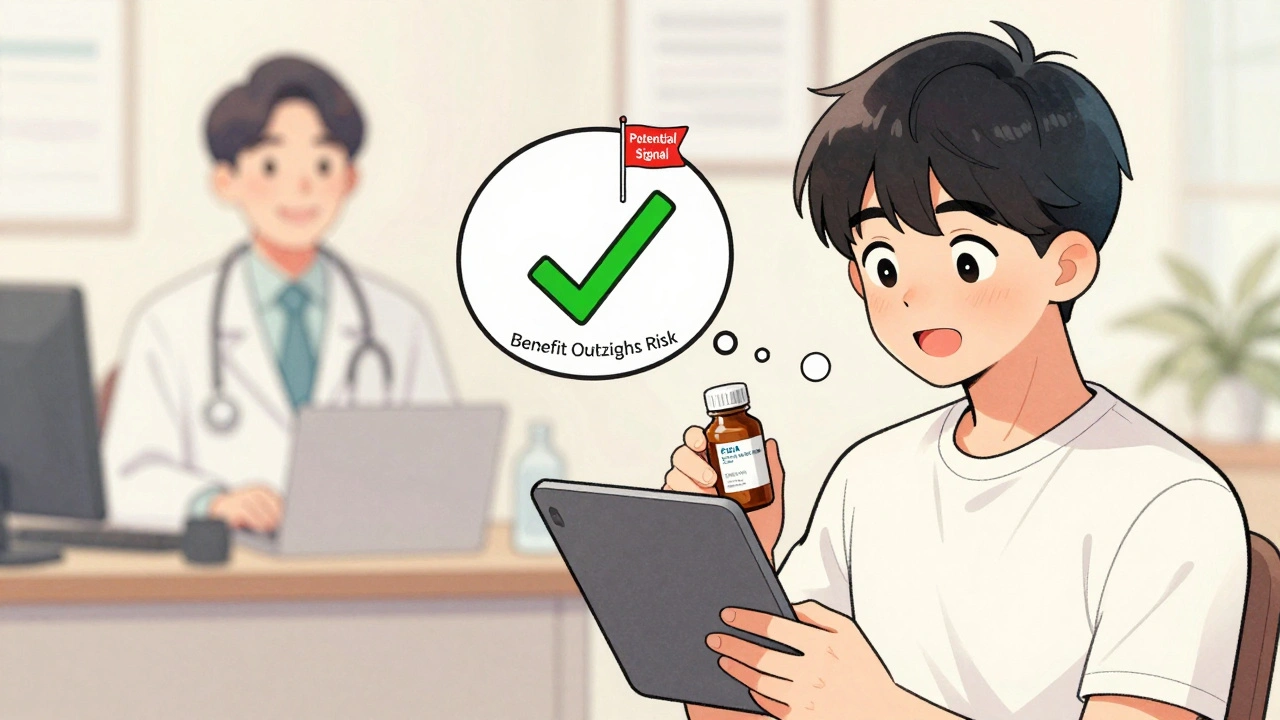
When the FDA issues a safety alert about a medication, it can feel like a red flag-like you’re being told to stop taking your drug immediately. But that’s not what most of these alerts mean. The FDA doesn’t issue warnings lightly, but neither does it confirm danger the moment something looks suspicious. Understanding the difference between a risk signal and a confirmed risk is the key to making smart decisions about your health.
What FDA Safety Announcements Actually Say
The FDA publishes Drug Safety Communications about 40 to 50 times a year. Most of these aren’t emergency notices. They’re updates-sometimes urgent, often cautious-that say: "We’re seeing something unusual. We’re looking into it. Don’t panic yet."
Take the example of a recent alert about a diabetes drug linked to a rare but severe infection called Fournier’s gangrene. The FDA didn’t say, "Stop this medicine." Instead, they said: "The estimated incidence is 0.2 cases per 1,000 patient-years compared to 0.06 in non-users." That’s a clear, measurable number. It tells you the risk is real, but extremely low. For someone with poorly controlled diabetes, the benefit of preventing kidney failure or heart disease far outweighs this tiny chance of infection.
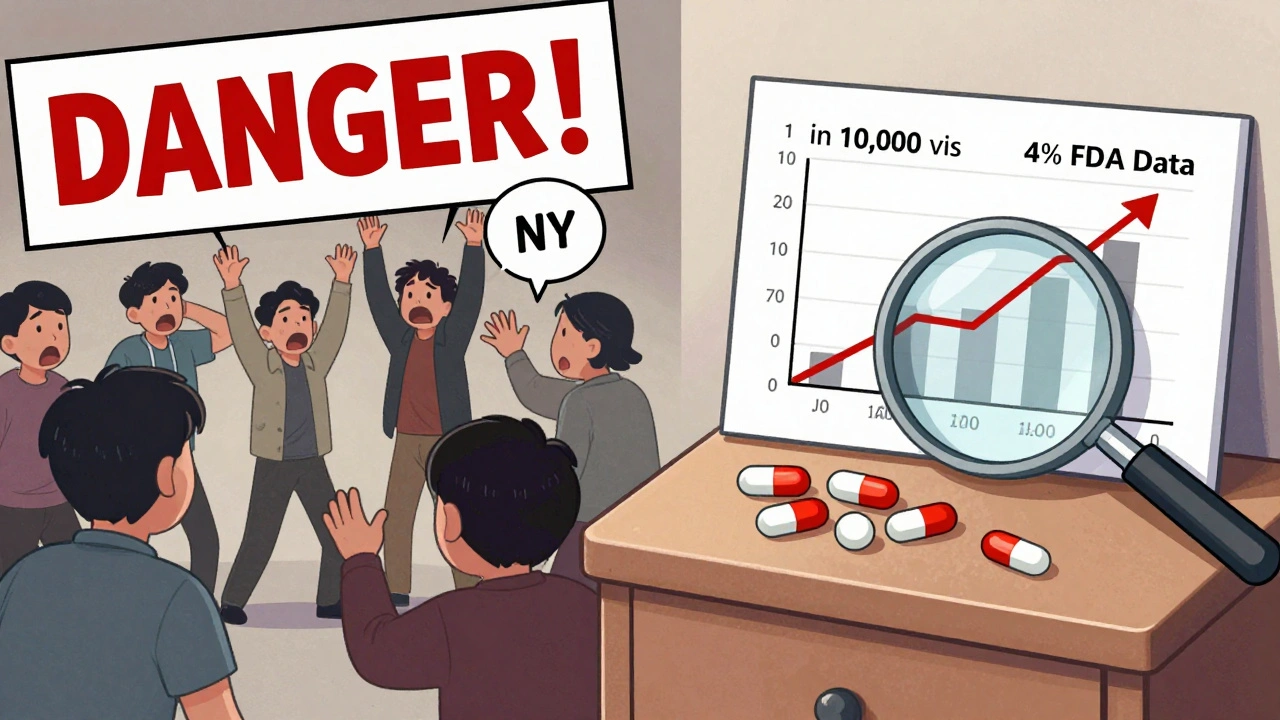
On the other hand, some alerts are vaguer. You might read: "The FDA is investigating a potential link between this drug and liver injury." That’s not a conclusion. It’s a starting point. The FDA receives over 1.2 million adverse event reports every year. Most are incomplete, unverified, or unrelated. A report saying "I took Drug X and felt sick" doesn’t prove Drug X caused it. Maybe the person was sick from something else. Maybe they were taking five other medications. The FDA’s job is to find patterns across millions of reports-not react to single stories.
The Difference Between Adverse Events and Adverse Reactions
Not every bad thing that happens after taking a drug is caused by the drug. The FDA makes a critical distinction:
- Adverse Event (AE): Any unwanted medical occurrence after taking a drug. It could be coincidence.
- Adverse Drug Reaction (ADR): A harmful reaction that is reasonably believed to be caused by the drug.
For example, if you take a blood pressure medication and then get a headache two days later, that’s an adverse event. But if multiple patients on the same drug develop the same rare type of liver damage-much more often than people not taking the drug-that’s an adverse drug reaction. The FDA uses statistical tools and real-world data from over 25 million reports in its FAERS database to spot these patterns.
That’s why you’ll often see phrases like "potential signal" or "possible association." These are red flags for regulators, not alarms for patients. The FDA doesn’t say "this drug causes X" until they’ve ruled out other explanations and seen consistent evidence across multiple studies.
How to Read an FDA Alert Like a Clinician
Here’s how to quickly assess any FDA safety announcement:
- Is it a "potential signal" or a "confirmed risk"? Look for the language. If it says "FDA is evaluating" or "we’re seeing reports," it’s a signal. If it says "this drug increases risk of" or "labeling must be updated," it’s confirmed.
- Is the risk serious? The FDA defines "serious" as fatal, life-threatening, disabling, or requiring hospitalization. A rash? Probably not serious. Liver failure? Yes.
- What’s the benefit? Are you treating a life-threatening condition like cancer, epilepsy, or severe depression? Then even a higher risk might be acceptable. A drug for mild acne? The bar for safety is much higher.
- Are there alternatives? If this drug is your only option, the risk-benefit balance shifts. If there are five other drugs that work just as well with fewer side effects, then the decision changes.
- Is there a number? The best alerts give you numbers. "Risk increased from 1 in 10,000 to 2 in 10,000." That’s useful. "Risk may be increased"-that’s not.
Many doctors skip these steps. A 2022 AMA survey found 68% of physicians felt FDA alerts lacked enough context. That’s why patients end up terrified-thinking a "potential signal" means the drug is dangerous. In reality, 65% of FDA alerts lead only to labeling updates, not changes in prescribing.
What to Do When You See an Alert
Don’t stop your medication. Don’t call your doctor in a panic. Do this instead:
- Read the full alert on the FDA website. Don’t rely on headlines or social media posts. The full text explains what’s known and what’s not.
- Check the date. Is this new? Or did the FDA update an old alert? Sometimes the same issue is revisited years later with better data.
- Look for the "Takeaway" section. The FDA now includes this in most alerts. It says exactly what patients and providers should do-often: "Continue taking as prescribed and discuss with your provider."
- Ask your doctor: "Is this risk relevant to me?" Your age, other conditions, and medications matter. A risk that applies to elderly patients with kidney disease may not apply to a healthy 30-year-old.
One physician on Reddit shared how patients called her in a panic after an alert about SSRIs and pregnancy. The alert didn’t mention that the absolute risk increase was 0.5%-from 2% to 2.5%. Untreated depression during pregnancy carries risks five times higher. That context was missing from the headline. The doctor spent hours reassuring patients and explaining numbers they’d never seen before.
Why the FDA Gets It Right-Most of the Time
The system isn’t perfect. Critics say the FDA is too slow to act. Others say it’s too quick to scare people. But the data shows it works.
Since 2007, the FDA has required quarterly public reports of potential safety signals. That’s transparency most countries don’t offer. The European Medicines Agency does something similar, but the FDA is unique in making its raw data publicly searchable. That’s how independent researchers spot issues the agency might miss.
And when the FDA does act, it’s usually because the benefit-risk balance has truly shifted. Take the case of rosiglitazone, a diabetes drug pulled from the market in 2010 after data showed increased heart attack risk. The benefit-lowering blood sugar-wasn’t strong enough to justify the risk. That’s a good call.
On the flip side, the FDA didn’t pull COVID-19 vaccines after reports of myocarditis in young men. Why? Because the risk of heart damage from the virus itself was far higher. The benefit outweighed the risk, even for a rare side effect. That’s risk-benefit analysis in action.
What’s Changing in 2025
The FDA is getting better at communicating. By late 2025, new guidance will require all safety alerts to include standardized risk numbers. No more vague statements. If a drug increases risk, it will say by how much-compared to baseline, compared to alternatives.
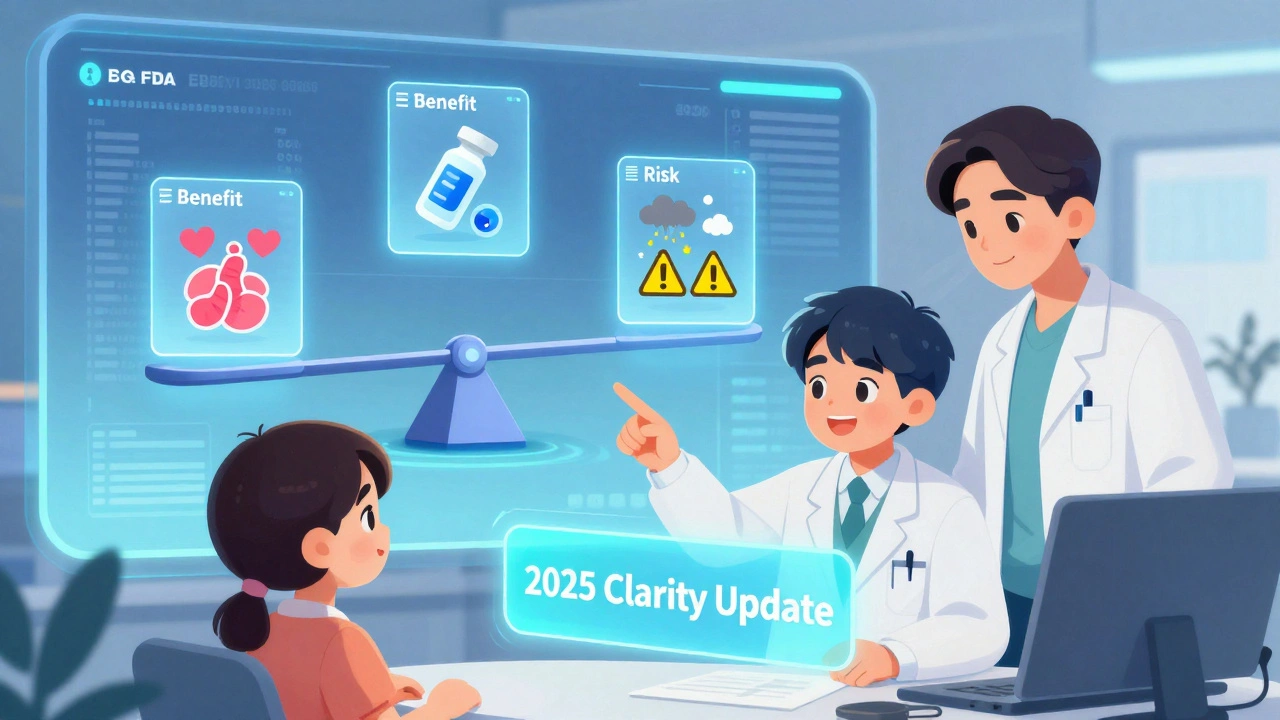
They’re also building a patient-facing tool to visualize risk and benefit visually-like a simple scale showing how much a drug helps versus how much harm it might cause. This is huge. Most patients don’t understand percentages. But they understand: "This drug reduces your chance of stroke by 40%, but gives you a 1 in 1,000 chance of a serious bleeding event."
These changes are driven by patient feedback. In 2022, 75% of patients said they felt confused by safety alerts. Now, the FDA is listening.
Final Rule of Thumb
Here’s the simplest way to think about it:
If you’re taking a drug for a serious condition, and you’re doing well on it-don’t stop because of an alert.
Medications are never risk-free. The goal isn’t zero risk. It’s the best possible balance. The FDA doesn’t approve drugs that are dangerous. It approves drugs where the good outweighs the bad-and then watches closely when millions of people start using them.
Stay informed. Ask questions. But don’t let a headline make you quit something that keeps you alive.
Should I stop taking my medication if the FDA issues a safety alert?
No, not unless the alert specifically says to. Most FDA safety alerts are "potential signals"-meaning they’re investigating a possible link, not confirming danger. Stopping your medication without medical advice can be more harmful than the risk being investigated. Always talk to your doctor before making changes.
What’s the difference between a potential signal and a confirmed risk?
A potential signal means the FDA has noticed a pattern in reports that might suggest a new side effect, but it hasn’t proven causation yet. A confirmed risk means the FDA has reviewed enough evidence-including clinical studies and real-world data-to conclude the drug likely causes the problem. Only about 40% of potential signals become confirmed risks.
Why do some FDA alerts cause panic if they’re not definitive?
Because headlines simplify complex information. Media often reports "FDA warns of X risk" without clarifying "potential" or "rare." The FDA itself says these alerts don’t mean you should stop the drug. But patients hear "warning" and assume the worst. The FDA is working to fix this by requiring clearer language and quantitative risk estimates starting in 2025.
How does the FDA decide if a drug’s benefits outweigh its risks?
The FDA uses six key factors: how severe the condition is, whether there are other treatment options, how strong the drug’s benefit is, how frequent and serious the side effects are, whether the risks can be managed, and what patients say about their experience. For life-threatening diseases like cancer, higher risks are acceptable. For mild conditions like occasional headaches, even small risks matter more.
Can I report a side effect to the FDA myself?
Yes. The FDA’s MedWatch program lets patients and caregivers report side effects directly. You can do it online, by phone, or by mail. Even incomplete reports help. If many people report the same issue, it can trigger a formal investigation. Your report could help identify a risk before it affects others.
Do other countries handle drug safety the same way as the FDA?
Most use similar systems, but the FDA is unique in publicly posting quarterly potential safety signals from its database. The European Medicines Agency publishes detailed benefit-risk reports, but less frequently. Japan and Canada rely more on real-world data from healthcare systems. The FDA’s approach is more transparent but also more prone to public misunderstanding because of how signals are presented.

Ian Glover
My name is Maxwell Harrington and I am an expert in pharmaceuticals. I have dedicated my life to researching and understanding medications and their impact on various diseases. I am passionate about sharing my knowledge with others, which is why I enjoy writing about medications, diseases, and supplements to help educate and inform the public. My work has been published in various medical journals and blogs, and I'm always looking for new opportunities to share my expertise. In addition to writing, I also enjoy speaking at conferences and events to help further the understanding of pharmaceuticals in the medical field.
15 Comments
-
Kara Bysterbusch
December 3, 2025 AT 09:39Thank you for this meticulously articulated exposition on the FDA’s risk-benefit calculus. The distinction between 'adverse event' and 'adverse drug reaction' is not merely semantic-it is epistemological. One must recognize that pharmacovigilance operates within a probabilistic paradigm, not a deterministic one. The public’s conflation of statistical signal with clinical certitude is a failure of science communication, not regulatory incompetence. The 2025 standardization of risk quantification is, frankly, long overdue and profoundly necessary.
-
Rashmin Patel
December 4, 2025 AT 21:28Y’all are overcomplicating this. Look. If you’re on a drug for a life-or-death condition-diabetes, epilepsy, depression, cancer-and you’re not having a bad reaction, DON’T STOP. The FDA doesn’t send alerts because they think you’re dumb. They send them because they want you to be INFORMED, not panicked. I’m a nurse. I’ve seen people quit their anticoagulants because of a headline. One guy had a stroke. Another lost a leg. Your meds aren’t the enemy. The fear-mongering headlines are. And yes, I used emojis because I’m tired of people treating medical advice like a philosophy seminar. 🚨💊🧠
-
Kidar Saleh
December 5, 2025 AT 09:18There’s something profoundly unsettling about how easily medical nuance collapses under the weight of media sensationalism. I’ve watched patients in the UK panic over the same alerts-only to later discover the risk was lower than that of being struck by a vending machine. The FDA’s transparency is admirable, but the delivery system is broken. We need plain-language summaries at the top of every alert-not buried in a 12-page PDF.
-
Chloe Madison
December 6, 2025 AT 00:50THIS. This right here is the kind of post that makes me believe in humanity again. I’ve been on a mood stabilizer for 11 years. When the FDA dropped the 'possible link to weight gain' alert, I thought my life was over. Turns out? It was a 3% increase-and I gained 2 lbs. My doctor said, 'Chloe, you’re not gaining weight from the drug. You’re gaining weight from the fact that you finally feel like eating again.' I cried. Then I ate a burrito. Thank you for explaining this so clearly.
-
Makenzie Keely
December 7, 2025 AT 04:21It is imperative to underscore the distinction between 'potential signal' and 'confirmed risk.' The former denotes a statistical anomaly; the latter, a causally validated phenomenon. The FDA’s FAERS database, while imperfect, is the most comprehensive pharmacovigilance system in the world. Yet, the public’s inability to parse probabilistic language-e.g., 'increased risk' without baseline context-renders these alerts counterproductive. The 2025 standardization initiative is a watershed moment in patient-centered pharmacotherapy.
-
Joykrishna Banerjee
December 7, 2025 AT 19:03Oh, so now we’re supposed to trust the FDA because they ‘got it right’ with rosiglitazone? Please. They approved Vioxx for years before pulling it. They delayed metformin’s label update for lactic acidosis for a decade. And now they’re ‘listening’ to patients? They’ve been collecting data since 1968 and still can’t tell if a headache is a side effect or just Tuesday. This post is corporate PR dressed as education. 🤡
-
Myson Jones
December 7, 2025 AT 19:30I just want to say-thank you. I’ve been on a blood thinner for atrial fibrillation, and when I saw the alert about bleeding risk, I panicked. I didn’t know how to read it. I Googled it. Got three conflicting answers. Then I found this. I printed it out. Showed it to my doctor. She nodded and said, ‘You’re doing exactly what you should.’ That’s the power of clear communication. I’m still here. And I’m taking my meds.
-
parth pandya
December 9, 2025 AT 07:48hey i just wanted to say i read this whole thing and it helped a lot. i was scared to take my blood pressure med after an alert but now i get it. the risk is like 1 in 10000 and i have a 50% chance of a stroke without it. i’ll keep takin it. thanks for writin this. p.s. sorry for typos im on my phone
-
Albert Essel
December 10, 2025 AT 19:12The most dangerous thing about these alerts isn’t the drugs-it’s the silence from doctors who don’t take five minutes to explain them. I’ve seen patients stop life-saving medications because their provider said, ‘It’s fine,’ without elaboration. Transparency isn’t just the FDA’s job. It’s ours too.
-
Charles Moore
December 12, 2025 AT 06:47I’m from Ireland. We don’t get FDA alerts here-but we get the same headlines. My cousin in Boston sent me this. She said, ‘Charles, this is what we need in Dublin.’ We’re all just trying to survive a system that treats us like data points. This post didn’t just inform me-it reminded me that I’m not alone in this fear. Thank you.
-
Gavin Boyne
December 13, 2025 AT 11:29So let me get this straight: the FDA spends $2 billion a year to warn us about risks that are statistically negligible, while ignoring the fact that 40% of Americans can’t afford their meds? The real safety alert is that we live in a country where a 0.02% chance of gangrene gets more press than a 40% chance of bankruptcy. Bravo, FDA. You’ve turned pharmacology into a horror movie. 🎬
-
sagar bhute
December 13, 2025 AT 19:42Let’s be real-this is just corporate propaganda. The FDA is a puppet of Big Pharma. They don’t care if you live or die. They care about lawsuits. That ‘0.2 cases per 1,000’? That’s a number they cooked up to make you feel safe. Meanwhile, your liver is rotting and your kidneys are failing. You think they’ll tell you that? No. They’ll just update the label and charge you $500 for the new prescription. Wake up.
-
Cindy Lopez
December 14, 2025 AT 12:42Wow. This is… a lot. I read the first paragraph and got bored. I’m just gonna stop my meds.
-
James Kerr
December 15, 2025 AT 22:04My grandma’s on three meds. She doesn’t read FDA alerts. She reads me. I tell her: ‘If it’s helping you walk, don’t quit.’ She says, ‘Good. Now pass the cookies.’ 🍪❤️


Write a comment
More Articles
Capecitabine and cancer-related anemia: Strategies for management
In my recent research on cancer-related anemia, I came across some interesting strategies for managing this condition, particularly with the use of Capecitabine. As a chemotherapy drug, Capecitabine has shown promising results in reducing anemia symptoms in cancer patients. One approach includes adjusting the dosage and scheduling of Capecitabine to optimize its effectiveness in treating anemia. Additionally, combining Capecitabine with other treatments, such as iron supplementation, can provide further benefits. It is crucial for cancer patients and their healthcare team to collaborate in finding the most suitable management plan for their specific needs.

Return to Work With Chronic Pain: Essential Accommodations and Plans
Learn how to navigate returning to work with chronic pain. This guide covers legal rights, common accommodations, and practical plans to ensure successful reintegration.

How Environmental Factors Contribute to Bacterial Eye Infections
Bacterial eye infections can be influenced by various environmental factors. This article explores how elements such as pollution, contact with contaminated water, and seasonal changes can contribute to the spread and severity of these infections. It also offers practical tips for prevention and maintaining good eye health.
Rashi Taliyan
December 2, 2025 AT 22:23Okay but can we talk about how terrifying it is to see your medication on an FDA alert? I was on that diabetes drug for two years and when I saw the headline, I nearly threw my pill organizer out the window. Turns out the risk was 0.2 per 1,000? I cried. Then I called my endo. She laughed and said, 'Rashi, you’re more likely to get hit by lightning than get Fournier’s gangrene.' I’m still on it. And alive. 🙏