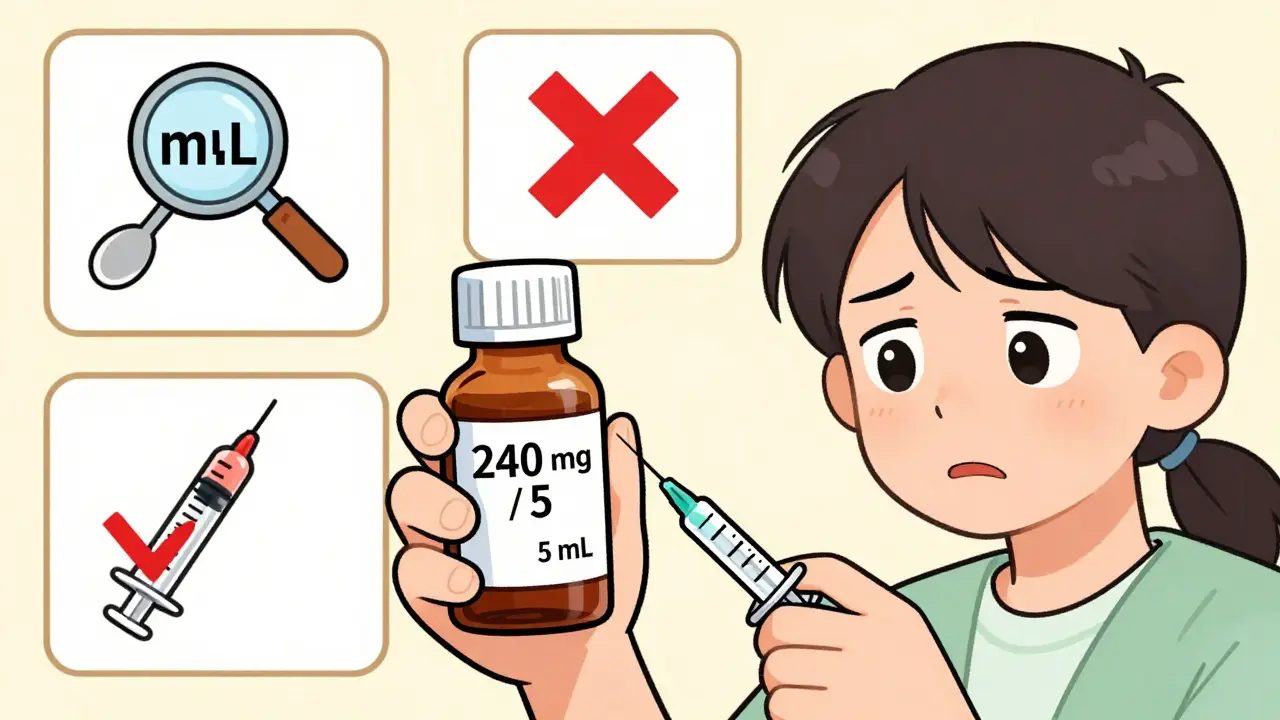
Getting the right dose of liquid medicine isn’t just about following the label-it’s about understanding exactly what it says. A wrong measurement can mean the difference between healing and harm. In the U.S., an estimated 1.3 million injuries each year come from medication errors, and nearly half of those involve liquid prescriptions for kids. The good news? The system has changed. Most pharmacies now use a single, clear standard: milliliters (mL). But if you’ve ever stared at a label wondering if 5 mL is the same as a spoonful, you’re not alone. Here’s how to read it right.
What’s on the label? Three key pieces
Every liquid prescription label has three critical parts you need to check every time:
- Total container volume - This tells you how much liquid is in the bottle. It’s usually printed near the bottom and looks like "120 mL" or "240 mL." This is NOT the dose. It’s just how much medicine the bottle holds.
- Concentration - This is the most important number. It tells you how much medicine is in each milliliter. It’s written like: "160 mg / 5 mL" or "125 mg per 5 mL." That means every 5 mL of liquid contains 160 mg (or 125 mg) of the active drug.
- Dosage instructions - This says how much to give and how often. It might say: "Take 10 mL every 6 hours." Or, "Give 2.5 mL once daily." Always match this number to the concentration to find the right amount.
Here’s a real example: Your child’s prescription says:
- Concentration: 240 mg / 5 mL
- Dosage: Give 120 mg every 8 hours
That means you don’t give 120 mg straight. You give the amount of liquid that contains 120 mg. Since 5 mL contains 240 mg, half of that (2.5 mL) contains 120 mg. So you give 2.5 mL-not 120 mL. Mixing up the number on the label with the dose is one of the most common mistakes.
Why milliliters (mL) and not teaspoons?
Older labels used to say "1 tsp" or "1 tbsp." That’s gone. Why? Because a teaspoon isn’t a teaspoon. A household spoon can hold anywhere from 2.5 mL to 7.5 mL. A tablespoon? It can be 5 mL or 20 mL. That’s a 300% difference. A 2016 study in the Journal of Pediatrics found parents using spoons were twice as likely to give the wrong dose compared to those using mL-measured devices.
The National Council for Prescription Drug Programs (NCPDP) and the FDA now require all liquid prescriptions to use only milliliters. This isn’t optional. By 2020, 92% of major pharmacy chains like CVS and Walgreens had switched. Even independent pharmacies are catching up-though not all are there yet.
And here’s a small but life-saving detail: numbers on the label must be written a certain way. If the dose is less than 1 mL, it must start with a zero. So it says 0.5 mL, not .5 mL. If it’s 5 mL, it must not say 5.0 mL. That trailing zero used to cause confusion-someone might read 5.0 as 50. Johns Hopkins found this simple rule cut 10-fold dosing errors by 47%.
What about the measuring device?
The bottle might come with a plastic cup or syringe. That’s your tool. Never use a kitchen spoon-not even if it says "teaspoon" on it. The measuring device should match the label’s units. If the label says mL, the cup or syringe should have mL markings.
Check the markings. Some devices go up to 0.1 mL. Others only show every 1 mL. If your dose is 3.7 mL and your syringe only has marks at 3 mL and 4 mL, you’re stuck. That’s why some pharmacies now include syringes with finer lines. Always ask for one if you’re unsure.
And here’s something most people don’t realize: the measuring device might not be accurate. A 2016 study found that over-the-counter dosing cups had a 98.6% mismatch between what they showed and what they actually held. That’s why you should use the one that came with the prescription-not a leftover from last time.
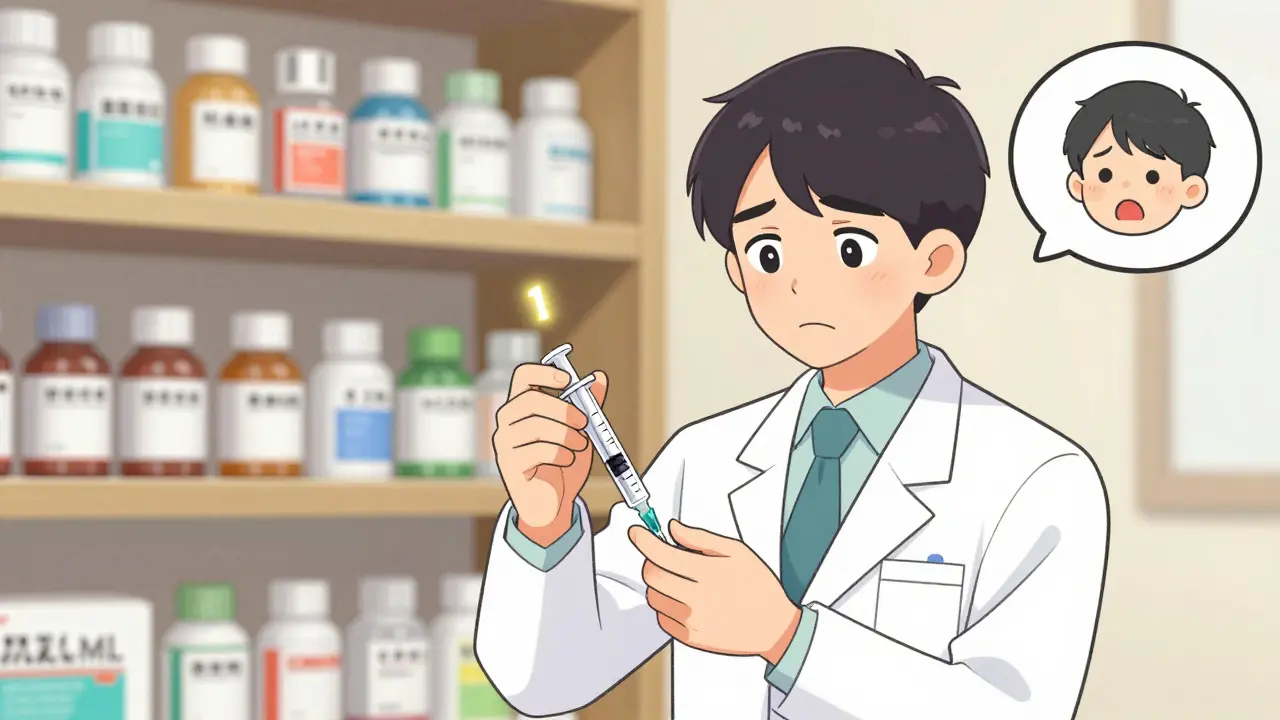
What if the label is confusing?
You’re not supposed to guess. If you see something like:
- "240 mg / 5 mL" and the dose says "Take 1 mL"
- "500 mL" on the bottle and you think that’s the dose
- ".8 mL" and you’re not sure if that’s 8 mL
Stop. Call the pharmacy. Ask: "Can you walk me through this?" Pharmacists are trained to explain this. They should have given you a demonstration when you picked it up. If they didn’t, ask now. Don’t wait until you’re at home with a crying child.
A 2021 study from Memorial Sloan Kettering found that patients who repeated back the instructions-known as the "teach-back" method-made 63% fewer mistakes. Try saying it out loud: "So, the medicine is 160 mg in every 5 mL, and I need to give 80 mg. That means I give half of 5 mL, which is 2.5 mL. Got it." If you can say it clearly, you probably got it right.
What about children and infants?
Most liquid medicines are for kids. About 75% of all liquid prescriptions are for children under 12. And the doses? Tiny. Sometimes as small as 0.8 mL for a baby. That’s less than two drops. This is why precision matters so much.
Infant doses are often written in decimals: 0.4 mL, 0.7 mL. No rounding. If the label says 0.7 mL, you give exactly 0.7 mL. Use a syringe. Never pour from a cup. Syringes are the most accurate tool for these small amounts. Most pharmacies will give you one for free if you ask.
And don’t assume a "children’s" label is safe. Some children’s acetaminophen is 160 mg/5 mL. Others are 100 mg/5 mL. If you switch brands, the dose changes. Always check the concentration.
What’s changing in 2026?
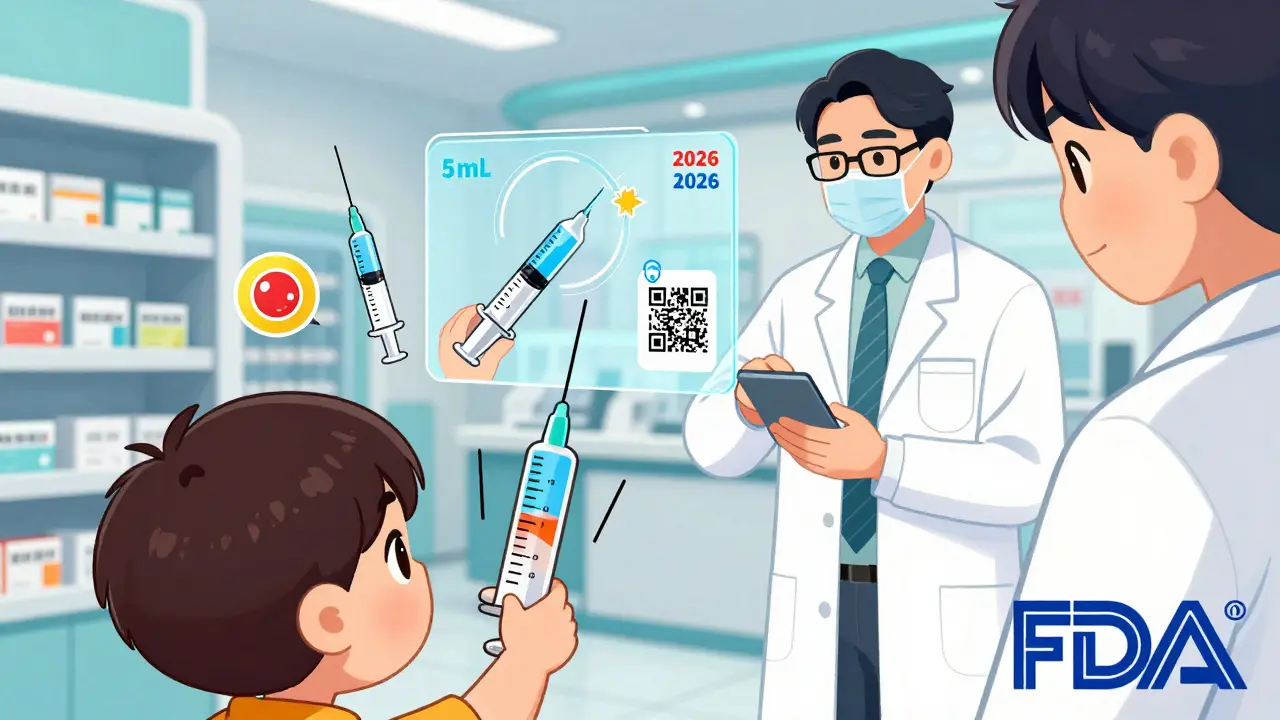
Things are getting even clearer. In 2023, the FDA proposed new rules requiring pictograms on all liquid medicine labels-simple pictures showing how to fill a syringe or cup. A 2022 study showed visual aids cut errors by 37%. By 2026, you’ll likely see a little drawing next to the dose: a syringe with a line at 5 mL, or a cup with an arrow pointing to the right level.
Some pharmacies are already testing QR codes. Scan it, and a short video plays showing exactly how to measure the dose. Amazon Pharmacy and McKesson’s Medly system are leading this. It’s not everywhere yet-but it’s coming.
Also, by 2025, Medicare will start penalizing pharmacies that don’t follow the mL-only standard. That means even small, independent pharmacies will have to upgrade their systems. The goal? Zero errors. The path? Clear labels, proper tools, and patient education.
What to do next
When you get a liquid prescription:
- Look for the concentration: "___ mg / ___ mL"
- Find the dose: "Take ___ mL"
- Use the measuring device that came with it-never a spoon
- If you’re unsure, call the pharmacy and ask them to explain it out loud
- Ask for a syringe if the dose is under 5 mL
And if you’ve ever given the wrong dose? You’re not alone. But now you know how to avoid it. The system is designed to protect you. You just have to read it right.
Can I use a kitchen teaspoon if I don’t have a measuring cup?
No. A kitchen teaspoon can hold anywhere from 2.5 mL to 7.5 mL. That’s a huge difference. If your child’s dose is 5 mL, using a spoon might mean giving 7 mL-almost 40% too much. Always use the measuring device that came with the medicine. If you lost it, call the pharmacy. They’ll give you a new one for free.
Why does the label say "160 mg/5 mL"? Isn’t that confusing?
It looks confusing at first, but it’s actually the clearest way. The "160 mg" is the amount of active medicine. The "5 mL" is the volume of liquid it’s mixed in. So if you need 80 mg, you give half of 5 mL, which is 2.5 mL. This system lets pharmacies make one bottle that can be used for different doses-instead of having a separate bottle for every strength.
What if the dose is 0.8 mL? How do I measure that?
Use a 1 mL oral syringe. These are designed for exact small doses. Most pharmacies will give you one at no cost. Don’t try to estimate with a cup. Even a 0.1 mL error can matter in babies. A syringe lets you pull back to the exact line. If you’re not sure how to use it, ask the pharmacist to show you.
Is it okay to mix liquid medicine with juice or food?
Only if the pharmacist says so. Some medicines lose effectiveness when mixed. Others can change how they’re absorbed. Always ask before mixing. If you’re told it’s okay, still measure the full dose first, then mix it. Never pour medicine into a full cup of juice and assume the whole cup is the dose.
Why do some labels still have "tsp" on them?
They shouldn’t. Since 2016, the FDA has required all new prescriptions to use only mL. If you see "tsp," it’s likely an old label from a pharmacy that hasn’t updated its system. Report it. Ask for a new label with mL only. You have the right to a safe, standardized label.

Ian Glover
My name is Maxwell Harrington and I am an expert in pharmaceuticals. I have dedicated my life to researching and understanding medications and their impact on various diseases. I am passionate about sharing my knowledge with others, which is why I enjoy writing about medications, diseases, and supplements to help educate and inform the public. My work has been published in various medical journals and blogs, and I'm always looking for new opportunities to share my expertise. In addition to writing, I also enjoy speaking at conferences and events to help further the understanding of pharmaceuticals in the medical field.
13 Comments
-
Ferdinand Aton
March 6, 2026 AT 14:35Wait, hold up. You’re telling me we’re banning teaspoons because some people are bad at measuring? What about countries where mL doesn’t exist? We’re not all Americans with access to pharmacy syringes. This feels like overcorrection. My grandma gave medicine with a spoon and we all survived. Maybe the problem isn’t the spoon-it’s the lack of education.
-
Jeff Mirisola
March 8, 2026 AT 14:24I love how this post breaks it down so clearly. Seriously, this is the kind of info that should be on every prescription bottle in giant letters. I’m a nurse and I still get tripped up sometimes. The concentration part? That’s the golden key. I always tell my patients: "If it says 160 mg per 5 mL and you need 80 mg-you’re not giving 80 mL. You’re giving half the liquid." It’s not math. It’s logic. And if you’re still confused? Call the pharmacy. They’re paid to explain this. Don’t be shy.
Also-yes, use the syringe. Even if it’s 0.3 mL. That’s two drops. Two. Not "kinda close." Babies don’t have room for "kinda close."
-
Susan Purney Mark
March 10, 2026 AT 05:36Thank you for this. 🙏 I just got my grandson’s first prescription and I was so nervous. I printed this out and showed my daughter. She cried because she said, "I wish I’d known this when I gave him the last dose." We got the syringe. We wrote it down. We even did the teach-back thing. He’s fine. You’re not alone. And you’re doing great. 💕
-
Ian Kiplagat
March 10, 2026 AT 17:57Interesting. In the UK, we’ve used mL for decades. But we also use oral syringes religiously. No spoons. Ever. Even adults get them for liquid meds. The NHS has a whole guide. I’ve seen parents try to use a coffee spoon. It’s terrifying. Glad the US is catching up. Small details save lives.
-
Amina Aminkhuslen
March 11, 2026 AT 02:57OMG. I just realized I’ve been giving my son 10 mL of medicine when the label said 5 mL because I thought "5 mL" meant "five spoonfuls." I’ve been a monster. I’m so sorry, baby. 🤕 I’ve been using the same cup from last year’s cold. I didn’t even know the markings were wrong. I’m calling the pharmacy right now. I need a new syringe. And maybe therapy. But first-this post saved me. Thank you.
-
Joey Pearson
March 11, 2026 AT 06:21You got this. 💪 Seriously. Every parent who’s ever stared at a label and panicked? You’re not failing. The system is confusing. But now you know. And knowledge = power. Go get that syringe. Write it down. Say it out loud. You’re already doing better than 90% of people. Keep going.
-
Adebayo Muhammad
March 12, 2026 AT 03:44Let us not forget the epistemological foundations of dosage measurement: the Cartesian dualism between quantity and perception. The milliliter is not an absolute-it is a social construct, shaped by pharmaceutical hegemony. The teaspoon, as a pre-modern, vernacular unit, represents an embodied epistemology of care, rooted in tactile wisdom. To discard it is to alienate the caregiver from the ritual of healing. The FDA’s standardization is not progress-it is colonization of the domestic sphere. And yet… I still use the syringe. Because I fear the consequences more than I fear ideology.
-
Bridget Verwey
March 13, 2026 AT 03:36So let me get this straight: You’re telling me I’m supposed to trust a plastic syringe that might be off by 10%… but I can’t trust a kitchen spoon? 🤨 I’ve been using the same teaspoon for 17 years. It’s been through oatmeal, soup, and now antibiotics. It’s got character. Also, why is the 0.5 mL rule so important? Who decided that? Did they have kids? Or did they just write this in a conference room with a Starbucks latte?
-
Sean Callahan
March 13, 2026 AT 22:55just read this and i was like wait i gave my daughter 12 ml last time becuase i thought the 120 mg meant 12 ml?? i dont even know how i got here but im so scared right now. i think i need to go to the er. or maybe just cry. help.
-
William Minks
March 14, 2026 AT 08:01Big thanks for this. I’m a dad of twins and I’ve been using the same syringe since 2021. I didn’t realize they can go bad. Just replaced it. Also-QR code idea? YES. I’d scan it while holding a screaming baby. That’s the future. 👏
-
Aaron Pace
March 16, 2026 AT 04:34Wait wait wait-I just looked at my kid’s prescription. It says 0.7 mL. I thought that was 7 mL. I’ve been giving 10x the dose. Oh my god. I’m calling the pharmacy. NOW. 🚨
-
Roland Silber
March 18, 2026 AT 02:54This is excellent. One thing missing: What if the syringe doesn’t have 0.1 mL markings? I’ve got one that only shows 0, 1, 2, 3 mL. My dose is 2.7 mL. Do I guess? Or is there a trick? I’ve been using the line between 2 and 3. But is that accurate? Also-can I use a syringe from a different medicine? I have one from last month’s ear infection. Is it safe?
And yes, I called the pharmacy. They said "just use the syringe that came with it." But I lost it. So… now what?


Write a comment
More Articles

Top Alternatives to FelixForYou.ca for Telemedicine in 2025
Discover the leading alternatives to FelixForYou.ca, a Canadian telemedicine platform, focusing on digital healthcare options available in 2025. Highlighting Maple Health, Tia Health, Livewell, Telus Health, and Jill Health, this article provides insights into each service's offerings, pros, and cons. Whether looking for 24/7 access to healthcare professionals, adaptable programs, or specialized medical services, these alternatives cater to varied health needs. Consider factors such as accessibility, cost, and service range to choose the right telemedicine solution.
Prepaid Drug Mail-Back Envelopes for Medication Disposal: How They Work and Where to Get Them
Prepaid drug mail-back envelopes let you safely dispose of expired or unused medications by mail-no trips to a pharmacy needed. Learn how they work, what you can send, and where to get them for free.
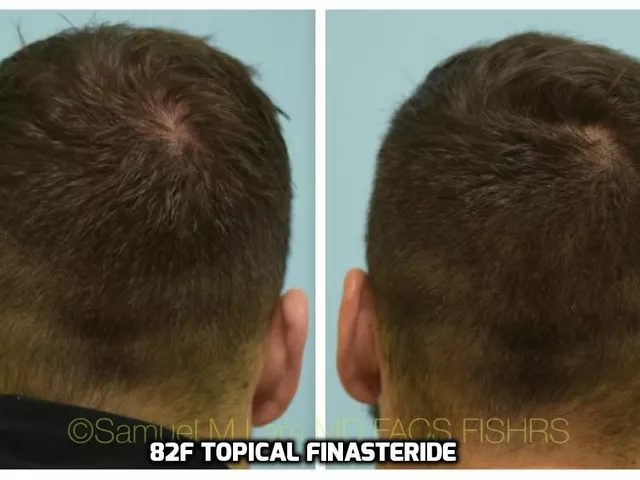
Minoxidilfinasteride and Hair Loss in Travel: Tips for Staying Confident on the Go
Traveling can be stressful, especially when dealing with hair loss. Thankfully, Minoxidilfinasteride has been a game changer in managing this issue. To stay confident on the go, I make sure to stick to my treatment routine and pack my Minoxidilfinasteride in my travel kit. I also carry a hat or a stylish scarf to cover up any thinning spots. Most importantly, I remind myself that confidence comes from within, and I don't let hair loss hold me back from enjoying my travels.
phyllis bourassa
March 6, 2026 AT 12:58Oh honey, I’ve been there. Stared at that label like it was ancient hieroglyphics. My kid had a 0.8 mL dose and I used a spoon because I was tired. Ended up in the ER at 2 a.m. with a panicked toddler. Don’t be like me. Just get the damn syringe. They give them for free. Seriously. Ask. Again. And again. Your child’s life isn’t a guessing game.