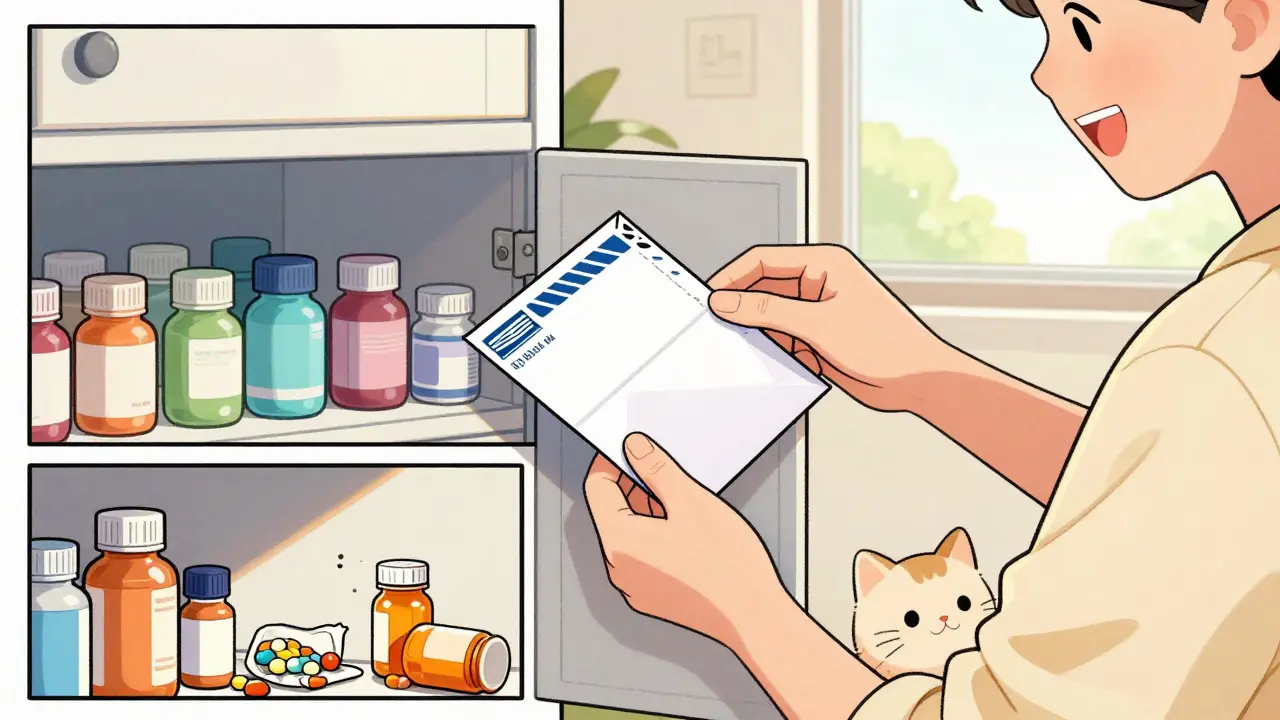
Every year, millions of unused or expired pills sit in bathroom cabinets, kitchen drawers, and medicine chests across the UK and beyond. People keep them ‘just in case,’ forget about them, or don’t know what to do with them. But leaving old medications lying around isn’t just messy-it’s dangerous. Kids, pets, or even visitors can accidentally take them. Worse, flushing them down the toilet or tossing them in the trash can poison water supplies and harm wildlife. The good news? There’s a simple, safe, and legal way to get rid of them: prepaid drug mail-back envelopes.
What Are Prepaid Drug Mail-Back Envelopes?
These are specially designed envelopes you can order online or pick up at a pharmacy. They come with prepaid postage, so you don’t pay anything to send them back. You fill them with unused or expired prescription drugs, over-the-counter medicines, pet medications, or even medicine samples. Then you seal them and drop them in any USPS mailbox. No trips to a drop-off site. No waiting for a special collection day. Just fill, seal, mail. The system was created to solve two big problems: preventing drug abuse and protecting the environment. The U.S. Drug Enforcement Administration (DEA) started the National Prescription Drug Take Back Program in 2010 after realizing how many people were hoarding opioids and other controlled substances. Since then, over 1 million pounds of unused meds have been collected in single events alone. Mail-back envelopes became a legal, convenient extension of that effort under the Secure and Responsible Drug Disposal Act of 2010. Today, the FDA calls mail-back envelopes “one of the best ways to safely dispose of unused or expired prescription and nonprescription medicines.” Unlike flushing or trashing, these envelopes ensure your meds are destroyed in high-temperature incinerators at DEA-approved facilities. No landfill. No water contamination. No chance they’ll be dug up or stolen.What Can You Put in These Envelopes?
Not everything goes in. But most common medications do:- Prescription pills and liquids
- Over-the-counter drugs like ibuprofen, allergy meds, or cough syrup
- Pet medications (yes, even your dog’s heartworm pill)
- Medicine samples from doctors’ offices
- Lotions and creams (up to 4 ounces total)
- Needles, syringes, or sharps (these need special biohazard disposal)
- Aerosol cans or inhalers (they’re pressurized and can explode)
- Illicit drugs like cocaine or heroin
- Chemotherapy drugs or radioactive meds (these require hospital-level handling)
- Any non-medical items-cosmetics, vitamins (unless prescribed), supplements, or household chemicals
How Do You Use One?
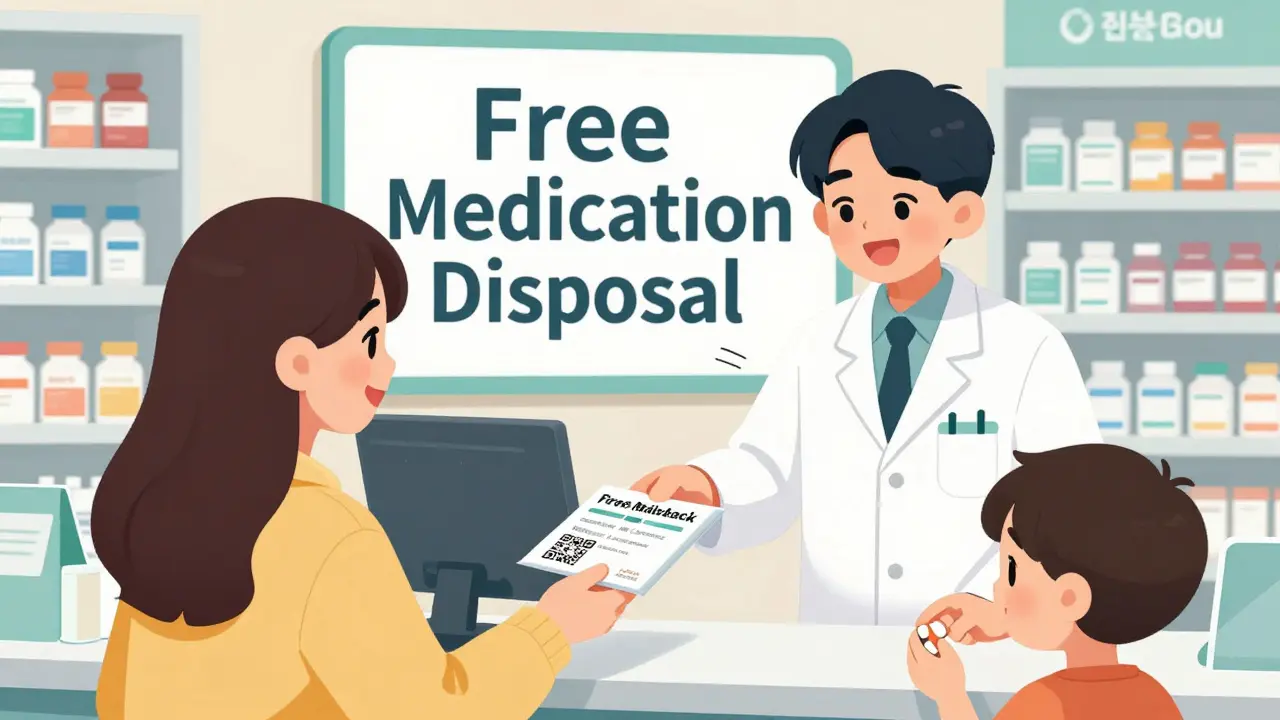
It’s easier than mailing a birthday card.- Get the envelope. Order online from providers like Mail Back Meds, Stericycle, or American Rx Group. Or pick one up for free at participating pharmacies, hospitals, or community health centers. Some pharmacies hand them out during prescription pickups.
- Fill it. Take out your old pills, liquids, or creams. You don’t need to remove them from the original bottle-but you MUST black out your name, address, and prescription number with a permanent marker. This protects your privacy.
- Seal it. Most envelopes have a tamper-evident seal. Once you close it, you can’t reopen it without tearing the flap. Some include a special orange tape to help you seal it properly.
- Mail it. Drop it in any U.S. Postal Service mailbox. Do NOT take it to your pharmacy, police station, or hospital. They can’t accept filled envelopes. Only the postal system can deliver them to the incineration facility.
Why This Beats Flushing or Throwing Them Away
Flushing meds used to be common advice. It’s not anymore. The EPA says pharmaceuticals in water systems harm fish, frogs, and even drinking water sources. Trashing them is just as bad. Trash collectors, scavengers, and even animals can get into your bin and find pills. That’s how opioid misuse starts-someone finds a bottle of oxycodone in the garbage. Mail-back envelopes eliminate both risks. They’re sealed, tracked, and incinerated under strict federal rules. The heat destroys every molecule of the drug. Nothing is recycled, reused, or dumped. The process is so secure that even the DEA monitors it. Plus, it’s free. No hidden fees. No monthly subscriptions. No need to join a program. You pay nothing when you mail it back.Who Offers These Envelopes?
Several companies run mail-back services, but they all follow the same rules:- Mail Back Meds sells packs of 3, 50, or 250 envelopes. Great for families, caregivers, or clinics. They offer online tracking and emphasize eco-friendly disposal aligned with EPA standards.
- Stericycle’s Seal&Send focuses on organizations-hospitals, nursing homes, pharmacies. They provide detailed reports on how many envelopes were collected and destroyed, useful for compliance and sustainability goals.
- American Rx Group partners with waste-to-energy plants. They turn your old pills into electricity. Their envelopes are legal in all 50 states and come with no contracts or extra charges.
- Opioid Analgesic REMS Program (launching March 31, 2025) will give free envelopes specifically for opioid painkillers. Pharmacies that prescribe these drugs will be required to offer them. This is a major step in fighting the opioid crisis.
What’s Changing in 2025?
Starting March 31, 2025, every pharmacy that prescribes opioid painkillers will be required to offer free mail-back envelopes. This isn’t optional. It’s a federal mandate under the Opioid Analgesic Risk Evaluation and Mitigation Strategy (REMS). The goal? Cut down on opioid misuse at the source-by making disposal as easy as picking up a prescription. This change will make mail-back envelopes far more accessible. Right now, you have to know where to find them. After March 2025, they’ll be right there on the counter when you get your pain meds. No extra trip. No extra cost. Other innovations are coming too. Some companies are now offering separate envelopes for inhalers and injectables. These require special handling because they’re pressurized or sharp. But the standard pill envelope will still be the most common tool for everyday use.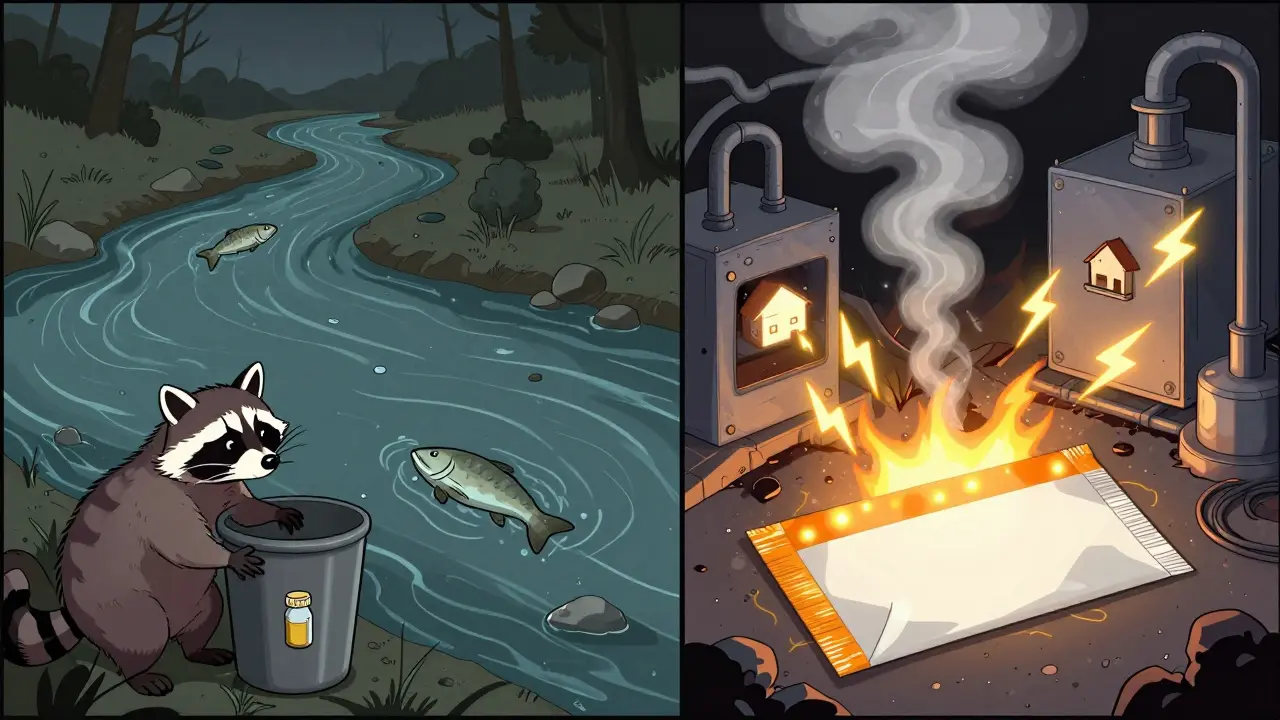
Common Mistakes People Make
Even though the process is simple, people mess up in predictable ways:- Leaving personal info on the bottle. Always black out your name, DOB, and Rx number. Even if you’re not worried about identity theft, it’s the law.
- Putting in sharps or inhalers. These can rupture during transport and injure workers. Use separate programs for them.
- Taking the filled envelope to the pharmacy. They can’t accept it. Only the mail system can deliver it to the incinerator.
- Waiting too long. If you’ve got a year’s supply of expired meds, don’t wait until the bottle’s full. Use the envelope as soon as you have a few pills you won’t use.
- Assuming all pharmacies offer them. Not every pharmacy participates. Call ahead or check the DEA’s website for a list of participating locations.
Is This Available in the UK?
Right now, prepaid mail-back envelopes are a U.S.-only system. The UK doesn’t have a national program like this. But the UK does have drug take-back bins in most pharmacies. You can drop off expired or unwanted meds at any participating pharmacy-no envelope needed. The NHS and local councils run these programs. If you’re in the UK, your best bet is to check with your local pharmacy. Ask: “Do you have a medicine return bin?” Most do. If not, contact your local council’s waste department. They’ll point you to the nearest drop-off point. The concept of mail-back envelopes is gaining global attention. The EU is testing similar programs. The UK may adopt something like it in the future. But for now, in-person drop-offs are the standard.Final Thoughts: Why This Matters
Medication disposal isn’t glamorous. But it’s vital. Every pill you throw in the trash or flush down the toilet is a risk-to your family, your community, and the planet. Mail-back envelopes fix that. They turn a messy, dangerous habit into a quiet, responsible act. You don’t need to be a doctor, a pharmacist, or a policy expert to use one. You just need to care enough to do the right thing. And that’s all it takes.Can I use a prepaid drug mail-back envelope if I live outside the U.S.?
No. These envelopes are designed for U.S. Postal Service delivery and DEA-regulated incineration facilities. If you live in the UK or elsewhere, check with your local pharmacy or council for medicine take-back programs. Most countries have drop-off bins at pharmacies instead.
Do I need to remove pills from their original bottles?
No. You can leave them in the bottle. But you must black out your name, address, prescription number, and any other personal info with a permanent marker. This protects your privacy. If you prefer, you can pour pills into a ziplock bag and toss the bottle-but only if you’ve erased all identifying details.
What if I accidentally put a needle or inhaler in the envelope?
Don’t panic. The envelope won’t explode or leak if you put in an inhaler or needle-but it could cause injury to workers handling it. If you realize the mistake before mailing, remove the item. If it’s already sealed and mailed, the facility will detect it and handle it safely. Still, always check the list of prohibited items before sealing the envelope.
Are these envelopes really free?
Yes. The postage is prepaid, and most providers don’t charge for the envelope itself. You can order them online at no cost, or pick them up for free at pharmacies. The only cost is your time. Some bulk orders for clinics or organizations may have fees, but for individual use, it’s completely free.
Can I mail back vitamins or supplements?
Only if they were prescribed to you by a doctor. Over-the-counter vitamins and supplements are not allowed unless they’re part of a controlled medication regimen. If you’re unsure, leave them out. The program is meant for prescription and over-the-counter medicines that pose a risk if misused-not daily supplements.
How do I know the envelope reached the right place?
Some providers, like Mail Back Meds, offer online tracking. You can enter your envelope’s ID number and see when it was received and destroyed. Others don’t track individual envelopes-but all are sent to DEA-registered incinerators. You can trust the system: the law requires it. If you want proof, choose a provider that offers tracking.
What happens to the envelope after it’s incinerated?
The envelope and its contents are burned at over 1,800°F. Everything turns to ash. The ash is tested to ensure no harmful residues remain, then safely disposed of. Some facilities use the heat to generate electricity, turning your old meds into power for homes and hospitals.

Ian Glover
My name is Maxwell Harrington and I am an expert in pharmaceuticals. I have dedicated my life to researching and understanding medications and their impact on various diseases. I am passionate about sharing my knowledge with others, which is why I enjoy writing about medications, diseases, and supplements to help educate and inform the public. My work has been published in various medical journals and blogs, and I'm always looking for new opportunities to share my expertise. In addition to writing, I also enjoy speaking at conferences and events to help further the understanding of pharmaceuticals in the medical field.
11 Comments
-
Margaret Khaemba
January 23, 2026 AT 00:17I love this so much. My mom’s a nurse and she’s always saying how many kids find pills in the trash. I’ve started keeping an envelope in my bathroom now. One for my anxiety med, one for my dad’s blood pressure stuff. It’s like a tiny act of care. <3
-
Malik Ronquillo
January 23, 2026 AT 13:32This is the dumbest thing I’ve read all week. You’re telling me I can’t just flush my expired ibuprofen? Like, it’s a pill. Not plutonium. People used to do this for decades without the world ending. Now we need a federal program to babysit our medicine cabinets?
-
Brenda King
January 25, 2026 AT 10:51I just got one of these from my pharmacy after my last refill. They handed it to me like it was a free sample. I didn’t even ask. I’m so glad they’re making this easy. My nephew’s 5 and he’s curious. I don’t want him finding anything. This is peace of mind. And yes I blacked out my name. Always.
-
Keith Helm
January 27, 2026 AT 08:45The Secure and Responsible Drug Disposal Act of 2010 explicitly authorizes this method. The DEA’s regulations under 21 CFR § 1317.21 govern the destruction protocol. All incineration facilities must be registered and audited annually. Compliance is mandatory.
-
Alec Amiri
January 28, 2026 AT 20:26Bro. You’re paying for a $2 envelope so you can mail your pills to a furnace? That’s not safe. That’s just expensive theater. Why not just crush them and mix with coffee grounds? Same result. Less paperwork.
-
Rob Sims
January 29, 2026 AT 20:10Oh wow. So the government wants us to mail our meds to a furnace. And we’re supposed to be grateful? This is the new normal. We’re not allowed to own things anymore. We have to ask permission to dispose of them. Next they’ll be coming to your house to take your toothpaste.
-
arun mehta
January 31, 2026 AT 13:59This is brilliant. In India, we have no such system. People throw pills in drains or leave them on roadside. I hope this model spreads. We need this. 🙏 The environment is suffering. And children are dying from accidental ingestion. This is not just convenient-it’s ethical.
-
Patrick Roth
February 1, 2026 AT 18:55Actually, the DEA doesn’t regulate mail-back envelopes. They’re run by private contractors. The federal mandate only applies to opioid REMS. Everything else is just corporate PR. You think this is about safety? It’s about liability. Pharmacies don’t want lawsuits.
-
Kenji Gaerlan
February 3, 2026 AT 00:37i just threw my old pills in the trash like always. its not a big deal. no one cares. you guys are overreacting.
-
Oren Prettyman
February 3, 2026 AT 13:48While the premise of this system is ostensibly laudable, one must critically interrogate the structural incentives underpinning its implementation. The proliferation of mail-back envelopes coincides precisely with the escalation of pharmaceutical industry lobbying efforts following the 2010 Act. The absence of a centralized, publicly funded disposal infrastructure suggests that the burden of compliance has been externalized onto the individual consumer, thereby obscuring systemic failures in prescription oversight and pharmaceutical waste management. Furthermore, the reliance on private contractors such as Stericycle and American Rx Group introduces potential conflicts of interest, particularly when such entities are also contracted by the same manufacturers whose products are being disposed of. This is not a solution-it is a sanitized form of corporate damage control.


Write a comment
More Articles

Breakthrough Restless Legs Syndrome Treatments in 2025: Latest Hopes for Relief
2025 is showing real progress for people battling Restless Legs Syndrome. Cutting-edge drugs and exciting non-drug therapies are giving new hope. This article dives deep into the genuine breakthroughs—what's working, how UK patients are coping, and which emerging options you should know about. Find out about new medicines like amantadine and why lifestyle changes are getting attention from experts. Everything here is down-to-earth, practical, and aimed at helping real sufferers finally get some rest.
Recent Authorized Generic Approvals: Current Options and Market Trends
Authorized generics are exact copies of brand-name drugs, made by the same company. In 2025, their approvals have dropped sharply due to FTC crackdowns and a shift toward biosimilars. Learn which ones are available and how to identify them.
Lana Kabulova
January 22, 2026 AT 20:23I just used one of these last week-my grandma’s leftover oxycodone was sitting in her drawer for 3 years. I blacked out the label, tossed it in, and mailed it. Done. No guilt. No mess. Seriously, why isn’t everyone doing this?