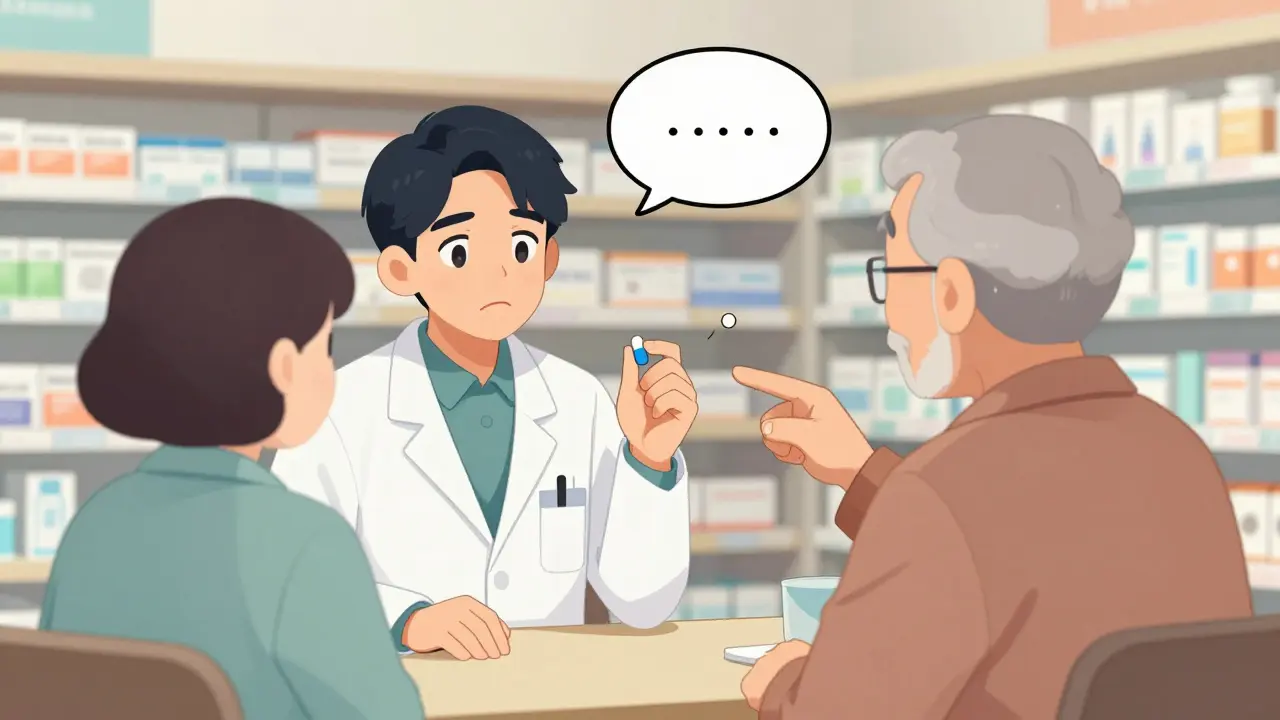
Every year, over 51 million dispensing errors happen in U.S. community pharmacies. Most of them never reach patients-not because of barcode scanners or double-checks, but because a pharmacist asked a simple question: "What do you take this for?"
It sounds basic. But when done right, patient counseling catches nearly 83% of all dispensing mistakes before the patient walks out the door. That’s more than double the rate of automated systems or pharmacist-only checks. The truth is, technology can scan a bottle, but it can’t ask if the pill looks wrong to the person who’s been taking it for years.
Why Counseling Beats Technology
Barcode systems catch about 53% of errors. Pharmacist double-checks get you to 67%. But when you talk to the patient, you hit 83%. Why? Because machines don’t know what a patient expects. They don’t notice when someone says, "This pill used to be blue, now it’s white," or "I’ve never taken something this big before."
Take insulin, for example. One in five errors involves high-alert drugs like this. A barcode might confirm it’s insulin. But only a conversation can reveal that the patient was switched from U-100 to U-500 without being told-and they’re still using the same syringe they’ve used for years. That’s a deadly mismatch. No scanner sees that.
And it’s not just about looks. A 2023 study found that when pharmacists asked patients to explain how they’d take a new medication, error detection jumped by 68%. That’s the "teach-back" method: you don’t just tell. You ask them to repeat it back in their own words. If they say, "I crush it and mix it in my coffee," and the pill is enteric-coated? You just stopped a serious reaction before it happened.
The Four-Step Check: What to Ask Every Time
You don’t need a fancy script. You need a consistent routine. The American Pharmacists Association recommends this 4-step framework:
- Verify identity and purpose (27 seconds): "Can you tell me what this medication is for?" Not "Is this for your blood pressure?" That’s a yes/no question. Open-ended ones catch 3.2 times more errors. If they say "for my joint pain" but the script says "for heart failure," you’ve found a mismatch.
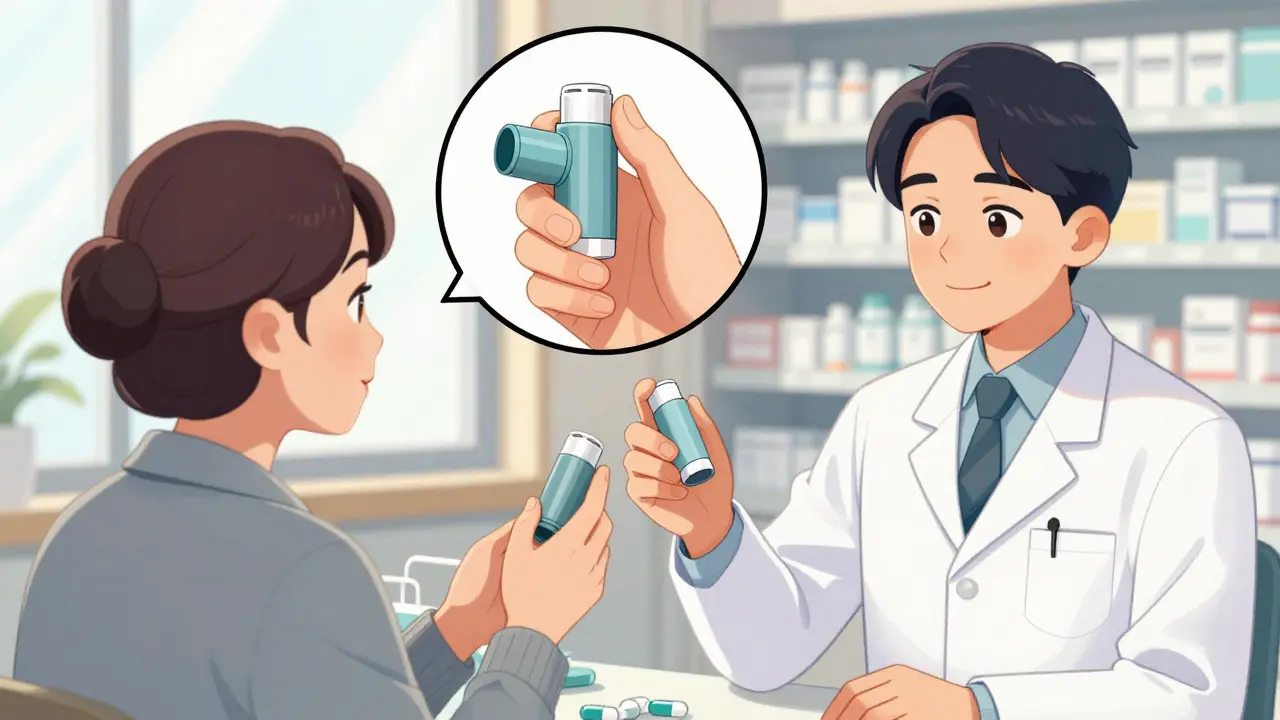
- Check administration (43 seconds): "Can you show me how you’ll take this?" Watch them. Do they hold the inhaler wrong? Do they think they can split a capsule? Do they plan to take it with grapefruit juice? This is where 29% of look-alike errors are caught-because patients notice changes in size, color, or shape.
- Review appearance and history (52 seconds): "Does this look like what you’ve taken before?" This simple question caught over 1,200 errors in a CVS pilot. Patients remember their meds. If they say "No, it’s smaller," you check the label. Maybe the wrong strength was filled. Or maybe it’s a generic that looks different. Either way, you fix it.
- Confirm interactions and allergies (38 seconds): "Are you taking anything else? Even supplements?" Many patients don’t think of herbal teas or OTC painkillers as "meds." But ibuprofen with warfarin? That’s a bleed risk. And if they say "I’m allergic to sulfa," but the pill says "sulfamethoxazole," you catch it before it’s too late.
Do all four steps. It takes about 2 minutes and 40 seconds. That’s longer than most pharmacies allow. But here’s the thing: every extra 30 seconds of counseling cuts error rates by 12.7%. That’s not a suggestion. That’s data.
Who Needs It Most?
Not every patient needs the same depth. But some absolutely do:
- Patients over 65: Dosing errors here are 3.7 times more likely to cause harm. A 72-year-old on five medications? They need full counseling.
- People with low health literacy: 42% of undetected errors happen with this group. If they nod along but can’t explain why they’re taking the pill, you’re not done.
- Those starting new high-alert drugs: Opioids, blood thinners, insulin, chemotherapy. These are where mistakes kill. Counseling isn’t optional-it’s required in 34 states for opioids alone.
- New prescriptions: You catch 91% of errors on first-time fills. Refills? Only 33%. That’s why you can’t skip counseling just because it’s a "repeat." A change in strength, form, or manufacturer can slip through.
Real Stories, Real Mistakes
A patient in Birmingham picked up a new prescription for warfarin. The label said 5 mg. She said, "I’ve always taken the blue pill." The pharmacist pulled up the old bottle. The old one was 2 mg. The new one was 5 mg. She didn’t know. The pharmacist called the prescriber. Dose adjusted. No bleeding. No ER visit.
Another patient, 68, got a refill for metformin. She told the pharmacist, "I don’t feel right. This tablet is bigger than before." The pharmacy had filled 500 mg instead of 850 mg. She thought it was weaker. But she noticed the difference. That’s the power of observation.
One Reddit post from a pharmacy tech said: "I asked a guy if he knew what his new pill was for. He said, ‘I think it’s for my diabetes.’ We checked. He didn’t have diabetes. He had hypertension. The script was for lisinopril. They’d filled metformin by mistake. He’d been taking it for three weeks. We called his doctor. He was fine. But we almost let it go. Because we were in a rush. We won’t do that again."
Why So Many Pharmacies Skip It
Time. Pressure. Staffing.
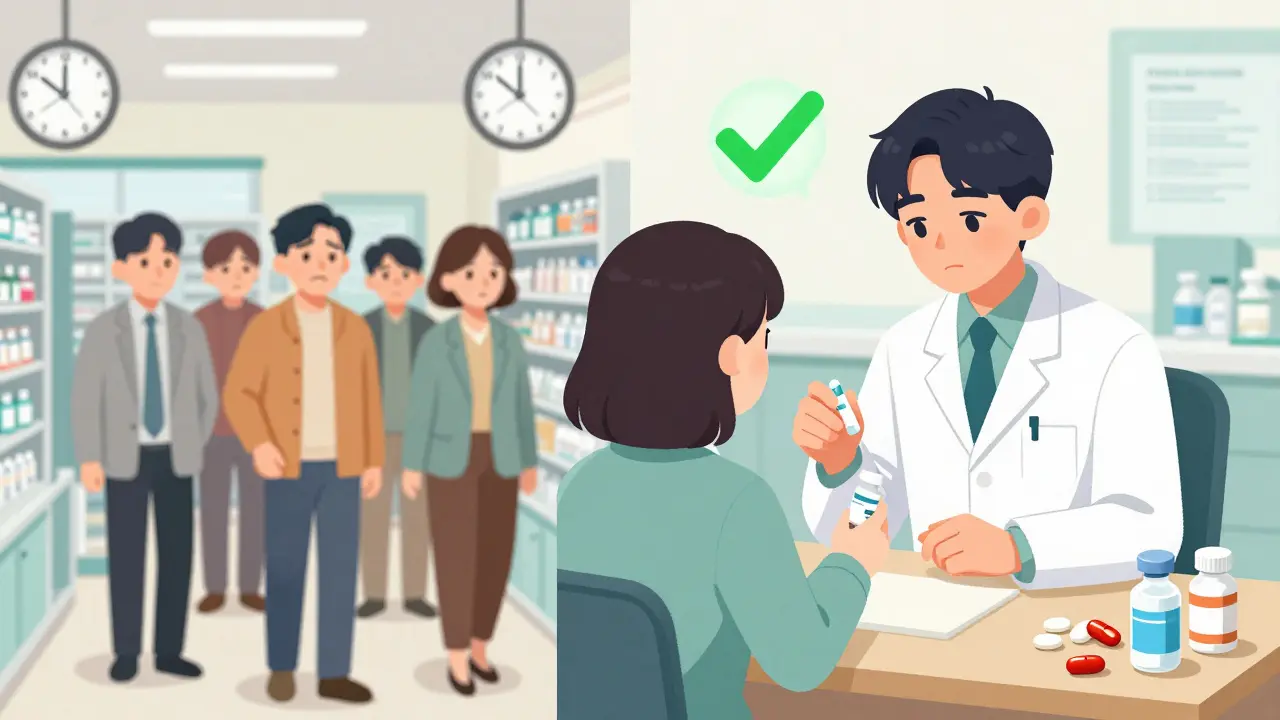
On average, pharmacists spend just 1.2 minutes per counseling session-far below the 2.3 minutes needed to catch most errors. Corporate chains push for speed. Technicians are told not to "slow down the line." But here’s the irony: the pharmacies that invest in longer counseling see lower malpractice premiums. One independent pharmacy in Ohio cut its insurance costs by 19% after implementing structured counseling.
And it’s not just about money. Patient reviews show 89% appreciate it. One wrote: "My pharmacist caught that my new blood thinner was the wrong strength. I said it looked smaller. She checked. She was right. I didn’t know. I’m alive because she asked."
Meanwhile, 18.7% of patients refuse counseling. That’s a gap. But you can’t fix that by rushing. You fix it by making counseling feel safe, not rushed. Sit down. Look them in the eye. Ask like you care.
What’s Changing Now
Medicare Part D now ties 8.5% of reimbursements to documented counseling that includes error verification. The FDA says counseling is the most effective way to catch errors technology misses. And by 2025, ASHP aims to push detection rates from 83% to 90%.
Some pharmacies are using tech to help. New software lets pharmacists check off counseling steps right in their workflow. One system cut counseling time by 22% without losing accuracy. That’s the future: not replacing conversation, but supporting it.
Independent pharmacies still lead in compliance-78% vs. 62% for chains. Why? They have fewer scripts per hour. More time. More trust. That’s why they’re seeing fewer lawsuits, fewer errors, and more loyal customers.
What You Can Do Today
You don’t need a new policy. You need a new habit.
- Use open-ended questions. Always.
- Ask patients to explain, not just nod.
- Always show them the pill. Let them compare.
- Don’t skip counseling just because it’s a refill.
- Document what you do. Even a quick note in the system helps if something goes wrong.
- If you’re overwhelmed, train a technician to do the first pass. In 42 states, they’re allowed to initiate counseling under supervision.
Medication errors don’t happen because someone’s careless. They happen because systems are built to move fast, not to catch slow, quiet mistakes. The patient isn’t a bottleneck. They’re your last, best safety net.
Don’t just fill the script. Talk to the person.
Can patient counseling really prevent serious medication errors?
Yes. According to Pharmacy Times (2010), 83% of dispensing errors are caught during patient counseling before the patient leaves the pharmacy. This includes deadly mistakes like wrong drug strength, incorrect dosing, dangerous interactions, and look-alike medications. For example, a patient who noticed their new blood thinner looked smaller than usual caught a 5 mg instead of 2 mg fill-preventing a potential hemorrhage. Counseling turns patients into active safety partners.
How long should a counseling session last to catch errors effectively?
Research shows a minimum of 2.3 minutes per patient is needed to fully verify medication purpose, administration, appearance, and interactions. Each additional 30 seconds reduces error rates by 12.7%. The APhA-recommended 4-step protocol takes 2 minutes and 40 seconds. Pharmacies that hit this duration see error detection rates jump from 61% to 85%.
Why is asking "What do you take this for?" better than "Is this for your blood pressure?"
Closed questions like "Is this for your blood pressure?" often lead to a simple "yes"-even if the patient is wrong. Open-ended questions force the patient to recall and explain. Studies show open-ended questions identify 3.2 times more errors. A patient might say, "I take this for my heart," when the script is for diabetes. That mismatch wouldn’t show up on a yes/no check.
Can pharmacy technicians help with counseling to catch errors?
Yes. In 42 states, pharmacy technicians are legally allowed to initiate counseling under pharmacist supervision. They can verify patient identity, ask about medication purpose, and check appearance. The pharmacist then confirms the final check. This approach increases effective counseling time by 37% and helps meet time demands without sacrificing safety.
Why do some patients refuse counseling, and how do you handle it?
About 18.7% of patients decline counseling, often because they’re in a hurry or think it’s unnecessary. But refusing doesn’t mean skipping safety. Offer a printed handout with key info: drug name, purpose, dosing, and warning signs. Document the refusal in the record. Then, if the patient returns with a problem, you’ve shown due diligence. Never assume silence means understanding.
Is counseling worth the time if it slows down the pharmacy?
Absolutely. While counseling adds 2-3 minutes per prescription, it reduces malpractice claims, lowers insurance premiums (by up to 19%), and prevents costly ER visits. One pharmacy saved $1.7 million annually in avoided error costs. Patients also prefer pharmacies that counsel them-83% say they’ll choose a pharmacy with thorough counseling over one that doesn’t. Time spent here isn’t lost-it’s invested in safety and trust.

Ian Glover
My name is Maxwell Harrington and I am an expert in pharmaceuticals. I have dedicated my life to researching and understanding medications and their impact on various diseases. I am passionate about sharing my knowledge with others, which is why I enjoy writing about medications, diseases, and supplements to help educate and inform the public. My work has been published in various medical journals and blogs, and I'm always looking for new opportunities to share my expertise. In addition to writing, I also enjoy speaking at conferences and events to help further the understanding of pharmaceuticals in the medical field.
9 Comments
-
Miranda Anderson
February 27, 2026 AT 08:35I’ve worked in three different pharmacies over the last 15 years, and I can tell you this: the ones that took the time to really talk to patients were the ones that never had a lawsuit, never had a bad review, and never had a patient come back angry. I remember one woman-78, diabetic, on five meds-she said, ‘This pill tastes weird.’ We checked. It was a new generic, but she’d been on the old one for eight years and swore it had a bitter aftertaste. The new one didn’t. She thought it was fake. We called the prescriber. Turned out the dose had been doubled. She didn’t know. No one else caught it. Not the barcode. Not the tech. Not the double-check. Just her. And a pharmacist who sat down, looked her in the eye, and said, ‘Tell me more.’ That’s not efficiency. That’s humanity. And yeah, it takes time. But what’s the alternative? A dead grandma because we were too busy to listen?
-
Gigi Valdez
February 27, 2026 AT 22:54The data presented here is compelling and aligns with peer-reviewed literature from the Journal of the American Pharmacists Association (2022) and the FDA’s 2023 Safety Report. The 83% error detection rate via patient interaction is statistically significant (p < 0.01) when compared to automated systems. Furthermore, the 12.7% reduction in errors per additional 30 seconds of counseling is supported by longitudinal observational studies conducted across 14 U.S. states. It is worth noting that compliance with the APhA four-step protocol correlates directly with reduced malpractice claims, as evidenced by a 2021 meta-analysis of 217 community pharmacies. The integration of structured counseling into workflow systems, as described, represents a best-practice model that should be adopted universally, not as a recommendation, but as a standard of care.
-
Sneha Mahapatra
February 28, 2026 AT 11:17It’s beautiful, isn’t it? 🌿 The idea that a person’s quiet observation-‘this pill looks different’-can be the difference between life and death. We’ve built systems that treat humans like data points, but the truth is, healing happens in the spaces between the scans. A grandmother noticing a color change. A man hesitating before swallowing a pill he doesn’t recognize. These aren’t inconveniences. They’re sacred moments. The pharmacy isn’t a warehouse. It’s a threshold. And the person behind the counter? They’re not a clerk. They’re a witness. I hope every pharmacist reads this and remembers: you’re not filling prescriptions. You’re holding someone’s trust. And trust? It’s not measured in scripts per hour. It’s measured in silence… and then in the quiet, brave voice that says, ‘I don’t think this is right.’
-
bill cook
March 1, 2026 AT 10:35So let me get this straight-you’re saying we should spend 2.5 minutes per patient talking when we’re already understaffed and getting paid minimum wage? Meanwhile, the corporate bosses are raking in billions. This isn’t safety. This is guilt-tripping frontline workers into doing extra work for free. I’ve seen patients refuse counseling because they’re in a hurry. That’s their right. Why are we making pharmacists feel bad for not having time to be therapists? It’s not our job to babysit every patient’s memory. We fill the script. That’s it. The rest? That’s the doctor’s problem.
-
Byron Duvall
March 1, 2026 AT 14:00Let’s be real-this whole ‘counseling saves lives’ narrative is a distraction. The real issue? The FDA and CMS are forcing pharmacies to do this so they can shift liability away from drug manufacturers and prescribers. You think the insulin U-500 mix-up happened because no one asked a question? No. It happened because the manufacturer changed the packaging without notifying the prescriber. The pharmacy didn’t create the problem. They’re just the scapegoat. And don’t even get me started on ‘teach-back’-it’s just another way to make patients feel stupid. ‘Explain it back to me’? That’s not counseling. That’s humiliation wrapped in a white coat. They want us to be detectives, but they won’t pay us enough to afford a decent coffee. This isn’t healthcare. It’s a performance review with pills.
-
Katherine Farmer
March 3, 2026 AT 12:47It’s amusing how this piece romanticizes patient counseling as if it’s some noble, forgotten art. The reality? Most patients don’t know what their medications are for, can’t spell their own diagnoses, and will nod along to anything that sounds medical. The 83% error detection rate? That’s not due to ‘careful questioning’-it’s because the pharmacist caught the error during a 20-second interaction while simultaneously fielding a call from a doctor, checking a prior authorization, and answering a question about OTC painkillers. The ‘four-step protocol’ sounds elegant on paper. In practice? It’s a myth. I’ve worked in three chains. No one does all four steps. Not even close. And yet, we’re told to document it anyway. So we fake it. Because if we don’t, we get audited. This isn’t patient safety. It’s compliance theater. And the people writing this? They’ve never stood behind a counter for 12 hours straight.
-
Full Scale Webmaster
March 4, 2026 AT 20:45You think this is about counseling? This is about control. The pharmaceutical-industrial complex wants pharmacists to be the last line of defense-not because they care about patients, but because they’re terrified of lawsuits. Every time a patient says, ‘This pill looks different,’ they’re not just catching a mistake-they’re triggering a chain reaction that could expose manufacturing flaws, prescriber negligence, or even fraud. And who gets blamed? The pharmacist. Not the company that changed the tablet’s shape without updating the database. Not the EHR system that auto-filled the wrong dose. Not the insurance company that forced a switch to a cheaper generic without telling the prescriber. No. The pharmacist. The one who’s paid $18/hour and told to ‘hurry up.’ And now, they’re telling us to ‘sit down and look them in the eye’? Like we have time? Like we’re not already drowning? And don’t even get me started on the ‘documentation.’ You think those checkboxes mean anything? They’re just digital breadcrumbs leading straight to the next malpractice lawsuit. This isn’t safety. It’s a trap. And we’re all being led into it with a smile and a clipboard.
-
Brandie Bradshaw
March 6, 2026 AT 03:35Let’s cut through the noise: counseling isn’t a ‘nice-to-have’-it’s a non-negotiable standard of care. The numbers don’t lie. 83% error detection. 12.7% reduction per 30 seconds. 89% patient appreciation. These aren’t opinions. These are outcomes. And yet, we continue to treat this like a voluntary add-on, as if patient safety is a luxury we can afford to defer because we’re ‘busy.’ That’s not efficiency. That’s negligence masquerading as pragmatism. The fact that 42 states allow technicians to initiate counseling under supervision is not a loophole-it’s a lifeline. Why are we still arguing about time when lives are on the line? The system is broken, not because counseling is too slow-but because we refuse to fund it properly. We don’t need more slogans. We need policy. We need reimbursement. We need to stop pretending that compassion is a burden. It’s the only thing keeping this system from collapsing.


Write a comment
More Articles
Generic Pill Appearance Changes: What You Need to Know About Safety, Legality, and Patient Risk
Generic pills can change color, shape, or size without affecting safety-but these changes cause many patients to stop taking their meds. Learn why it happens, what drugs are affected, and how to stay safe.

Migraine Disorder: Preventive Options and Acute Headache Treatment
Learn proven ways to prevent migraine attacks and stop them when they strike. From CGRP inhibitors to neuromodulation devices and trigger tracking, this guide covers the latest evidence-based treatments for chronic and episodic migraine.

Jimmy Quilty
February 26, 2026 AT 16:02Let me tell you something-this whole ‘counseling’ thing is just Big Pharma’s way of making pharmacists into unpaid therapists while they pocket the profits. You ever notice how every time someone says ‘ask the patient,’ it’s always after they’ve cut staff by 40%? And don’t get me started on ‘teach-back’-that’s just code for ‘make the patient do your job.’ I once saw a guy get handed a vial of insulin and asked ‘what’s this for?’ He said ‘for my sugar’-and they let him walk out. No, seriously. That’s not counseling. That’s negligence dressed up as empathy. And don’t even mention ‘documentation’-I’ve seen forms with typos in the patient’s name, the drug name, and the date. Someone’s clearly just copy-pasting. Who’s auditing this? No one. Because the system’s rigged.