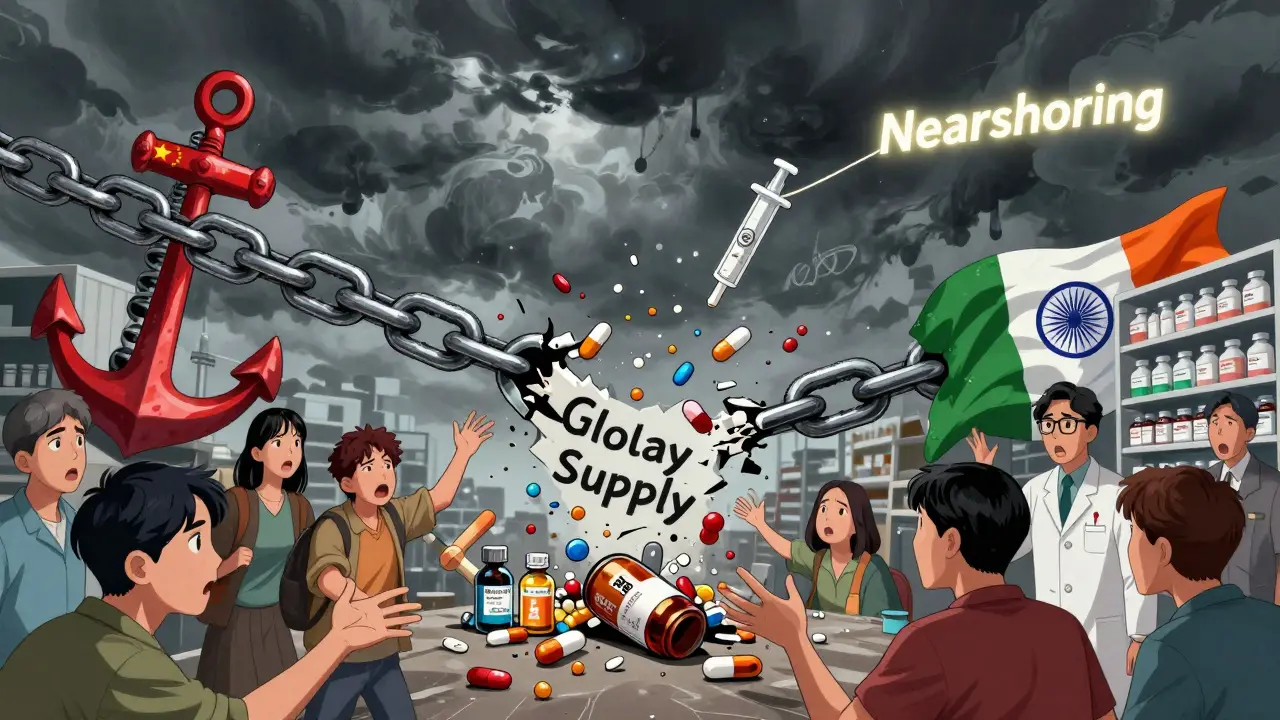
When you walk into a pharmacy and find your prescription out of stock, it’s not a glitch. It’s a symptom of a global system that’s been stretched too thin. The truth is, international supply chains are the invisible backbone of modern medicine-and they’re breaking under pressure. Over 80% of the active ingredients in U.S. prescription drugs are made overseas, mostly in China and India. And when geopolitical tensions, port closures, or shipping delays hit, patients pay the price. This isn’t about politics. It’s about physics: if the chain snaps, the medicine stops moving.
How Did We Get Here?
In the 1990s, pharmaceutical companies didn’t just outsource manufacturing-they outsourced entire production systems. Why? Because it was cheaper. Labor in India and China cost a fraction of what it did in the U.S. or Europe. Regulatory oversight was looser. Taxes were lower. By 2025, over 50% of global pharmaceutical manufacturing output came from just two countries. That sounds efficient. Until it isn’t.Take the case of heparin, a blood thinner used in every hospital. In 2008, a contaminated batch from China caused over 80 deaths in the U.S. That should’ve been a wake-up call. Instead, companies doubled down on cost-cutting. By 2025, 94% of multinational drugmakers still relied on single-source suppliers for critical ingredients. That’s like building a bridge with only one steel cable. One snap, and everything falls.
The Domino Effect of Disruptions
In 2024, a port strike in Shanghai shut down 17 major pharmaceutical shipping lanes for 45 days. No one noticed until hospitals in Ohio and Georgia ran out of antibiotics. The delay wasn’t because the drugs weren’t made-it was because the containers sat on docks while customs paperwork got stuck in bureaucratic limbo. That’s the hidden cost of globalization: complexity.Lead times from China to the U.S. have increased by 50% since 2019. That means if a factory in Guangdong shuts down for a week, it takes over a month for the ripple to reach a pharmacy shelf. Meanwhile, U.S. logistics costs hit $2.3 trillion in 2025-8.7% of the entire national GDP. That’s not just shipping fees. It’s the cost of keeping extra inventory, paying for air freight, and scrambling to find backup suppliers.
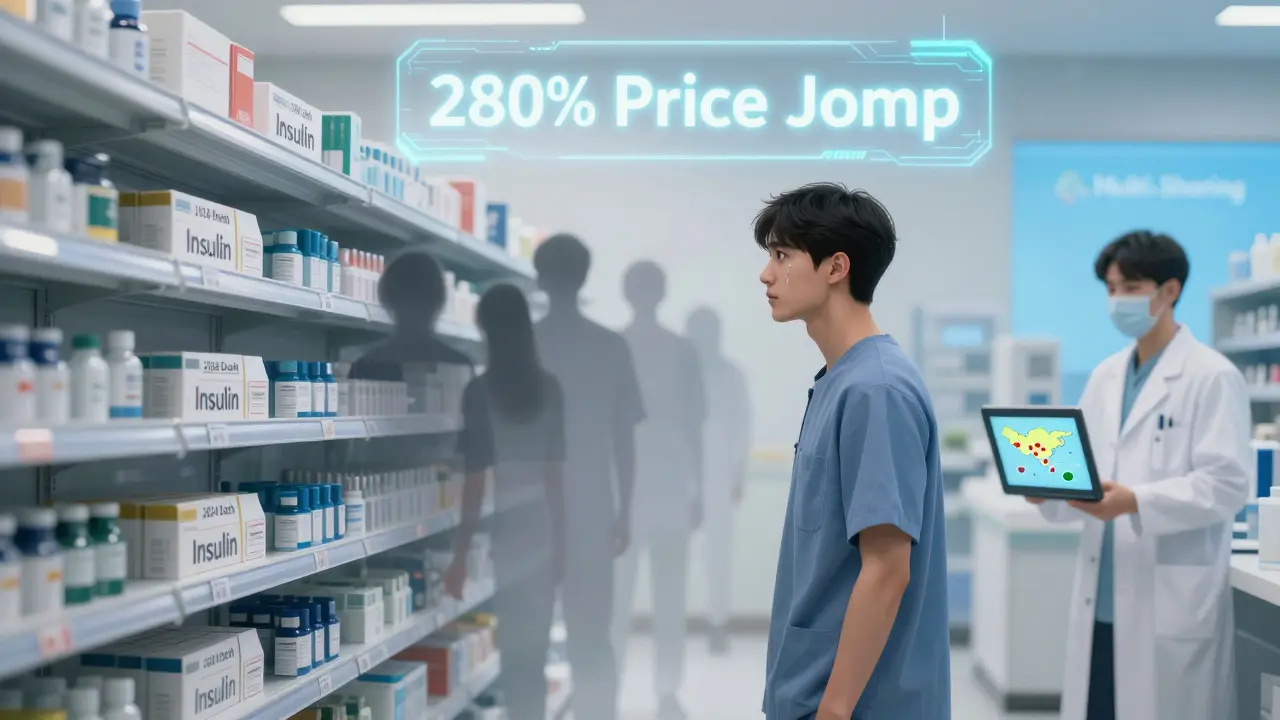
And it’s getting worse. The U.S. imposed 12 new tariff categories on Chinese pharmaceutical inputs between 2024 and 2025. Those tariffs didn’t stop imports-they just made them more expensive. One generic diabetes drug saw a 280% price jump overnight. Patients skipped doses. Hospitals rationed. That’s not speculation. That’s data from the American Pharmacists Association’s 2025 report.
Who’s Getting Hit the Hardest?
It’s not just big-name drugs. The shortages are most dangerous for older, generic medications-things like insulin, epinephrine, and antibiotics. These aren’t high-margin products. They’re low-cost, high-volume essentials. And because they’re cheap, companies stopped investing in local production. Why build a factory when you can buy from a supplier who’s 70% cheaper?But here’s the catch: 90% of global businesses are small or mid-sized manufacturers. They don’t have the cash to stockpile six months of inventory. When a supplier in India faces a power outage or a Chinese factory gets hit by flooding, these smaller drugmakers can’t pivot. They just go dark. That’s why 56% of companies surveyed by the National Foreign Trade Council in 2025 had to delay or cancel product launches. That’s not a business problem. It’s a public health crisis.
The New Rules: Multi-Shoring and Nearshoring
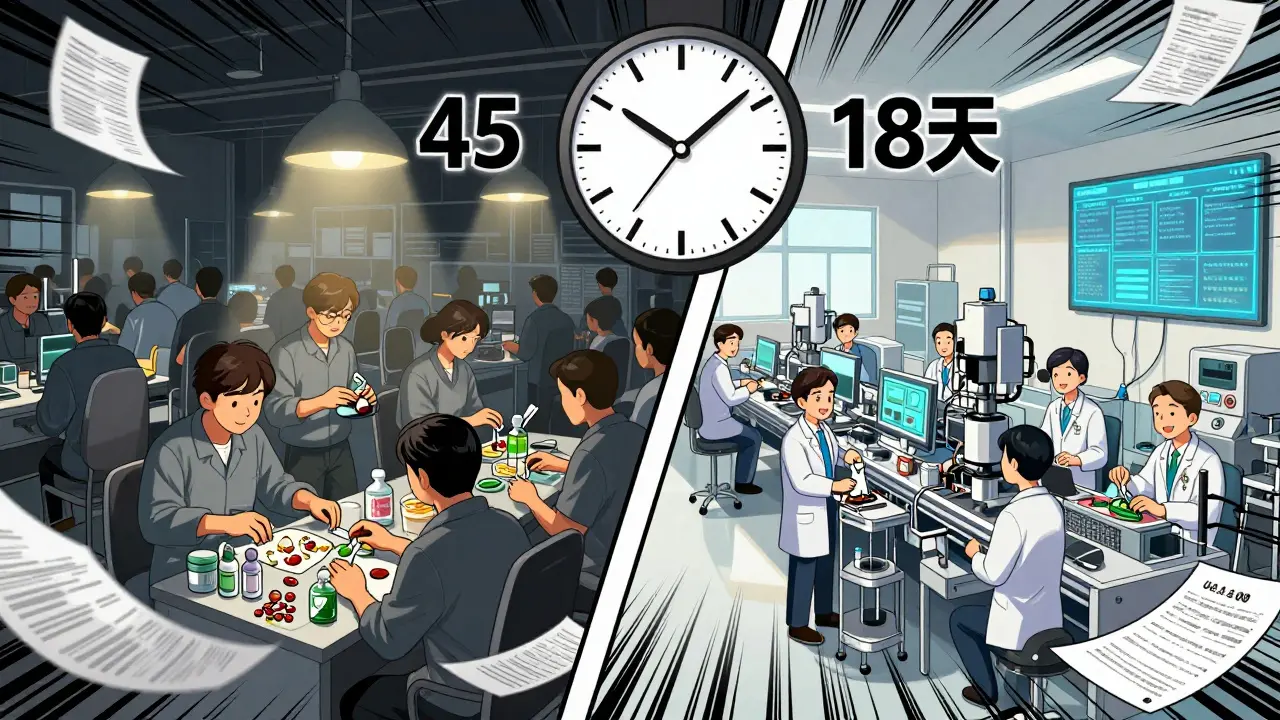
The smartest companies aren’t trying to bring everything back to the U.S. They’re spreading out. This is called multi-shoring: making the same drug in three different places-say, one in India, one in Mexico, and one in Poland. It’s not cheap. Setting up a second manufacturing line costs 22% of your annual procurement budget. But when disruption hits, your backup kicks in.One Fortune 500 medical device maker cut its drug shortage risk by 70% by moving 40% of its production to Mexico. Transportation costs dropped 35%. Lead times shrank from 45 days to 18. And because Mexico is part of the USMCA trade deal, tariffs stayed stable. That’s the sweet spot: geographic diversity without sacrificing speed.
And it’s working. By 2025, 78% of pharmaceutical firms had adopted supplier diversification-up from 35% in 2020. Companies that did this saw 65% fewer disruption days per year. That’s not a minor improvement. That’s the difference between a hospital having enough insulin and a patient going without.
Technology Isn’t a Magic Fix
You’ve heard about AI, blockchain, and digital twins. They’re real. And they’re helping. A company in Birmingham, Alabama, used AI-powered demand forecasting to reduce its inventory waste by 30%. Another in Tennessee used blockchain to verify the origin of raw materials-cutting quality disputes by 65%. But here’s the truth: technology doesn’t fix bad strategy.Too many companies think buying a fancy software system will solve their supply chain problems. It won’t. If your only supplier is in a region prone to floods or political unrest, no algorithm can prevent a shortage. Digital tools help you see the problem faster. They don’t stop it.
And the workforce gap is real. 33% of global trade managers are understaffed in 2025. You can have the best AI in the world, but if no one knows how to use it-or if your customs broker is overworked and missing filings-you’re still vulnerable.
The Cost of Doing Nothing
Some experts argue reshoring is too expensive. Professor Richard Baldwin of IMD Business School points out that U.S. manufacturing wages are 4.8 times higher than in China. He’s right. But he’s missing the bigger picture. The cost of a shortage isn’t just dollars. It’s lives.In 2024, a single shortage of a critical antibiotic led to 120 extra deaths in U.S. hospitals, according to CDC data. That’s not an abstract number. That’s 120 families. That’s 120 funerals. When you’re choosing between paying $2 more per pill and risking a patient’s life, the math changes.
And the economic toll is mounting. The OECD cut its 2025 global GDP forecast to 2.9%-partly because trade barriers are slowing the flow of medical goods. That’s not just about cars or phones. It’s about the medicines that keep people alive.
What’s Next?
The path forward isn’t about going back. It’s about going smart. Governments need to stop treating supply chains like trade policy problems. They’re public health systems. The U.S. should incentivize domestic production of critical drugs-not through subsidies, but through guaranteed purchase agreements. If a company builds a factory to make life-saving antibiotics, the government buys a fixed amount every year. That gives companies certainty. That’s how you build resilience.For manufacturers, the answer is diversification. Don’t rely on one country. Don’t rely on one supplier. Build redundancy into your network. Use nearshoring where it makes sense. Invest in digital tools-not to replace people, but to empower them.
And for patients? Demand transparency. Ask your pharmacist: Where is this drug made? If they don’t know, it’s time to ask harder questions.
Why are so many drugs made in China and India?
China and India dominate drug manufacturing because they offer low labor costs, large-scale production capacity, and government support for chemical and pharmaceutical industries. For decades, U.S. and European drugmakers outsourced production to cut costs. Today, over 80% of active pharmaceutical ingredients (APIs) come from these two countries. While this kept drug prices low, it also created extreme dependency-making the entire system vulnerable to any single disruption, whether it’s a port strike, a natural disaster, or a trade war.
Can the U.S. make its own drugs again?
Yes, but not overnight. Building a domestic pharmaceutical manufacturing base requires billions in investment, trained workers, and regulatory approvals that take years. The U.S. has started with targeted efforts-like the Biomanufacturing and Innovation Initiative-which funds domestic production of critical drugs like insulin and epinephrine. But scaling this to cover all essential medicines would take a decade and major policy shifts. The goal isn’t to eliminate foreign suppliers-it’s to build backup capacity so no single country holds the entire supply chain hostage.
How do tariffs affect drug shortages?
Tariffs don’t stop imports-they just make them more expensive. When the U.S. imposed new tariffs on Chinese pharmaceutical inputs in 2024-2025, many manufacturers didn’t stop buying. Instead, they passed the cost to hospitals and patients. One study found that tariff-affected drugs saw price increases of 200-300%. That led to reduced usage, rationing, and even stockouts. In effect, tariffs made drugs harder to afford and harder to get, worsening shortages instead of fixing them.
What’s the difference between nearshoring and reshoring?
Nearshoring means moving production to a nearby country-like shifting from China to Mexico or from India to Poland. It keeps costs lower than reshoring (bringing production back to the U.S.) while cutting shipping times and reducing geopolitical risk. Reshoring means bringing manufacturing home, which is more expensive but offers the highest level of control. Most companies are choosing nearshoring because it’s a practical middle ground: faster, cheaper, and more resilient than relying on Asia alone.
Are drug shortages getting worse?
Yes, and they’re becoming more frequent and longer-lasting. In 2024, the FDA recorded over 250 active drug shortages, up from 120 in 2020. The average duration of a shortage rose from 11 months in 2020 to 18 months in 2025. Climate events, geopolitical conflicts, and workforce gaps are all contributing. What used to be occasional hiccups are now systemic failures. The trend won’t reverse without structural changes to how drugs are produced and distributed globally.

Ian Glover
My name is Maxwell Harrington and I am an expert in pharmaceuticals. I have dedicated my life to researching and understanding medications and their impact on various diseases. I am passionate about sharing my knowledge with others, which is why I enjoy writing about medications, diseases, and supplements to help educate and inform the public. My work has been published in various medical journals and blogs, and I'm always looking for new opportunities to share my expertise. In addition to writing, I also enjoy speaking at conferences and events to help further the understanding of pharmaceuticals in the medical field.
13 Comments
-
christian jon
February 13, 2026 AT 13:06I'm sorry - but did you just say 'physics' as if it's a law of nature that supply chains must snap? No. It's policy failure. It's corporate greed. It's a system designed to maximize quarterly earnings while offloading risk onto patients. And now you're telling me the solution is 'multi-shoring'? Like, spread the suffering? Mexico? Poland? Those places don't have the infrastructure. They don't have the skilled labor. They don't have the regulatory experience. This isn't about geography - it's about power. The pharma giants don't want to build factories. They want to outsource the blame. And you're giving them the script.
-
Suzette Smith
February 13, 2026 AT 17:32I just want to say - I love how everyone’s acting like this is a new problem. My grandma took insulin in the '70s. It was made in the US. It cost $5. Now it’s $300 and imported. Coincidence? I think not. We didn’t lose manufacturing because of globalization - we lost it because we stopped caring. And now we’re pretending we can fix it with ‘nearshoring’ like it’s a TikTok trend. It’s not. It’s people dying because we chose profit over care.
-
Pat Mun
February 14, 2026 AT 01:24I’ve been in this industry for 22 years - from quality control in New Jersey to auditing factories in Hyderabad. The truth is, most of the problems aren’t about location - they’re about oversight. A factory in Ohio with bad sanitation is just as dangerous as one in Shanghai. The difference? We can inspect the one in Ohio. We can’t inspect the one in China because we don’t have inspectors on the ground. And we stopped funding them. So now we’re blaming geography instead of our own neglect. We need more inspectors. More transparency. More audits. Not more tariffs. Not more nationalism. Just more accountability.
-
Sophia Nelson
February 15, 2026 AT 05:15This whole post is a scam. You’re not talking about drug shortages - you’re talking about your fear of China. The FDA approved 94% of the contaminated heparin batches in 2008. They knew. They didn’t stop it. Now you want to blame India and China? Look in the mirror. The FDA, the DEA, the pharmaceutical lobbyists - they’re the ones who gutted oversight. And now you’re pretending the solution is 'diversifying suppliers' like that’s a magic bullet. It’s not. It’s just a way to keep the same broken system running under a new name.
-
andres az
February 16, 2026 AT 14:36You know what they don’t tell you? The 'drug shortages' are engineered. The big pharma companies buy up competitors. They shut down local plants. They create artificial scarcity so they can jack up prices. Then they cry about 'global supply chains' so you think it’s China’s fault. The real story? The FDA approved 127 new drug applications in 2024 that were all manufactured by the same 3 corporations. They own the supply chain. They control the narrative. And they’re laughing all the way to the bank while you skip your insulin doses.
-
Steve DESTIVELLE
February 17, 2026 AT 16:27The question is not where the drug is made. The question is why we allow the commodification of life. When medicine becomes a product to be optimized for profit, then every human being becomes a variable in an equation. The supply chain is merely the symptom. The disease is the belief that life can be priced. The factory in Guangdong is not the villain. The boardroom in New York that calculates the cost of a life against the cost of a factory is. We are not facing a logistical crisis. We are facing a moral one. And no amount of nearshoring will fix that.
-
Stephon Devereux
February 18, 2026 AT 06:09Let’s cut through the noise. The real issue isn’t China or India - it’s the lack of public investment in manufacturing capacity. We built highways. We built satellites. We built the internet. But when it came to the infrastructure that keeps people alive? We starved it. The solution isn’t just diversification - it’s public-private partnership. Government guarantees. Long-term contracts. Workforce training. And yes - a national pharmaceutical reserve. We don’t need to make everything here. But we need to make enough to survive the next shock. This isn’t about nationalism. It’s about preparedness. And we’re not prepared.
-
Neha Motiwala
February 19, 2026 AT 05:49I’m from Mumbai - my dad worked in a pharma plant for 30 years. Let me tell you - they don’t just 'make' drugs there. They make them under pressure. 18-hour shifts. No OSHA. No safety gear. One time, a reactor exploded. 7 workers died. The company paid $2000 to each family. Then they moved production to another plant. And guess what? The FDA didn’t even blink. So don’t tell me about 'efficiency'. Tell me about exploitation. And tell me why you think paying $2 more for a pill is the moral high ground when people are dying to make it.
-
Ojus Save
February 19, 2026 AT 17:17i think the real issue is we dont have enough people working in logistics and quality control. like, seriously. i worked in a warehouse for a year and we lost like 3 shipments because no one signed the paperwork. its not china. its us. we just dont care enough to fix the basics.
-
Jack Havard
February 21, 2026 AT 01:27Multi-shoring? Please. It’s just a rebrand for 'we’re still outsourcing, but now we’re outsourcing to three different places so we can say we’re diversified'. The real problem? No one in pharma has skin in the game. They don’t own factories. They don’t employ workers. They don’t care if a hospital runs out. They just care about the next earnings call. And until we force them to take ownership - not just liability - nothing changes.
-
Gloria Ricky
February 22, 2026 AT 09:23i just want to say thank you for writing this. i’m a pharmacist in rural ohio and last month we ran out of amoxicillin for 3 weeks. kids were getting sicker. parents were crying. we had to call 17 different distributors. nobody had it. i’ve been in this job 12 years and this is the worst it’s ever been. it’s not about politics. it’s about people. we need to fix this. not just for us. for our kids.
-
Stacie Willhite
February 24, 2026 AT 00:47I’ve been reading everything here. And honestly? I feel like we’re all talking past each other. The truth is - we need all of it. Better oversight. More transparency. Strategic domestic capacity. Nearshoring. Workforce investment. And yes - guaranteed government purchases. It’s not one fix. It’s a system rebuild. And it’s going to take time. But if we stop arguing about who’s to blame and start asking 'what can we do?', then maybe - just maybe - we can stop watching people die because we were too scared to invest in the things that keep them alive.


Write a comment
More Articles
Warfarin Food Interactions: Complete Food List and Guidelines for Stable INR Control
Learn which foods affect warfarin, how to maintain stable INR levels, and what to avoid - including cranberry juice, grapefruit, and vitamin K-rich greens. Practical, evidence-based guidelines for safe long-term use.

Vamsi Krishna
February 13, 2026 AT 00:51Look, I get it - you're scared of China. But let's be real: 80% of APIs come from India and China because they've built the most efficient, scalable, and technically advanced manufacturing ecosystems on the planet. You think building a factory in Ohio with union wages and EPA compliance is gonna make penicillin cheaper? Nah. It'll make it unaffordable. We didn't 'outsource' because we were lazy - we outsourced because it made sense. Now you want to pay $300 for insulin because you're mad at Xi? That's not resilience. That's nationalism with a side of delusion.