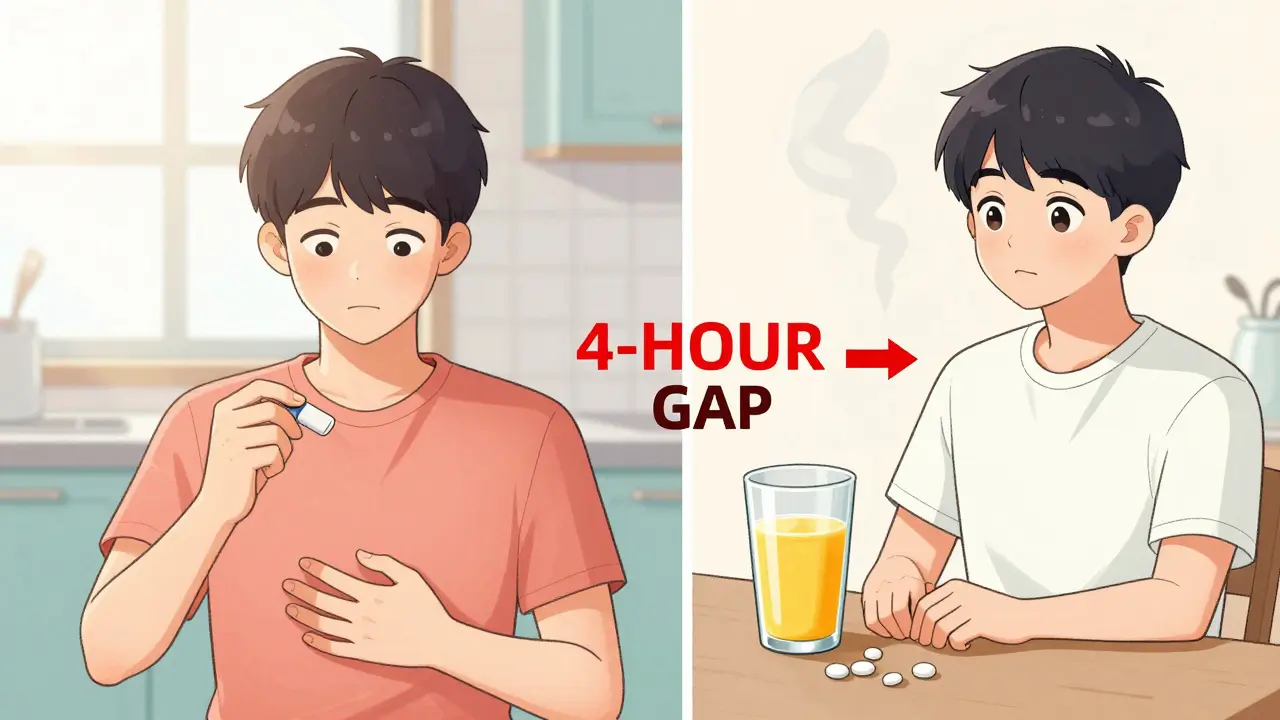
Levothyroxine & Iron Timing Calculator
This tool helps you determine if your levothyroxine and iron supplement doses are separated by at least 4 hours as recommended by medical guidelines. Proper timing is crucial for optimal thyroid medication absorption.
According to medical guidelines, levothyroxine and iron supplements should be separated by at least 4 hours. Taking them too close together can reduce levothyroxine absorption by up to 39%, which may lead to inadequate thyroid hormone levels.
Enter your medication times above to see if you're following the recommended 4-hour separation.
If you're taking levothyroxine for hypothyroidism and also need iron supplements, you're not alone. But if you're taking them at the same time, you might be sabotaging your thyroid treatment without even realizing it. The problem isn't that iron is bad - it's essential. And levothyroxine isn't a miracle drug - it's a life-saving replacement for the hormone your body can't make enough of. The issue is simple: when iron and levothyroxine meet in your gut, they stick together. Not just a little. Enough to cut your thyroid medication’s absorption by up to 39%. That means your TSH levels rise, your fatigue gets worse, and your body doesn't get the hormone it needs. And this isn't some rare edge case. About 28% of people on levothyroxine in the U.S. also take iron. That’s millions of people. And according to a 2025 NHS audit, 84% of them were taking them together - no gap, no warning, no clue.
Why Iron and Levothyroxine Don't Mix
Levothyroxine is absorbed mostly in the upper part of your small intestine. It needs a low stomach pH - meaning an empty, acidic stomach - to be absorbed properly. Iron supplements, especially ferrous sulfate (the most common kind), need acid too. But here's the twist: when iron enters the gut, it binds to levothyroxine like glue. They form an insoluble complex that your body can’t break down. That complex just passes through you, and your thyroid medication? Gone. Not absorbed. Not working.
This isn’t theoretical. A 2017 study in Thyroid showed a 39% drop in levothyroxine absorption when taken with iron. Another study in 2023 found the same thing: 20-39% less medication gets into your bloodstream. That’s enough to push your TSH from a perfect 2.0 to a concerning 6.0 - the kind of jump that makes your doctor say, “We need to increase your dose.” But if you stop taking iron, your iron levels crash. So what do you do?
The 4-Hour Rule: What the Experts Say
The clear, consistent advice from every major medical body is this: separate them by at least four hours.
- The British National Formulary (BNF 2024) says: “Separate levothyroxine and iron by at least four hours.”
- NICE guidelines (NG145, 2023) specifically mention ferrous sulfate: “Maintain at least four hours between doses.”
- Synthroid’s official prescribing info (AbbVie, 2024) states: “Take at least four hours before or after iron supplements.”
- MedlinePlus (NIH, 2024) echoes the same.
Why four hours? Because that’s how long it takes for levothyroxine to be mostly absorbed before iron enters the system. Studies show patients who stick to this rule maintain normal TSH levels 89% of the time. Those who don’t? Only 62%. That’s a huge gap.
Some sources - like Thyroid UK - suggest two hours might be enough. But that’s risky. People’s digestion varies. Some move food faster. Some slower. If you have celiac disease, Crohn’s, or even just slow gut motility, you might need six hours. The 4-hour rule isn’t arbitrary - it’s a safety buffer.
When to Take Them: Real-Life Schedules That Work
Most people take levothyroxine in the morning, 30-60 minutes before breakfast. That’s fine. But if you also take iron in the morning, you’re stuck. So here are two proven routines.
Option 1: Morning Levothyroxine, Afternoon Iron
- Take levothyroxine at 7:00 AM - on an empty stomach, with water, no food for 60 minutes.
- Take iron at 12:00 PM or 1:00 PM - with lunch or shortly after. This gives you a full 5-hour gap.
This works well for people who eat regular meals and don’t mind taking iron with food. Iron is easier on the stomach when taken with food - and food doesn’t interfere with absorption nearly as much as levothyroxine does.
Option 2: Nighttime Levothyroxine, Morning Iron
- Take iron at 7:00 AM - with breakfast or shortly after.
- Take levothyroxine at 10:00 PM - at least 3-4 hours after your last meal.
This is the secret weapon for many patients. A 2024 survey by the Thyroid Patient Advocacy Group found that 58% of people who switched to nighttime levothyroxine said it was “easier to maintain consistently.” Why? Because you’re not rushing before work. You’re winding down. And iron in the morning? No conflict. No guesswork. Just two clean windows.
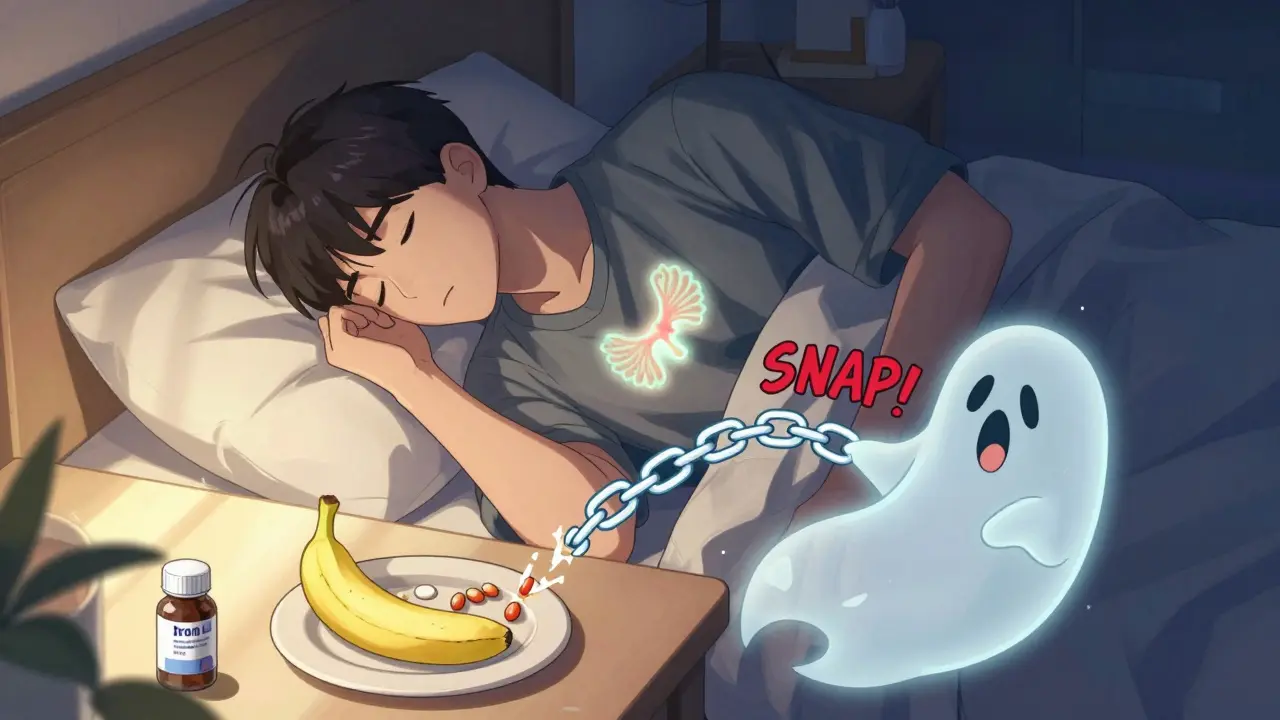
Important: If you switch to nighttime levothyroxine, make sure you’re not eating within 3-4 hours of your dose. A late snack? A glass of milk? That can mess with absorption too.
What About Different Iron Types?
Not all iron is the same. Ferrous sulfate is the cheapest and most common - and it causes the strongest interaction. Ferrous gluconate? Slightly less binding. Ferrous fumarate? About the same as sulfate.
There’s no “safe” iron when it comes to levothyroxine. All forms contain iron ions that bind to the hormone. Even “gentle” or “slow-release” iron doesn’t solve the problem - it just spreads the absorption out over time. The binding still happens.
One exception? Chelated iron. A new formulation called “ThyroSafe Iron” is in Phase II trials and showed 87% less binding in early tests. But it’s not available yet. Don’t waste money on “thyroid-friendly” iron supplements sold online. They’re not proven. Stick to the science.
What If You Can’t Wait Four Hours?
Some people get nauseous taking iron on an empty stomach. Some can’t remember to take it twice a day. Some are on 10 other meds. You’re not lazy. You’re human.
Here’s what you can do:
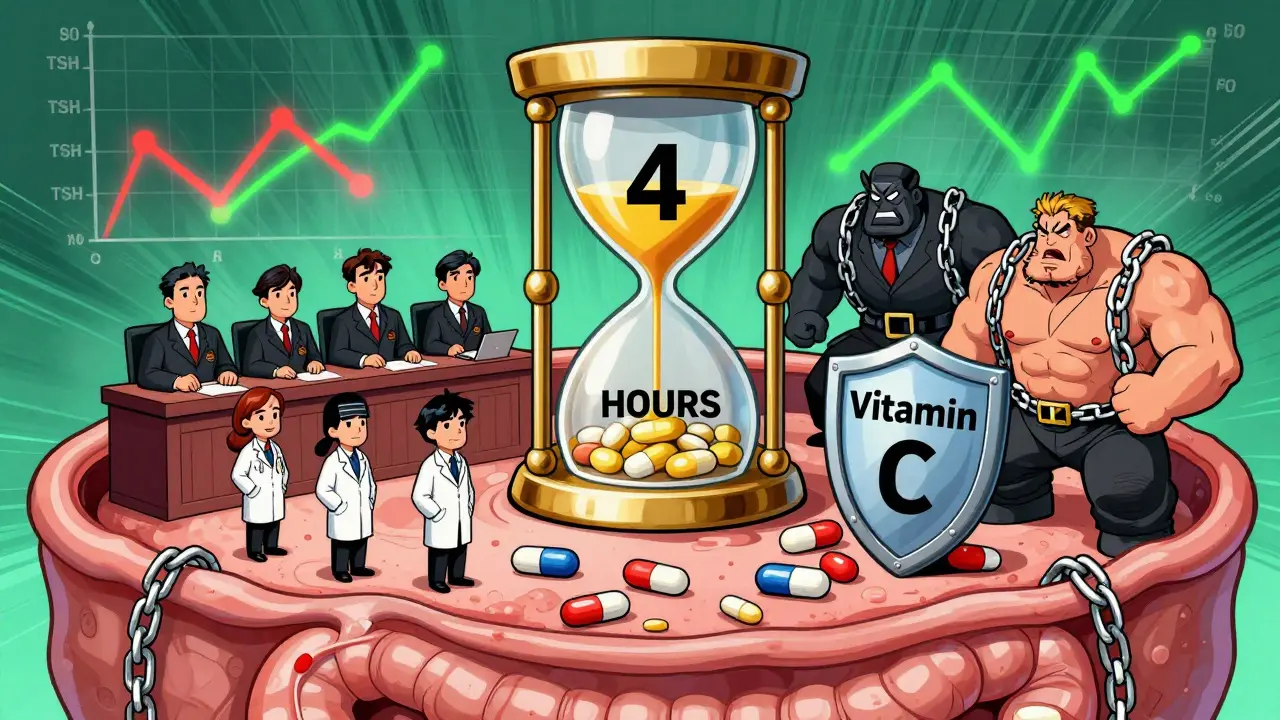
- Take iron with vitamin C. A 200mg dose of vitamin C with your iron improves absorption. That means you might need less iron - and less time for it to be absorbed. This can help reduce the risk if you’re forced closer together.
- Use a pill organizer with alarms. Set two phone alarms: one for levothyroxine, one for iron. Label them clearly. “7 AM - Thyroid Med Only.” “1 PM - Iron + Orange Juice.”
- Ask your doctor about switching to a different thyroid med. Liothyronine (T3) doesn’t interact with iron the same way. But it’s not a first-line treatment. Only consider this if you’re struggling badly and your TSH keeps rising despite timing.
- Check your iron levels. Maybe you don’t need daily iron. Maybe you can switch to weekly dosing. Or get an IV iron infusion - which bypasses the gut entirely. No interaction. No timing. Just results.
What Happens If You Ignore This?
Ignoring the timing doesn’t cause immediate harm. But over weeks or months, your thyroid levels drift. You start feeling tired again. Your weight creeps up. You get cold easily. Your mood dips. Your doctor says, “Your dose is too low,” and increases it. But if you keep taking iron with your pill, that new dose? Still not being absorbed. You’re stuck in a loop: higher dose → more side effects → no improvement → more confusion.
One patient from North Cumbria, UK, told her doctor she felt “fine.” But her TSH was 8.9 - more than double the target. She’d been taking iron with her levothyroxine for two years. Once she spaced them out, her TSH dropped to 2.1 in 8 weeks. No dose change. Just timing.
How to Stay on Track
Adherence is the biggest challenge. A 2023 survey by the American Thyroid Association found 41% of people over 65 found the 4-hour rule “difficult to maintain.” But here’s what works:
- Use visual tools. Thyroid UK’s free “Medication Timing Chart” (downloaded over 14,000 times in 2023) shows exactly how to space them. Print it. Tape it to your fridge.
- Link it to habits. “After I brush my teeth at night, I take my thyroid pill.” “After I eat lunch, I take my iron.”
- Track your TSH. Get it checked 6-8 weeks after changing your routine. If it’s still high, you’re still timing it wrong.
- Ask your pharmacist. Most will print out a simple dosing schedule. Just ask.
And if you’re a caregiver? Help your parent or partner set alarms. Write it down. Don’t assume they remember. This isn’t about forgetfulness - it’s about complexity.
Bottom Line: Timing Matters More Than You Think
You don’t need to be perfect. But you do need to be consistent. Four hours apart. Always. Whether you take levothyroxine in the morning or at night, whether you take iron with food or on an empty stomach - the gap must be there. No exceptions. No shortcuts.
This isn’t about being strict. It’s about making sure your medication works. Your thyroid doesn’t care if you’re busy. It doesn’t care if you forgot. It just needs the hormone to be absorbed. And iron? It’s stealing it.
Fix the timing. Check your levels. Feel better. It’s that simple.
Can I take iron and levothyroxine at the same time if I have no symptoms?
No. Even if you feel fine, taking them together reduces how much levothyroxine your body absorbs. You might not notice symptoms right away, but your TSH will rise over time. By the time you feel tired or gain weight, your thyroid levels have been off for months. The damage is silent until it’s serious.
What if I take iron at night and levothyroxine in the morning?
That’s actually one of the best schedules. As long as there’s at least four hours between doses - and you take levothyroxine on an empty stomach in the morning - this works perfectly. Many patients find this easier than taking iron in the afternoon.
Does taking iron with food reduce the interaction?
No. Food doesn’t stop iron from binding to levothyroxine. It just makes iron easier on your stomach. The chemical interaction still happens in your small intestine. The only way to prevent it is to separate the doses by at least four hours.
Can I switch to a different thyroid medication to avoid this?
Liothyronine (T3) doesn’t bind to iron the same way, but it’s not a replacement for levothyroxine in most cases. It’s used for specific conditions, not general hypothyroidism. Don’t switch unless your endocrinologist recommends it. Timing separation is still the safest, most effective solution.
How long does it take to see improvement after fixing the timing?
Most people see their TSH levels drop back into range within 6-8 weeks. That’s how long it takes for thyroid hormone levels to stabilize after absorption improves. Don’t check sooner - it won’t show the full picture. But if you’re still feeling awful after two months, talk to your doctor. You might need a dose adjustment.

Ian Glover
My name is Maxwell Harrington and I am an expert in pharmaceuticals. I have dedicated my life to researching and understanding medications and their impact on various diseases. I am passionate about sharing my knowledge with others, which is why I enjoy writing about medications, diseases, and supplements to help educate and inform the public. My work has been published in various medical journals and blogs, and I'm always looking for new opportunities to share my expertise. In addition to writing, I also enjoy speaking at conferences and events to help further the understanding of pharmaceuticals in the medical field.
14 Comments
-
George Vou
March 11, 2026 AT 22:35i heard this from a guy on youtube who said the real problem is big pharma wants you to buy 2 diff pills so they can charge more. also i think iron is just a scam anyway. my cousin took it for a year and got worse. maybe its the fillers? or maybe its the government? idk but i stopped taking both and now i feel like a god.
-
Scott Easterling
March 12, 2026 AT 18:00Seriously? Four hours? Who has that kind of discipline? I take my thyroid pill at 7 a.m., and I'm already late for work. Then I grab a protein bar with iron. Bam. Done. I'm not some robot. Also, why are you all so obsessed with numbers? My doctor said 'take it how you can.' And I'm not gonna stress over a 2-hour gap when I'm already on 7 other meds.
-
Mantooth Lehto
March 14, 2026 AT 00:12I’ve been doing this wrong for 3 years and I just found out? I’m crying. I’ve been so tired. My husband says I’m ‘not myself.’ I thought it was menopause. Or stress. Or the cat. Turns out it was the iron I took with my pill at 7 a.m. I switched to night-time levothyroxine and took iron at lunch. I slept 8 hours last night for the first time in years. Thank you. I’m not mad. I’m just… relieved.
-
Melba Miller
March 14, 2026 AT 10:11This country is falling apart. People can't even follow a simple 4-hour gap. We're handing out meds like candy and expecting people to read the fine print. Meanwhile, China’s got their thyroid patients on strict schedules and their TSH levels are stable. We need a national mandate. No more 'I forgot.' No more 'I eat late.' You take it right or you don't get the prescription. Period.
-
Katy Shamitz
March 16, 2026 AT 01:04Oh honey. I get it. You're tired. You're overwhelmed. But this isn't about willpower - it's about chemistry. Iron doesn't care if you're busy. It doesn't care if you're a single mom or a 70-year-old with three kids. It binds. And if you're not separating them, you're not getting the medicine. I've been there. I cried. I yelled at my husband. Then I set two alarms. One says 'THYROID ONLY.' The other says 'IRON + ORANGE JUICE.' It saved my life. You can do it too.
-
Nicholas Gama
March 17, 2026 AT 19:46The NHS audit? 84%? That’s not a statistic - that’s a national failure. The fact that this is even a question reveals how broken our healthcare literacy is. You don’t get to be 'busy' and expect a hormone replacement to work. This isn’t a suggestion. It’s a biochemical imperative. If you can’t follow this, you shouldn’t be on levothyroxine. Period.
-
Mary Beth Brook
March 19, 2026 AT 13:51The pharmacokinetic interaction is mediated by divalent cation chelation in the duodenum. Ferrous ions form insoluble complexes with levothyroxine’s phenolic hydroxyl groups, reducing bioavailability. The 4-hour window aligns with gastric emptying half-life and intestinal absorption kinetics. Alternative formulations like chelated iron are not yet validated. Adherence protocols must be standardized. No exceptions.
-
Neeti Rustagi
March 20, 2026 AT 00:54I am from India, and in our medical tradition, we have always respected the timing of medicines. It is not merely about science - it is about discipline. Your body is not a machine to be hacked. It is a temple. If you take iron and levothyroxine together, you are not just reducing absorption - you are disrespecting the very process of healing. Please, take the time. Your health is worth more than convenience.
-
Dan Mayer
March 21, 2026 AT 08:20i think the 4 hour rule is a myth. my doc said 2 hours is fine. plus i take it with coffee and its fine. also i read somewhere that vitamin c helps so i just crush my iron and mix it with orange juice. no prob. my tsh is perfect. maybe you guys are just overthinking this?
-
Janelle Pearl
March 22, 2026 AT 08:10I just want to say - if you're reading this and you're struggling with this, you're not alone. I used to forget. I’d take them together. I’d feel guilty. I’d cry. Then I got a pill organizer with colored compartments. I put 'thyroid' in the red slot, 'iron' in the green. I set two alarms. One at 7 a.m. One at 1 p.m. I didn't change my life. I just changed my routine. And now? I have energy. I sleep. I feel like me again. You can too. You're not failing. You're just learning.
-
Ray Foret Jr.
March 23, 2026 AT 18:39I switched to night-time levothyroxine and it changed my life. I used to be exhausted by 3 p.m. Now I’m running 5Ks. I take iron in the morning with breakfast. No stress. No alarms. Just wake up, eat, take iron. Go to bed, take thyroid. I didn’t even know this was a thing until last year. You guys are overcomplicating it. It’s simple. Just space it. And yeah - I’m still here. Alive. And not tired. 🙌
-
Samantha Fierro
March 25, 2026 AT 01:18I work as a nurse in an endocrinology clinic, and I see this every single day. Patients come in with TSH levels over 10. We ask about their routine. 'I take them together.' We explain. They say, 'I didn’t know.' We give them charts. We set alarms. We follow up. And 89% of them improve. Not because we changed their dose. Because we changed their timing. This isn't about being perfect. It's about being consistent. You can do this. We believe in you.
-
Robert Bliss
March 26, 2026 AT 12:57I used to think this was too much. But after my mom had her TSH drop from 9.2 to 2.3 in 8 weeks just by spacing them out? I got it. No drama. No magic. Just time. I set a reminder on my phone: 'Thyroid at 7, Iron at 1.' That’s it. I’m not a genius. I just followed the damn rule. And now she’s walking the dog again. That’s worth a little planning.


Write a comment
More Articles

Choosing the Right Compression Stockings for Oedema Relief
A step‑by‑step guide to picking the right compression stockings for oedema relief, covering pressure classes, sizing, material, and care tips.

Clomid: Understanding Its Uses, Benefits, and Potential Risks
Clomid, also known by its generic name Clomiphene, is a medication commonly used to treat infertility in women by stimulating ovulation. It's crucial for users to understand both its medical benefits and potential side effects, as well as interactions with other drugs. By discussing proper dosages and recommendations, individuals can make informed decisions about its use. This article provides comprehensive insights into Clomid, offering valuable tips and information for those considering it.

Stephen Rudd
March 11, 2026 AT 04:28Let me guess - you're one of those people who thinks science is just a suggestion. The 4-hour rule isn't magic. It's physics. Iron binds to levothyroxine like a rusted bolt to a steel beam. You can't just wing it because you 'feel fine.' Your TSH doesn't care how you feel. It only cares if the hormone got absorbed. And if you're still taking them together, you're not managing your health - you're gambling with it.