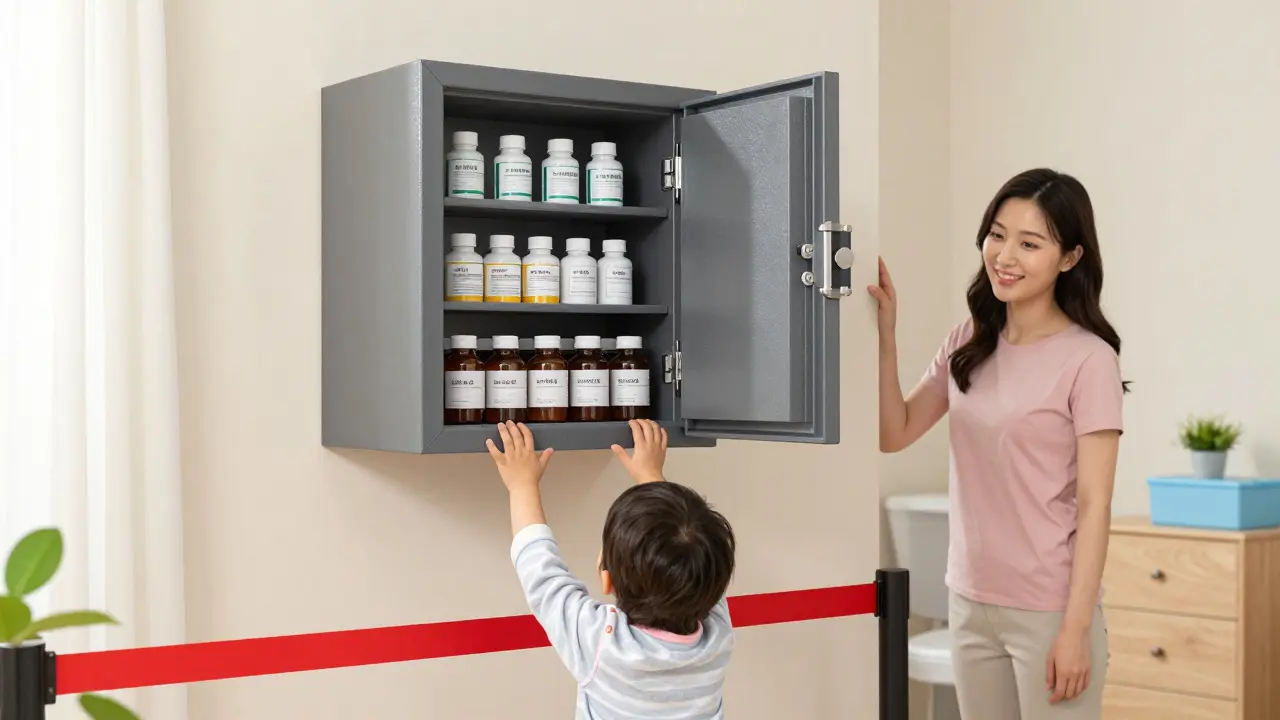
Every household in America keeps medications - pills, syrups, patches, inhalers. But how many of those medicines are still safe to take? How many are sitting where a toddler can grab them, or where humidity and heat have already started breaking them down? And worse - how many might not even be real?
Counterfeit drugs are not just a problem in developing countries. They’re in U.S. homes. Fake versions of opioids, insulin, antibiotics, and even heart medications have been found in online pharmacies and, more dangerously, in legitimate-looking packaging sold through third-party sellers. The FDA has tracked over 1,200 cases of counterfeit medications entering the U.S. supply chain since 2020. Many of these fake pills contain lethal doses of fentanyl, or worse - nothing at all. If you’re taking a pill that doesn’t work, it’s not just a waste of money. It could be life-threatening.
Why Your Medicine Cabinet Is a Risk Zone
The bathroom cabinet is the most common place people store medications. It’s convenient. But it’s also the worst place for them. Every time you take a shower, humidity spikes above 80%. That’s bad news for pills like aspirin, which turns into vinegar and salicylic acid within two weeks. Ampicillin? It loses 30% of its strength in just seven days at that humidity. Insulin? It degrades 15% per hour at room temperature. If you’re relying on it to control diabetes, that drop could mean a trip to the ER.
And then there’s access. A 2023 study from the Washington State Department of Health found that 70% of teens who misuse prescription drugs get them from their own home - often within 15 minutes of deciding to try them. Most of those teens found the meds in unlocked cabinets, nightstands, or even mom’s purse. The American Academy of Pediatrics says child-resistant caps alone only reduce accidental poisoning by 45%. But when you combine them with locked storage? That jumps to 92% protection.
What Real Safe Storage Looks Like
Safe storage isn’t just about keeping kids away. It’s about keeping your medicine effective. The FDA, CDC, and EPA all agree: the gold standard is a locked container, kept in a cool, dry place between 68°F and 77°F. That means your bedroom dresser - not the bathroom. A drawer with a lock. A small safe. Even a locked gun safe works if it’s not too humid inside.
Here’s what you need to do:
- Keep everything in original bottles. Pill organizers are convenient, but they strip away the label, expiration date, and dosage info. The FDA says this causes 78% of medication errors. If you use a pill organizer, only fill it for the day, and keep the original bottle locked up.
- Lock it. Use a lockbox that meets ASTM F2057-20 standards - meaning it can resist tampering by a 4-year-old for at least 10 minutes. Install it at least 5 feet high. If you have elderly family members, choose a combination lock with large dials (Arthritis Foundation recommends these for those with limited grip strength).
- Store temperature-sensitive meds properly. Insulin, certain antibiotics, and biologics must stay between 36°F and 46°F. Keep them in a lockable container inside the fridge - but not in the door. The door fluctuates too much. Place it on a shelf near the back, away from food.
- Keep light-sensitive drugs protected. Tetracycline, riboflavin, and some blood pressure meds break down fast in sunlight. Store them in opaque containers or inside a closed cabinet.
- Never leave meds out during use. 68% of accidental poisonings happen because someone left pills on the counter while giving them to a child or taking their own dose. Always return them to the locked spot immediately.
Spotting Fake Medications
Counterfeit drugs look real. They often have the same color, shape, and branding. But here’s how to check:
- Compare packaging. Look for misspellings, blurry logos, or mismatched fonts. Real drug labels have precise printing. Fake ones look slightly off.
- Check the pill itself. Real pills have consistent color, texture, and markings. If one pill in the bottle looks different, stop using it.
- Verify the source. Only buy from licensed U.S. pharmacies. Avoid online sellers that don’t require a prescription. The FDA warns that 96% of websites selling drugs without a prescription are illegal.
- Use the FDA’s Drug Safety app. It lets you scan barcodes on medication packaging to verify authenticity. It’s free, and it works with most prescription bottles.
If you suspect a fake, don’t throw it away. Take it to a pharmacy that offers drug take-back services. There are over 14,000 permanent collection sites nationwide. The DEA runs a National Prescription Drug Take Back Day twice a year - but you don’t have to wait. Just walk in.
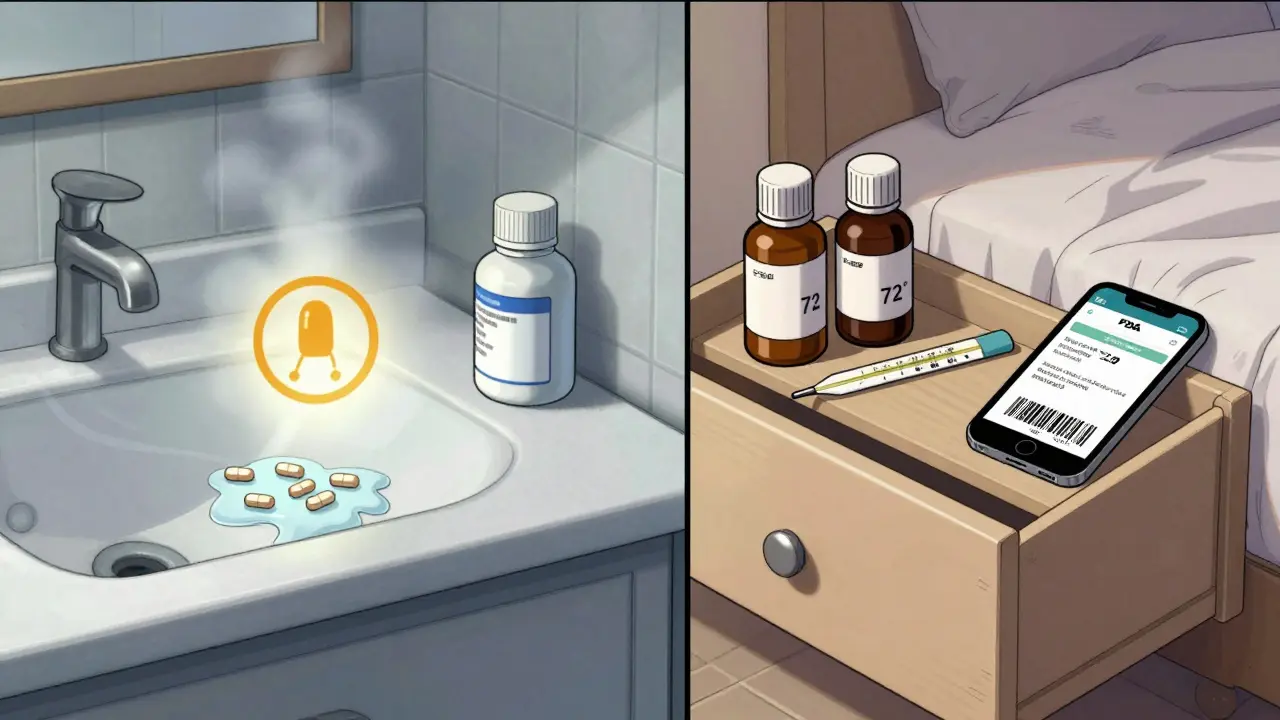
What Happens When You Don’t Store Right
The numbers don’t lie. In 2023, accidental medication poisonings sent 48,000 children under five to emergency rooms. Each visit cost an average of $3,200. That’s $153 million in emergency care costs - all preventable. And that’s just kids. Teens misusing opioids from home cabinets? That’s a leading cause of overdose deaths in that age group.
But it’s not just about accidents. Degraded meds are just as dangerous. If your blood pressure pill lost 20% of its strength because it sat in a steamy bathroom, you’re not getting the protection you need. Your body doesn’t know the difference. You feel fine - until you don’t.
And counterfeit drugs? They’re not just ineffective. They’re deadly. In 2024, the CDC confirmed 3,200 overdose deaths linked to fake oxycodone pills that contained fentanyl. Many of those pills were bought online or given by a friend who got them from a non-pharmacy source.
Real People, Real Solutions
One mother in Ohio told Reddit’s r/Parenting she started using a Gunvault MicroVault on her nightstand after her 3-year-old nearly swallowed her thyroid medication. “It’s small, quiet, and I can open it in the dark,” she wrote. “My anxiety dropped 90%.”
A man in Washington with chronic pain uses a wall-mounted safe at six feet high. “I need my meds fast during a flare-up,” he said. “But I have two toddlers. This lets me reach it in three seconds - and they can’t touch it.”
Both stories show the same thing: secure storage doesn’t have to be complicated. It just has to be consistent.
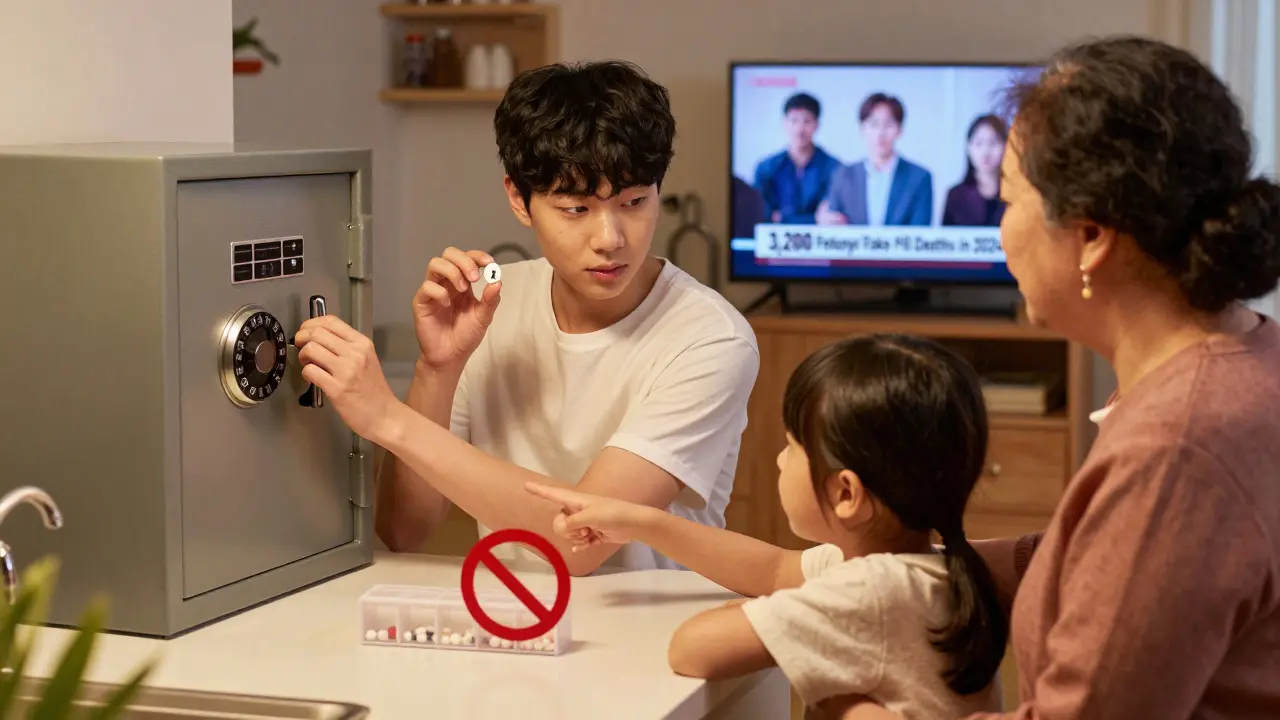
What’s Next: Smart Safes and Better Systems
The market for medication safes is growing fast. Sales jumped 18.7% each year since 2020. By 2029, it’ll be worth over half a billion dollars. Why? Because more people are waking up to the risks.
Smart safes are coming - ones that unlock with your fingerprint or voice. Some even send alerts if someone tries to open them. And in pilot programs at major pharmacies, blockchain systems are being tested to track every pill from manufacturer to your door. It’s not sci-fi. It’s coming.
By 2026, visiting nurses will start checking medication storage during home visits. And home safety ratings might soon include a “medication security” score - just like smoke detectors.
Do This Now
You don’t need to wait for a system change. You can act today:
- Go to every room in your house. Find every medication - even old ones in drawers or back of cabinets.
- Check expiration dates. Toss anything expired (but don’t flush it - take it to a drop-off site).
- Move everything to one locked container in a cool, dry place.
- Teach everyone in the house: “This is not candy. This is not a game.”
It takes 21 days to form a habit. After that, locking up your meds becomes as normal as locking your door.
Can I store all my medications in the same locked box?
Yes - and you should. Keeping all medications in one secure location reduces confusion and risk. Just make sure the box is locked, cool, and dry. Separate refrigerated items (like insulin) into their own small lockable container inside the fridge. Never mix prescriptions with over-the-counter drugs unless you’re using a labeled compartment inside the main safe.
What if I have arthritis and can’t open child-resistant caps?
You’re not alone. The Arthritis Foundation recommends using combination locks with large dials or push-button safes that don’t require fine motor skills. You can also ask your pharmacist for non-child-resistant caps - but only if you have a locked storage solution in place. Never skip the lock just because the cap is hard to open.
How do I know if my medicine is counterfeit?
Look for inconsistencies: blurry text, odd colors, wrong pill shape, or packaging that feels flimsy. Compare it to the version you’ve used before. If you bought it online without a prescription, it’s likely fake. Use the FDA’s Drug Safety app to scan the barcode. If it doesn’t verify, stop using it and take it to a pharmacy for disposal.
Is it safe to store pills in a pill organizer?
Only if you use it as a daily dispenser - not a long-term storage solution. Always keep the original bottle with the label, expiration date, and dosage instructions locked up. Pill organizers don’t protect against moisture, light, or tampering. They also make it harder to spot expired or wrong meds.
Where can I safely dispose of old or unwanted meds?
Take them to a DEA-registered drug take-back location. These are found in pharmacies, hospitals, and police stations. You can find the nearest one using the DEA’s website or by calling your local pharmacy. Never flush pills or throw them in the trash - they pollute water and can be dug up by others.

Ian Glover
My name is Maxwell Harrington and I am an expert in pharmaceuticals. I have dedicated my life to researching and understanding medications and their impact on various diseases. I am passionate about sharing my knowledge with others, which is why I enjoy writing about medications, diseases, and supplements to help educate and inform the public. My work has been published in various medical journals and blogs, and I'm always looking for new opportunities to share my expertise. In addition to writing, I also enjoy speaking at conferences and events to help further the understanding of pharmaceuticals in the medical field.
10 Comments
-
Darlene Gomez
March 25, 2026 AT 07:33It’s wild how we treat life-saving medicine like party snacks. We don’t leave the stove on unattended, we lock our doors, we install smoke alarms-but we leave opioids and insulin on the nightstand like it’s a snack bowl?
The fact that 70% of teen misuse comes from home? That’s not just negligence. That’s a systemic blind spot. We fix bike helmets and car seats, but not medicine storage? We need to treat this like a public health emergency, not a ‘nice-to-have’ tip.
Also, the FDA app for scanning barcodes? Game changer. I just scanned my dad’s blood pressure med-turned out the batch was flagged. Saved him a stroke. This info should be on every prescription label. -
Katie Putbrese
March 25, 2026 AT 08:24If you dont lock your meds your a terrible parent and you deserve the consequences. Kids arent dumb theyre curious. If you leave pills out its your fault if they die. Lock it or dont have kids. End of story.
-
Linda Foster
March 25, 2026 AT 11:51While I appreciate the thoroughness of this guide, I must emphasize that the distinction between storage for adults versus pediatric households remains under-addressed. The FDA’s recommendations are designed for general use, yet they fail to account for the nuanced needs of individuals with mobility impairments or cognitive decline.
For instance, a combination lock requiring fine motor control may be inaccessible to someone with rheumatoid arthritis, yet mandating non-child-resistant caps without additional safeguards introduces risk. A balanced solution-such as biometric safes with voice activation and tamper alerts-should be subsidized or incentivized through insurance, not left to individual initiative.
Policy must evolve alongside awareness. -
Jacob Hessler
March 26, 2026 AT 09:06i just put my stuff in a tupperware and hid it in the closet. no lock, no big deal. if my kid gets into it they probly deserve to be high. jk. kinda. lol.
-
Chris Farley
March 27, 2026 AT 09:24Let’s be real-this whole ‘fake meds’ panic is just big pharma’s way to scare people into buying more expensive stuff from their approved pharmacies. You think the FDA doesn’t have a hand in this? They shut down online pharmacies, sure-but what about the ones that actually deliver real medicine at half the price?
And don’t get me started on the ‘locked box’ nonsense. Who are we, the Soviets? Next they’ll be requiring fingerprint scans just to take Tylenol. This isn’t safety-it’s control dressed up as care.
My grandpa took his pills from a jar on the counter for 40 years. He’s 92. Healthy. You think he needed a gun safe? Nah. He needed a good doctor. Not a prison for his medicine cabinet. -
Amber Gray
March 29, 2026 AT 01:49lmao at the 92% protection stat. so u mean if i lock my meds but my kid still finds them? its their fault? 😂 i just keep em in my bra. no one's gonna touch that. 💃💊
-
Danielle Arnold
March 29, 2026 AT 09:22Wow. So the solution to America’s opioid crisis is… a lockbox? Like if we just put our problems in a drawer and closed the lid, everything’s fine?
Meanwhile, people are dying because they can’t afford real meds, and we’re telling them to buy a $120 smart safe? This isn’t prevention. This is virtue signaling with a deadbolt. -
Korn Deno
March 30, 2026 AT 06:13There’s a deeper layer here that nobody’s talking about: the loss of trust. We don’t just store meds poorly-we don’t believe the system anymore. Why? Because we’ve been sold counterfeit pills wrapped in FDA logos. We’ve seen prices triple overnight. We’ve watched friends die from ‘real’ drugs that didn’t work.
So we hide them. We hoard them. We take them from strangers because we’ve lost faith in the pharmacy, the insurer, the government.
The lockbox won’t fix that. Transparency will. Traceability. Accountability. Not just storage. System change. -
Kevin Y.
March 31, 2026 AT 11:28Thank you for this meticulously detailed and compassionate overview. I work in home health nursing, and I can confirm: the most preventable emergency calls we receive involve unsecured medications. One recent case involved a 7-year-old who ingested a full bottle of lisinopril because it was left on the kitchen counter while the parent answered a phone call.
The solution isn’t just hardware-it’s habit formation. I now include a ‘medication safety checklist’ in every home visit. It takes two minutes. It saves lives.
I’d also like to add: if you’re using a pill organizer, label each compartment with the day and time. Use a permanent marker. Even small details prevent deadly errors.


Write a comment
More Articles
How to Use Patient Counseling to Catch Dispensing Mistakes in Community Pharmacies
Patient counseling catches 83% of dispensing errors before they reach patients-more than barcode scans or double-checks. Learn how asking the right questions, checking pill appearance, and using teach-back methods can prevent deadly mistakes in community pharmacies.

HIV in the Developing World: Challenges and Opportunities for Progress
As a blogger who focuses on global health issues, I've recently delved into the topic of HIV in the developing world. The challenges faced in these regions include lack of access to healthcare, limited resources for prevention and treatment, and cultural barriers that hinder education and awareness. However, there are also significant opportunities for progress, such as increased global funding, innovative strategies to educate communities, and advancements in antiretroviral therapy. By working together and addressing these challenges, I believe we can make a substantial difference in the fight against HIV in the developing world. Let's continue to raise awareness and push for change!
Safe Allergy Medications During Pregnancy: What You Need to Know
Managing allergies during pregnancy requires careful medication choices. Safe options include nasal steroids like Rhinocort and second-gen antihistamines like Zyrtec. Avoid decongestants like Sudafed in the first trimester. Non-drug methods like saline rinses help reduce symptoms. Always consult your doctor before taking any medication.
Kevin Siewe
March 23, 2026 AT 23:28Storing meds in the bathroom is like leaving your car keys in a puddle and hoping they still work. I didn’t realize humidity could wreck insulin until I read this. My mom’s diabetes meds were in the shower cabinet for years. She’s fine now that we moved them to a locked drawer in her bedroom. Small change, huge difference.
Also, never thought about how pill organizers strip away safety info. Now I only fill mine for the day and keep bottles locked. Simple, but it cuts out so much risk.