NSAID Gastrointestinal Bleeding Risk Assessment
This tool helps you understand your risk of gastrointestinal bleeding while taking NSAIDs. Based on your answers, it will calculate your risk level and provide personalized recommendations.
Risk Factors Assessment
Answer the following questions to determine your risk level. Each 'yes' adds to your risk score.
Your Risk Assessment
You have risk factors.
Your Risk Factors:
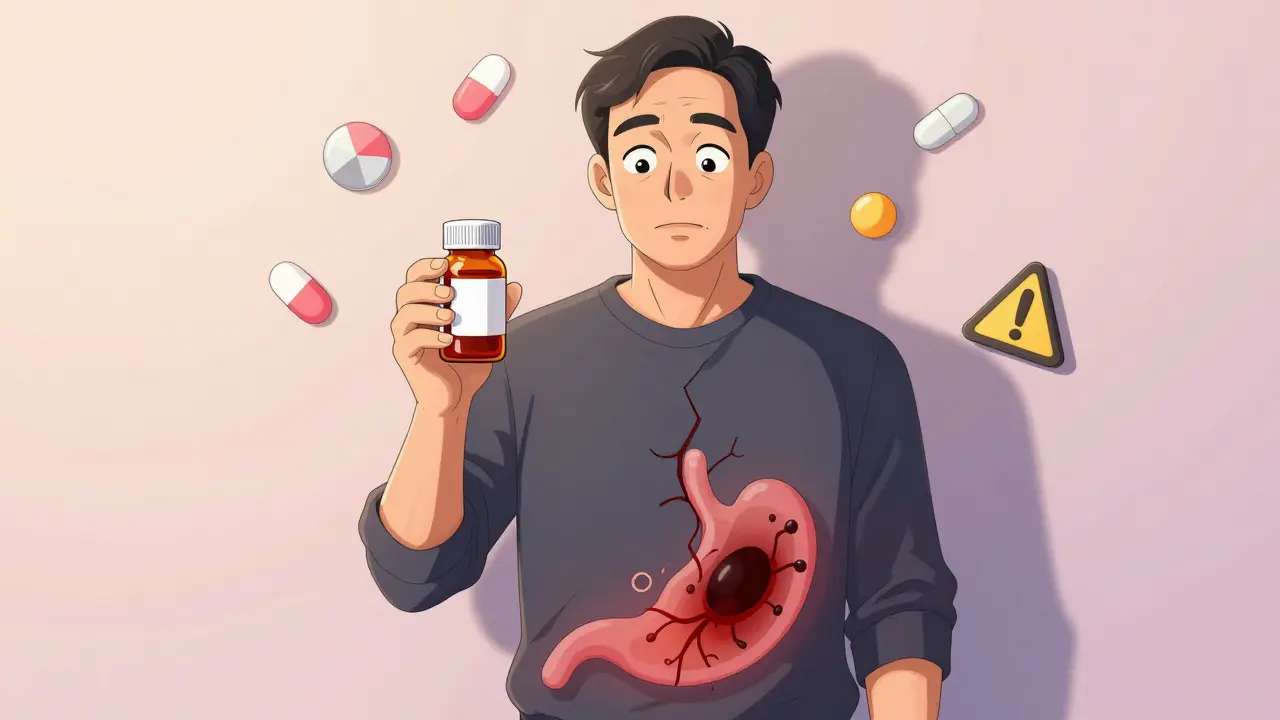
Every year, millions of people reach for ibuprofen, naproxen, or aspirin to ease a headache, sore knee, or back pain. These drugs-called NSAIDs-are everywhere: on pharmacy shelves, in medicine cabinets, even in the pockets of older adults who take them daily. But behind the convenience lies a quiet danger: NSAIDs are one of the leading causes of gastrointestinal bleeding, especially in people with peptic ulcer disease. Many don’t realize they’re at risk until they’re in the hospital with black stools, dizziness, or a sudden drop in hemoglobin. This isn’t rare. It’s common. And it’s preventable.
How NSAIDs Cause Bleeding
NSAIDs work by blocking enzymes called COX-1 and COX-2. COX-2 is involved in inflammation and pain, which is why these drugs help. But COX-1 is the one that protects your stomach lining. It helps produce mucus and bicarbonate that shield your stomach and duodenum from acid. When NSAIDs shut down COX-1, that protective layer breaks down. The acid eats away at the tissue. What starts as a small erosion can turn into a deep ulcer-and sometimes, it bleeds.
This isn’t just about stomach ulcers. Bleeding can happen anywhere in the GI tract. A 1999 study from the Cleveland Clinic Journal of Medicine found that 86% of patients with lower GI bleeding had taken NSAIDs-even though they didn’t have a visible ulcer. That means you can bleed from the small intestine or colon without ever having a classic peptic ulcer. The damage is silent until it’s severe.
Grade 1 lesions are tiny surface scrapes. Grade 4 are deep ulcers with visible blood vessels. Once you hit Grade 3 or 4, bleeding becomes likely. And the risk isn’t the same for everyone. Age, other medications, and how much you take all change the game.
Who’s Most at Risk?
Not everyone who takes NSAIDs bleeds. But some people are walking into danger without knowing it. The biggest red flags:
- Age 70 or older-risk doubles every decade after 60
- History of peptic ulcer or prior GI bleeding
- Taking blood thinners like warfarin or aspirin
- Using corticosteroids (like prednisone)
- Taking more than one NSAID at a time
- Daily doses over 1,200 mg of ibuprofen
- Having serious heart, kidney, or liver disease
A 2021 American College of Gastroenterology guideline says if you have two or more of these, you’re in the high-risk group. That’s not a suggestion-it’s a warning. A 2017 Cochrane review showed that in high-risk patients, adding a proton pump inhibitor (PPI) like omeprazole cuts ulcer complications by 74%. That’s not a small win. It’s life-saving.
Over-the-Counter NSAIDs Are Just as Dangerous
Many people think, “It’s just Advil. It’s safe.” But that’s a myth. A 2021 review in Clinics in Medicine found that 26% of people take OTC NSAIDs at doses higher than recommended. And nearly half never tell their doctor. Why? Because they don’t see it as a drug. They see it as candy.
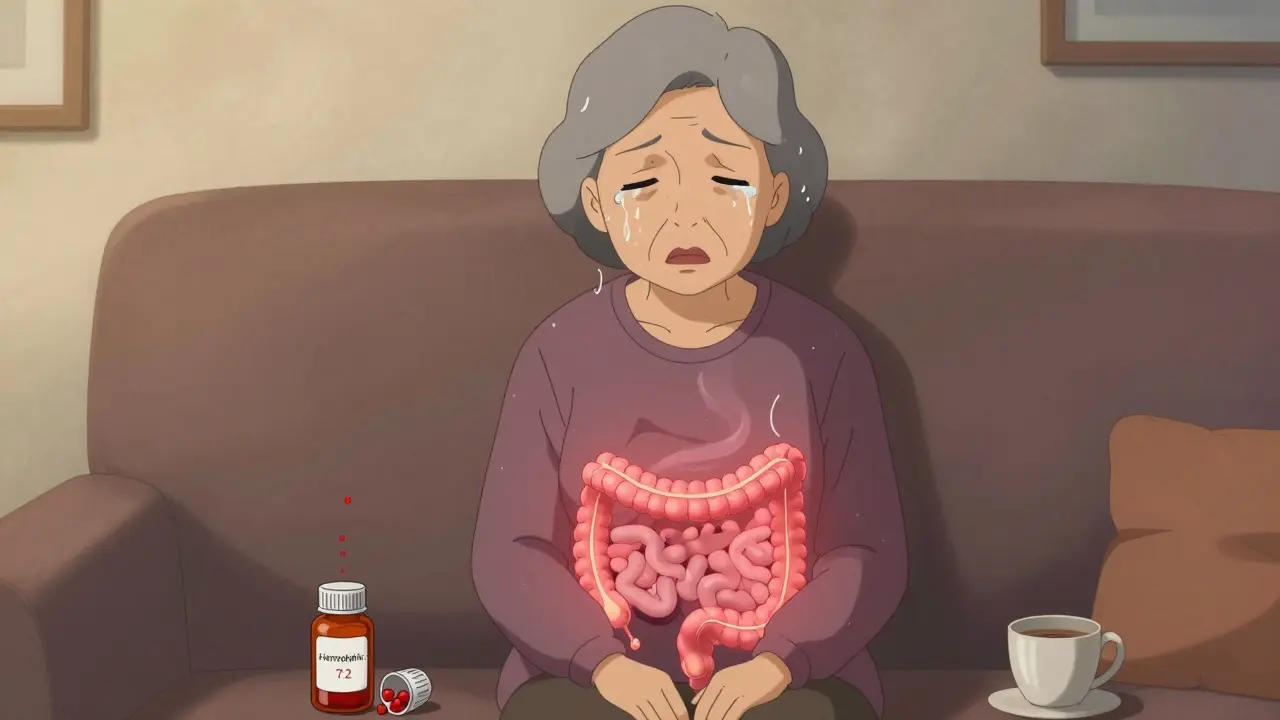
One Reddit user, u/ElderCareHelper, shared how their 78-year-old mother developed iron-deficiency anemia from slow, hidden bleeding. She had no pain, no nausea, no warning. Just fatigue and pale skin. Her hemoglobin dropped to 7.2 g/dL. She needed three units of blood. She’d been taking naproxen daily for arthritis for over a year. No one asked her about it.
That’s not an outlier. A 2022 Arthritis Foundation survey of over 5,000 people showed that 42% stopped taking NSAIDs because of stomach issues. But most didn’t stop because they were warned. They stopped because they got sick.
COX-2 Inhibitors: Safer for the Stomach, Riskier for the Heart
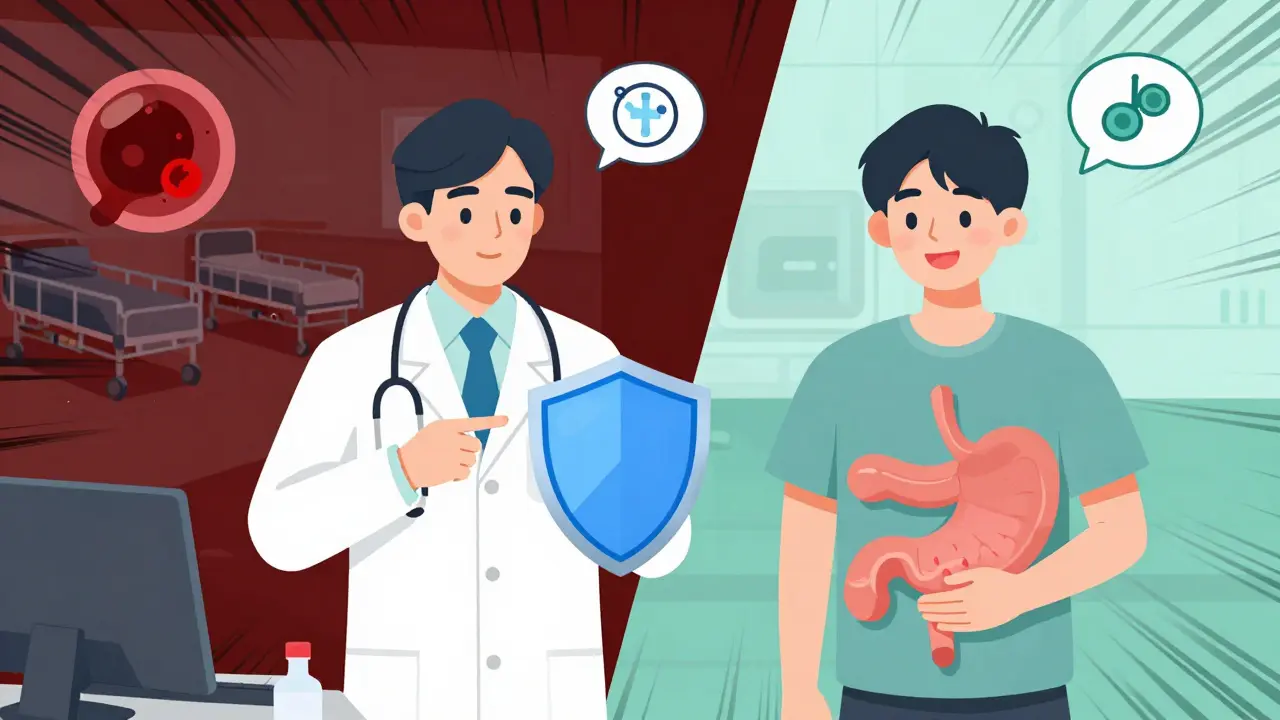
When the risks became too clear, drugmakers developed COX-2 inhibitors-drugs like celecoxib and rofecoxib-that targeted only the inflammation enzyme, sparing the stomach. And they worked. A 2000 Lancet study found celecoxib had half the rate of serious ulcers compared to ibuprofen.
But then came the catch. The 2004 APPROVe trial showed rofecoxib (Vioxx) doubled the risk of heart attacks. It was pulled from the market. Celecoxib stayed, but with a black box warning. Today, COX-2 inhibitors still carry a higher cardiovascular risk than traditional NSAIDs. For someone with heart disease, they might be worse than naproxen.
That’s why the American College of Rheumatology’s 2023 guidelines say: if you have heart problems, avoid COX-2 inhibitors. If you have a history of bleeding, use them with a PPI. There’s no perfect option. Only better trade-offs.
What Actually Protects Your Stomach?
If you need NSAIDs and you’re at risk, what can you do?
- PPIs (proton pump inhibitors): Omeprazole, esomeprazole, pantoprazole. These are the gold standard. They cut ulcer risk by 75%. They’re cheap, widely available, and well-tolerated.
- Misoprostol: This drug replaces the protective mucus that NSAIDs destroy. It works-but 1 in 5 people get diarrhea or cramps. Most quit taking it.
- H2 blockers: Like famotidine. They help a little, but not enough for high-risk patients.
- Combination drugs: Vimovo (naproxen + esomeprazole) was approved in 2023. In one trial, it cut ulcers from 25.6% to 7.3%. It’s more expensive, but for high-risk patients, it’s worth considering.
Don’t assume your doctor will bring this up. In a 2022 HealthUnlocked survey, 63% of NSAID users had GI symptoms-but only 37% talked to their doctor. If you’re taking NSAIDs daily and have any stomach discomfort, bloating, fatigue, or dark stools, say something. Don’t wait.
Real Numbers, Real Consequences
NSAID-related GI bleeding isn’t a footnote. It’s a public health crisis.
- 107,000 hospitalizations per year in the U.S.
- 16,500 deaths annually
- $2.2 billion in healthcare costs
That’s more than the entire annual budget of many small hospitals. And it’s almost entirely preventable. The FDA has required black box warnings on all NSAIDs since 2005. That’s the strongest warning they give. It’s not a suggestion. It’s a legal requirement because the data is undeniable.
And yet, the market keeps growing. The global NSAID market hit $11.3 billion in 2022. Nearly 1 in 6 U.S. adults takes them weekly. Among people with arthritis, it’s over 1 in 3. People need pain relief. But they also need protection.
What Should You Do?
If you’re on NSAIDs long-term:
- Ask yourself: Do I have any of the risk factors? Age? History of ulcers? Blood thinners? Steroids?
- If yes to two or more, talk to your doctor about a PPI. Don’t wait for symptoms.
- Use the lowest dose for the shortest time possible.
- Don’t mix NSAIDs. No ibuprofen + naproxen.
- Watch for signs: black or tarry stools, vomiting blood, unexplained fatigue, dizziness.
- Consider alternatives: acetaminophen for pain, physical therapy, weight loss, or topical treatments.
If you’re over 65 and taking NSAIDs without a PPI, you’re playing Russian roulette with your gut. The odds aren’t in your favor.
What’s Next?
Science is working on better options. New drugs called CINODs-COX-inhibiting nitric oxide donators-are in phase III trials. Naproxcinod, for example, showed 50% fewer ulcers than naproxen in a 2021 study. They might offer pain relief without the gut damage. But they’re years away.
For now, the best tools we have are simple: know your risk, use protection, and don’t assume OTC means safe. The goal isn’t to stop NSAIDs. It’s to use them wisely. Because pain matters. But so does your stomach.

Ian Glover
My name is Maxwell Harrington and I am an expert in pharmaceuticals. I have dedicated my life to researching and understanding medications and their impact on various diseases. I am passionate about sharing my knowledge with others, which is why I enjoy writing about medications, diseases, and supplements to help educate and inform the public. My work has been published in various medical journals and blogs, and I'm always looking for new opportunities to share my expertise. In addition to writing, I also enjoy speaking at conferences and events to help further the understanding of pharmaceuticals in the medical field.
8 Comments
-
Vincent Clarizio
January 12, 2026 AT 00:00Let’s be real here-this whole NSAID crisis isn’t about pharmaceutical negligence or even patient ignorance, it’s about the fundamental collapse of our relationship with medicine as a culture. We treat pills like candy because we’ve been sold the myth of the ‘quick fix’ since the 1980s. We don’t want to sit with discomfort, we don’t want to do physical therapy, we don’t want to lose weight or stretch or meditate-we just want a little blue pill to make the ache go away. And now we’re paying for it with internal bleeding, ICU stays, and death certificates written in black stool. COX-2 inhibitors? PPIs? These are Band-Aids on a hemorrhaging artery of systemic denial. We need a cultural reckoning, not just a prescription change. The body doesn’t lie. It bleeds. And it’s screaming at us through every tarry bowel movement. Are we listening? Or are we just reaching for another Advil?
-
Michael Patterson
January 13, 2026 AT 12:55everyone says ppi’s are the answer but no one talks about how they mess with magnesium and vit b12 and cause osteoporosis over time. so now you got a bleeding ulcer from NSAIDs and then you get weak bones from the medicine meant to fix it. classic pharma trap. also, misoprostol is the real MVP but nobody wants to deal with the cramps and diarrhea. so they just keep taking ibuprofen and hope for the best. lol
-
Alfred Schmidt
January 14, 2026 AT 18:23Are you kidding me? You’re telling me people are still taking OTC NSAIDs without knowing the risks? I’ve seen 70-year-olds on naproxen like it’s aspirin. And then they show up in the ER with Hgb 6.0 and act like it’s a surprise. This isn’t medical advice-it’s a public service announcement. If you’re over 65 and on NSAIDs without a PPI, you’re not just irresponsible-you’re a walking liability to the healthcare system. Stop being lazy. Talk to your doctor. Or don’t. But don’t blame the system when your stomach eats itself.
-
Sean Feng
January 16, 2026 AT 18:15NSAIDs kill. PPIs are a bandaid. End of story.
-
Jason Shriner
January 16, 2026 AT 21:53soooo… we’re supposed to believe that the same pharma companies that sold us opioids are now just *accidentally* giving us stomach ulcers? sure. totally. 🤡
next they’ll tell us aspirin was never meant to thin blood… it was just a ‘side effect’ of wanting to make us feel better. yeah. right.
-
Priya Patel
January 18, 2026 AT 21:01My uncle in India has been taking paracetamol for years for his back pain, and he’s 72 and still hiking! He says, ‘If it doesn’t hurt too bad, I don’t take it.’ So simple. But so many of us overmedicate because we’re scared of discomfort. Maybe the real solution isn’t more pills… but more patience. 💚
-
Jennifer Littler
January 20, 2026 AT 02:19From a clinical pharmacology standpoint, the COX-1/COX-2 selectivity paradigm is fundamentally flawed when applied to chronic NSAID use. The GI toxicity isn't solely COX-1 mediated-there’s significant mucosal disruption via mitochondrial dysfunction and neutrophil infiltration. PPIs mitigate acid-mediated damage but do not address the underlying epithelial apoptosis. The real gap lies in mucosal repair modulation-currently underexplored in clinical guidelines. Until we target the regenerative pathway (e.g., via prostaglandin E2 analogs or Wnt signaling enhancers), we’re treating symptoms, not pathophysiology. Also, the 74% reduction in ulcer complications with PPIs? That’s relative risk. Absolute risk reduction is closer to 5-7% in low-risk populations. Don’t overprescribe.


Write a comment
More Articles
Understanding Vaginal Burning and Its Connection to Chronic Pelvic Pain
Explore how vaginal burning can signal chronic pelvic pain, its causes, diagnosis, and practical treatment steps for lasting relief.

Zithromax: Uses, Side Effects, Dosage, and Key Safety Tips
Zithromax, known as azithromycin, is a popular antibiotic used for various bacterial infections. This article covers what it treats, how it works, common side effects, real-world tips for use, and what to expect during treatment. Learn important safety information, how to take Zithromax for best results, and answers to questions people often ask before starting this medication.
Understanding Cabergoline: How It Works and What to Expect
Cabergoline is a medication I recently came across, and I thought it would be helpful to share my understanding of how it works and what to expect. It's primarily used to treat high levels of prolactin in the body, which can cause various health issues. The drug works by acting on dopamine receptors, which helps to reduce prolactin levels. Some common side effects include nausea, dizziness, and headache, but most people tolerate the medication well. If you're prescribed cabergoline, it's important to follow your doctor's instructions closely and report any concerning side effects.
Priscilla Kraft
January 10, 2026 AT 13:50Just had my mom get hospitalized last year from a silent NSAID bleed-she’d been taking naproxen daily for 5 years thinking it was ‘just pain relief.’ No warning, no pain, just extreme fatigue. She’s on omeprazole now and feels like a new person. If you’re over 60 and on NSAIDs, please, please talk to your doctor. It’s not scare tactics-it’s survival. 🙏❤️