
Health systems aren’t waiting for the next crisis. With healthcare workforce shortage hitting record levels, hospitals and clinics across the U.S. and beyond are running on emergency mode - but not just by hiring more bodies. They’re rebuilding how work gets done, who does it, and what tools support them. The numbers don’t lie: by 2026, the U.S. could be short 3.2 million healthcare workers. Nurses, techs, doctors, and even administrative staff are stretched thin. Burnout is at 63%, and nearly half of nurses are thinking about quitting. So what’s actually working?
Stretching what you have: cross-training and flexible scheduling
Instead of just adding more staff, many hospitals are making better use of who’s already there. Cross-training has become a standard tactic - nurses learning basic phlebotomy, medical assistants handling intake forms, and even administrative staff managing simple billing tasks. Forty-three percent of hospitals now use this approach, according to the American Nurses Association. It reduces bottlenecks and gives employees more variety in their day - which helps with morale.
Flexible scheduling is another quiet game-changer. Shifts aren’t one-size-fits-all anymore. Some nurses work three 12-hour shifts. Others do four 10-hour days. Some get weekends off in exchange for weekday nights. Thirty-seven percent of major hospital systems ran pilot programs with flexible schedules, and burnout dropped by 19%. At Cleveland Clinic, flexible shifts cut turnover by 25%. It’s not just about rest - it’s about control. When people can choose when they work, they’re less likely to leave.
Bringing in outside help - but smarter
Travel nurses were once seen as a last resort. Now, they’re part of the regular plan. Twelve point seven percent of U.S. hospitals used travel nurses during peak times in 2023. But the real shift is in how they’re managed. Instead of relying on dozens of agencies, big systems like Kaiser Permanente are building their own internal staffing models. That cuts agency fees and gives them more control over quality and fit. They’ve reduced external agency reliance by 28%.
Per diem staff - those hired day-by-day - are also growing. Twenty-two percent of facilities now use them, especially for holidays, flu season, or sudden surges. International hires are up too. Eighteen percent of U.S. hospitals are recruiting globally, especially for nurses and radiology techs. It’s not a perfect fix - visa delays and cultural adaptation take time - but it’s filling critical gaps.
AI isn’t replacing people - it’s unburdening them
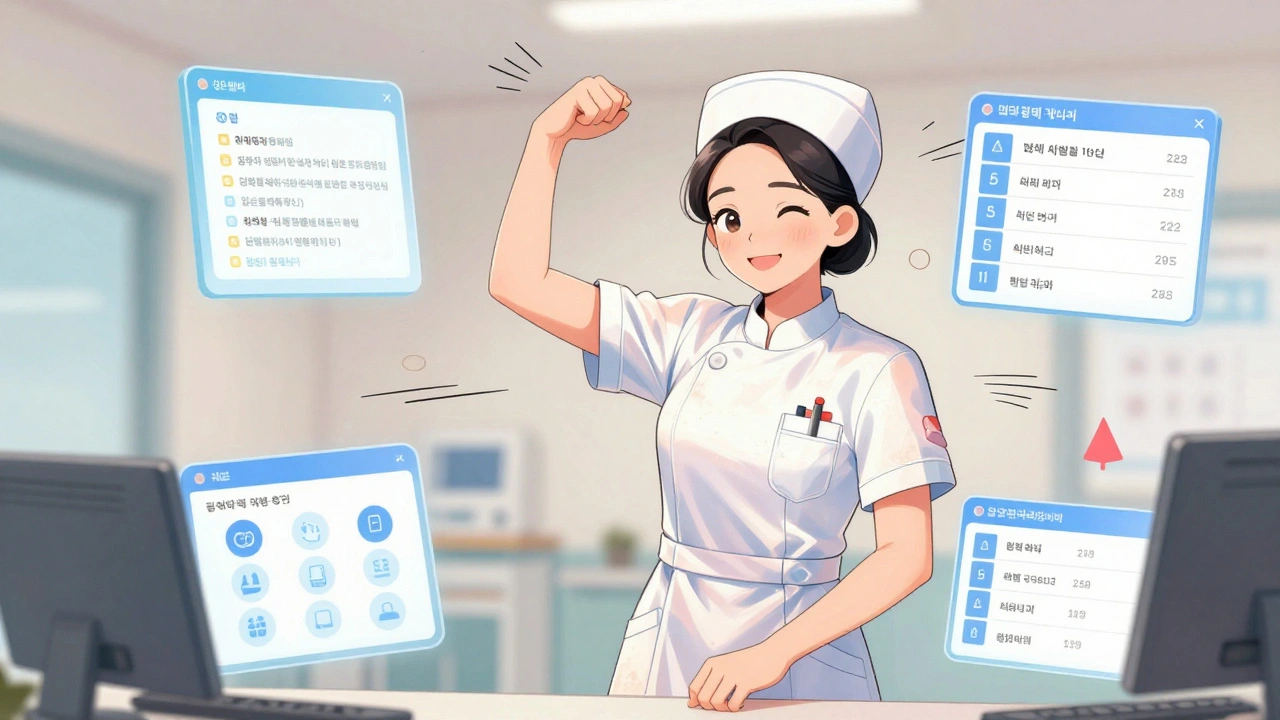
Artificial intelligence isn’t here to take jobs away. It’s here to take the boring stuff off people’s plates. At Baptist Health, with 23,000 employees, AI-powered document processing cut administrative work by 37%. That means nurses aren’t spending hours entering data into systems. They’re spending it with patients.
Generative AI spending in healthcare is expected to jump 51% from 2024 to 2025. Tools now auto-summarize patient notes, suggest discharge plans, flag medication errors, and even schedule follow-ups. IDC predicts the industry will save $382 billion by 2027 just by automating routine tasks. That’s not sci-fi - it’s happening now in hospitals from Atlanta to Seattle.
Keeping people from leaving: money, support, and growth
Signing bonuses? They’re common now. Most hospitals offer $15,000 to $25,000 just to walk in the door. Tuition reimbursement is offered by 68% of major systems. Loan forgiveness programs are used by 57% of public hospitals. These aren’t perks - they’re survival tools.
But money alone doesn’t keep people. Mental health support is becoming standard. Hospitals are hiring dedicated wellness coordinators, offering free counseling, and running peer support groups. One study found mental health programs reduced turnover by 17%.
And career paths? Big factor. Nurses don’t just want to stay - they want to grow. Accelerated nursing programs have nearly doubled graduate numbers since 2013. Micro-credentials - short certifications in areas like wound care or diabetes management - are now used by 29% of systems. They give staff a sense of progress without going back to school for years. Retention jumped 23% where these programs exist.
Changing where care happens
Not every patient needs to be in a hospital. That’s the new mantra. Team-based care - where nurse practitioners and physician assistants handle routine visits while doctors focus on complex cases - is now used by 78% of primary care clinics. Patient capacity went up 33% without adding more doctors.
Home-based care is expanding fast. CMS reported a 22% drop in hospital readmissions thanks to better in-home monitoring and support. For older adults and people with chronic conditions, this isn’t just convenient - it’s life-changing. It also frees up hospital beds for emergencies.

Building the next generation - from the ground up
Long-term fixes need to start early. Mayo Clinic partnered with local community colleges in Minnesota to create a pipeline for rural healthcare workers. Between 2022 and 2024, their local hire rate jumped 47%. Johns Hopkins introduced phased retirement for nursing faculty - letting them teach part-time with full benefits. Retention rose 22%.
States are joining in. The National Governors Association launched a Learning Collaborative that helped 34 states build partnerships between hospitals and local schools. These aren’t just internships - they’re guaranteed job pathways. Students get paid while learning. Hospitals get trained workers. It’s a win.
The gap still exists - and it’s growing
But let’s be clear: none of this is a magic bullet. Sixty-three percent of healthcare workers still report burnout. Forty-two percent of nurses say they’re considering quitting. And in low-income countries, 83% of facilities don’t even have basic workforce planning tools. The U.S. has resources. Many others don’t.
What’s working best? Systems that combine tactics. Intermountain Healthcare slashed vacancy rates from 18% to 7% in two years by doing three things at once: flexible scheduling, AI tools, and community college partnerships. Cleveland Clinic boosted retention by 34% with career pathways, AI training, and flexible shifts.
The message? You can’t fix a broken system with one fix. You need layers - immediate relief, smart tech, better support, and long-term investment in people. The systems that survive aren’t the ones with the biggest budgets. They’re the ones that listen to their staff - and act.
What’s next?
Eighty-nine percent of healthcare leaders plan to spend more on AI and automation by 2026. That’s not hype - it’s necessity. But the real winners will be those who use tech to empower, not replace. Nurses who spend more time with patients. Techs who aren’t buried in paperwork. Administrators who can focus on strategy instead of scheduling.
The future of healthcare isn’t about having more people. It’s about making the people you have more effective, more supported, and more valued. That’s the real shortage we’re solving.

Ian Glover
My name is Maxwell Harrington and I am an expert in pharmaceuticals. I have dedicated my life to researching and understanding medications and their impact on various diseases. I am passionate about sharing my knowledge with others, which is why I enjoy writing about medications, diseases, and supplements to help educate and inform the public. My work has been published in various medical journals and blogs, and I'm always looking for new opportunities to share my expertise. In addition to writing, I also enjoy speaking at conferences and events to help further the understanding of pharmaceuticals in the medical field.
15 Comments
-
Joe Lam
December 4, 2025 AT 03:40Let’s be honest - none of this matters if you’re still paying nurses $28 an hour while CEOs take home seven figures. You can throw all the AI and flexible shifts at the problem, but if the culture is toxic and the pay is garbage, people will leave. This is capitalism pretending to care.
-
Chase Brittingham
December 5, 2025 AT 17:59I’ve seen this firsthand. My sister’s a nurse in Ohio. They started cross-training EMTs to handle vitals and intake - suddenly she had time to actually talk to patients instead of running between rooms. Burnout didn’t vanish, but it stopped being a death sentence. Small wins matter.
-
Gillian Watson
December 6, 2025 AT 22:04Interesting to see how much the UK could learn from this. We’ve got the same staffing crisis but no real investment in tech or flexible models. Just more overtime and guilt trips. Maybe we need to stop romanticizing ‘sacrifice’ and start treating healthcare like a profession, not a calling.
-
Michael Feldstein
December 6, 2025 AT 23:53Love the part about micro-credentials. My cousin did a 6-week cert in diabetes management and got promoted without going back to school. It’s not about degrees anymore - it’s about skills you can apply tomorrow. Hospitals that get that will keep talent. The rest will keep spinning their wheels.
-
Augusta Barlow
December 8, 2025 AT 03:40AI is just a distraction. They’re not fixing the root problem - they’re just automating the symptoms. Next thing you know, patients are talking to chatbots because ‘the system’ says it’s more efficient. And don’t get me started on how they’re using international hires to avoid raising wages at home. It’s exploitation dressed up as innovation.
-
jagdish kumar
December 9, 2025 AT 05:46The system is a temple of suffering. We worship productivity. We sacrifice the healers. The AI, the schedules, the bonuses - they’re incense. The gods are still hungry.
-
Benjamin Sedler
December 9, 2025 AT 14:12Wait, so we’re now celebrating hospitals that use travel nurses like they’re some kind of victory? That’s just outsourcing burnout. You pay a temp $150/hr to patch a hole while you ignore the crumbling foundation. And don’t even get me started on ‘wellness coordinators’ - that’s HR’s way of saying ‘we know you’re broken but we won’t fix the machine.’
-
Rudy Van den Boogaert
December 10, 2025 AT 05:59My uncle’s a rural ER doc. They started partnering with the community college down the road - paid students to shadow, then hired them after graduation. Two years later, turnover dropped from 60% to 18%. No magic. Just investment. Simple stuff, but no one does it until it’s too late.
-
Heidi Thomas
December 10, 2025 AT 19:51Stop lying to yourselves. Flexible shifts don’t fix burnout. You still have the same workload, just rearranged. And AI? It just makes you more productive for the same pay. This isn’t innovation - it’s efficiency porn. The real fix? Raise wages, reduce hours, and stop treating nurses like disposable parts.
-
michael booth
December 11, 2025 AT 23:18Team based care is the future. Nurse practitioners handling 70% of routine visits frees up physicians for complex cases. It’s not theory - it’s data driven. And it works. We’ve seen 30% higher patient satisfaction scores. The resistance is cultural not practical.
-
Dematteo Lasonya
December 12, 2025 AT 22:51Home-based care is the quiet revolution. I had my mom on a remote monitoring program after her heart surgery. She didn’t need to be in the hospital. She was safer at home. And the hospital saved $12k per admission. Why isn’t this standard everywhere?
-
Chad Handy
December 13, 2025 AT 09:34Let’s not pretend any of this is sustainable. Cross-training? That’s just making people do five jobs instead of three. Flexible scheduling? Great, unless you’re stuck with 3 AM shifts every other week. AI? It’s just another layer of surveillance disguised as help. And don’t even get me started on the signing bonuses - they’re just bait to get people in the door before the real grind sets in. The system is broken. These are Band-Aids on a severed artery. We need to rebuild from the ground up - not rearrange deck chairs on the Titanic.
-
Jordan Wall
December 15, 2025 AT 05:01AI in healthcare? More like AI in bureaucracy. The real bottleneck is the EHR - 17 different systems, 12 redundant fields, and zero interoperability. No one’s fixing that. They’re just slapping on generative AI to auto-fill the garbage. It’s like putting a Ferrari engine in a 1998 Corolla and calling it innovation. We need to replace the whole damn chassis, not polish the dashboard.
-
Bill Wolfe
December 15, 2025 AT 15:53Wow. So we’re patting ourselves on the back for using travel nurses and AI like it’s some kind of moral victory? Meanwhile, nurses are dying from stress-related heart attacks and we’re talking about ‘micro-credentials’ like it’s a TED Talk. This isn’t problem-solving. It’s performative compassion. You don’t solve a crisis by giving people a stress ball and calling it wellness. You fix the system. Or stop pretending you care.


Write a comment
More Articles

Bepotastine for Latex Allergy: Effectiveness, Dosage, and Alternatives
Explore whether bepotastine works for latex allergy, its mechanism, dosage, safety profile, and how it compares to other antihistamines.
How to Manage Medication Costs During Medicare Part D Coverage Gaps in 2024 (Before the Donut Hole Ends)
Learn how to lower prescription drug costs during Medicare Part D's coverage gap (donut hole) in 2024 before it ends. Discover real strategies like manufacturer discounts, generic switches, and Extra Help to avoid financial strain.

zac grant
December 3, 2025 AT 17:08AI is the real MVP here. At my hospital, we cut documentation time by almost 40% with automated note summarization. Nurses are actually smiling again. Not because they’re working less, but because they’re doing what they trained for - caring for patients, not chasing keystrokes.