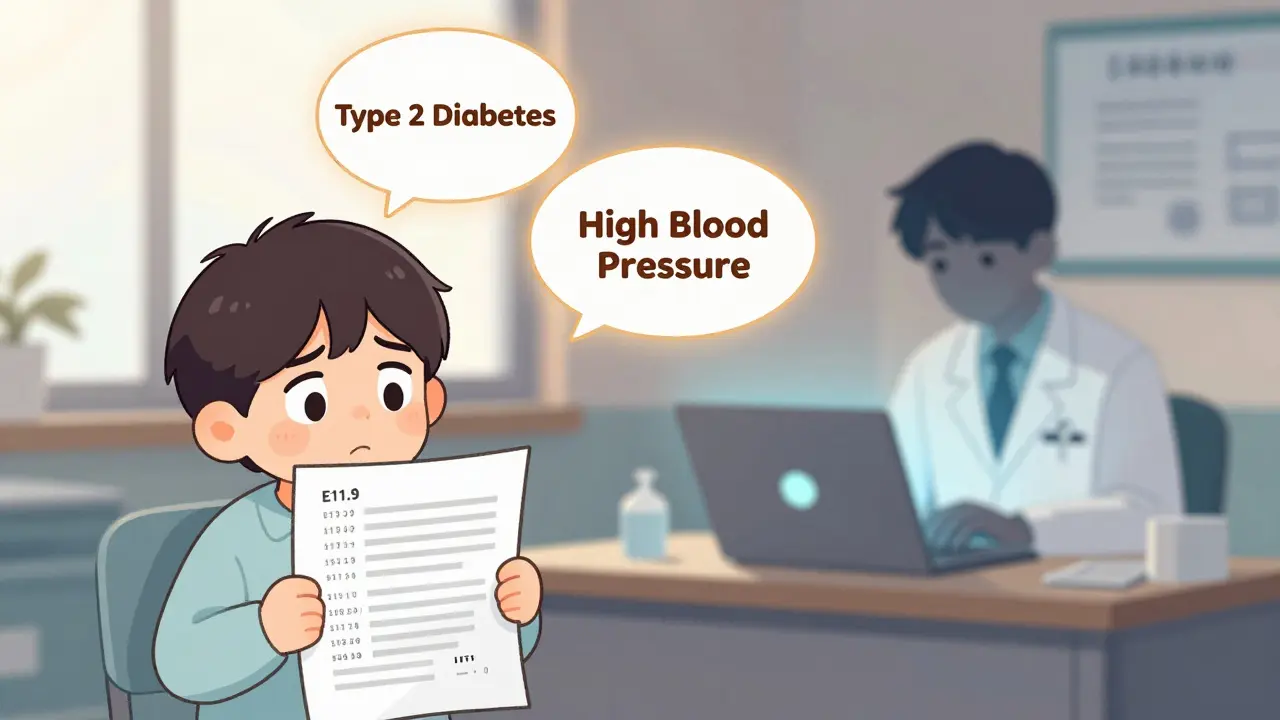
When you leave the doctor’s office, you might walk away thinking, "I have poorly controlled DM," and wonder if that means you’re failing at being a good patient. Meanwhile, your provider checked off "ICD-10 code E11.9" in the system, thinking they’d accurately documented your condition. But here’s the truth: patient information and healthcare provider information aren’t just different-they’re often speaking two different languages.
Why Your Doctor’s Notes Don’t Sound Like Your Experience
Healthcare providers use standardized codes to track diagnoses and treatments. These include ICD-10 for diseases (over 70,000 codes) and CPT for procedures (more than 10,000). These aren’t just bureaucratic tools-they’re how hospitals get paid, how insurance claims are processed, and how public health data is collected. But these codes don’t capture how you feel. You might say, "I’m so tired all the time, and I’m drinking water nonstop," but your provider writes "Type 2 Diabetes Mellitus, uncontrolled." That’s not a lie-it’s a translation. But it’s a translation that often leaves you confused, scared, or even ashamed. A 2019 study in the Journal of General Internal Medicine found that 68% of patients didn’t understand common medical terms. Over 40% didn’t know "hypertension" meant high blood pressure. Over 60% didn’t recognize "colitis" as an inflamed colon. When you’re handed a discharge summary filled with abbreviations and codes, you’re not being educated-you’re being handed a document written for a system, not for you.The Hidden Cost of Miscommunication
This gap isn’t just annoying. It’s dangerous. Dr. Thomas Bodenheimer, a leading voice in primary care reform, estimates that 30-40% of medication errors stem from patients misunderstanding what they were told. If you think "poorly controlled DM" means you’re a bad person, you might stop taking your pills out of guilt-not because you don’t believe they work. That’s not noncompliance. That’s miscommunication. The Institute of Medicine reported back in 2001 that communication failures contributed to 80% of serious medical errors. Fast forward to today, and little has changed structurally. A 2022 survey by the American Medical Association found that 57% of patients felt confused by the terms in their medical records. And 32% of them avoided follow-up care because they didn’t understand what their doctor wrote. Meanwhile, providers aren’t immune to frustration. In a 2023 Medscape survey, 64% of physicians said they spent 15 to 30 minutes per visit just explaining terms. That’s a third of a typical 15.7-minute appointment-time that could’ve been spent adjusting treatment, answering real concerns, or just listening.What’s Changing: Patient Access to Notes
The 21st Century Cures Act, passed in 2016, forced a major shift. Starting in April 2021, providers had to give patients access to their clinical notes without editing them. Before that, only 15% of patients could see what was written about them. By 2023, 89% could. That change created a problem: patients were reading notes written for billing and clinical workflows-and getting scared. One patient on PatientsLikeMe wrote: "My doctor said I had 'noncompliant behavior.' I thought I was being labeled a rebel. I didn’t know it meant I missed my last appointment." Some health systems responded by rewriting notes for patients. Kaiser Permanente’s "Open Notes" program, running since 2010, now reaches 2.7 million people. They started using plain-language versions of clinical notes-turning "myocardial infarction" into "heart attack," "hypertension" into "high blood pressure." The result? A 27% drop in patient confusion and a 19% increase in people taking their meds as prescribed.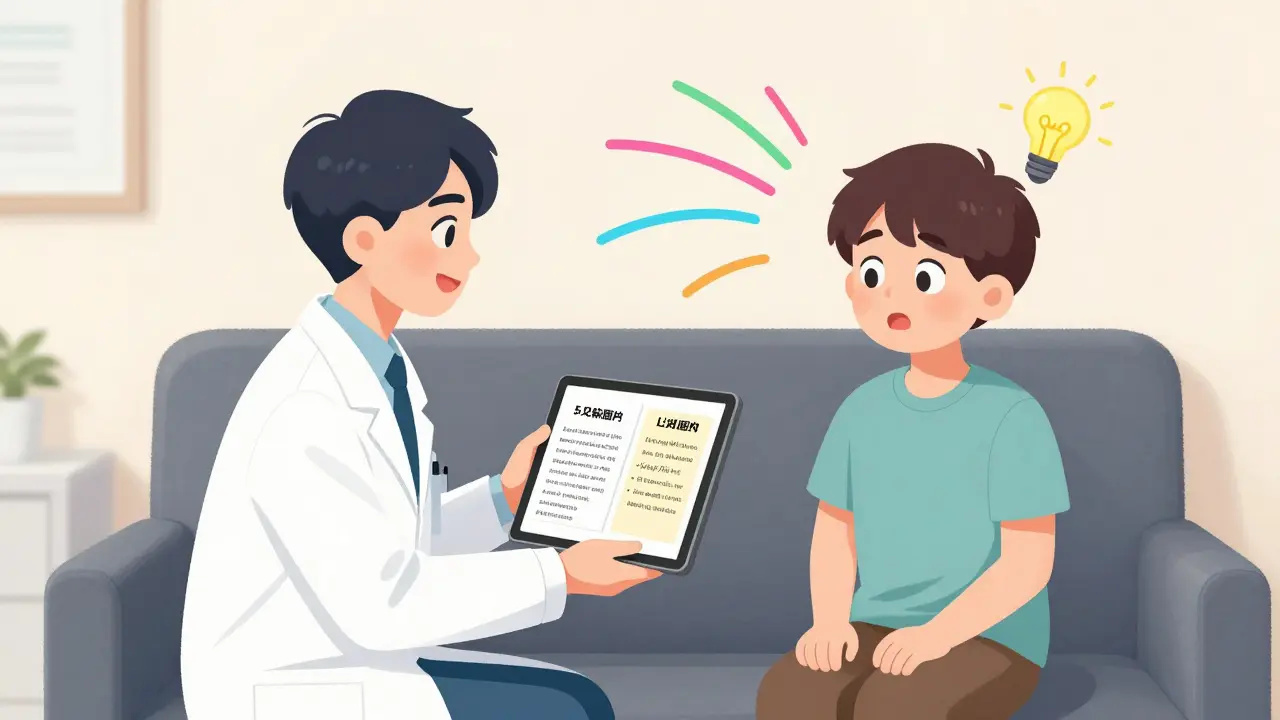
Who’s Bridging the Gap?
Enter Health Information Management (HIM) professionals. These aren’t just data entry clerks. They’re the translators between two worlds. Certified by AHIMA since 1928, they ensure that what’s written in the chart is accurate, complete, and protected under HIPAA. But now, their job includes something new: making sure the language doesn’t alienate the person it’s about. HIM specialists spend over 1,200 hours training-400 of those focused on ICD-10 coding alone. But they’re also learning how to help providers write in ways patients can understand. They’re the ones pushing for templates that auto-translate "hyperlipidemia" to "high cholesterol" in patient-facing documents. The AHRQ’s "Health Literacy Universal Precautions Toolkit" recommends the "teach-back" method: asking patients to repeat back what they heard. A 2018 JAMA study showed this cuts miscommunication by 45%. It’s simple. It’s effective. And it’s still not used in most clinics.The Future Is Dual-Language Systems
The world is catching up. The WHO’s ICD-11, rolled out globally in 2022, now includes patient-friendly descriptions alongside clinical codes. For the first time, a disease code comes with a plain-language explanation built in. Technology is helping too. The HL7 FHIR standard, used by 78% of major U.S. health systems, allows EHRs to show two versions of the same note: one for providers, one for patients. Epic’s MyChart, used by 76% of its clients, now lets patients toggle between clinical and plain-language terms in their records. And AI is stepping in. Google Health’s Med-PaLM 2, released in 2023, can convert clinical notes into patient-friendly language with 72.3% accuracy. It’s not perfect yet-95% is the target for clinical use-but it’s a start. By 2027, the American Medical Informatics Association predicts 60% of EHRs will have real-time translation features built in. That means when a doctor types "E11.9," the patient’s portal will automatically show "Type 2 Diabetes, not well managed." No more guessing. No more shame.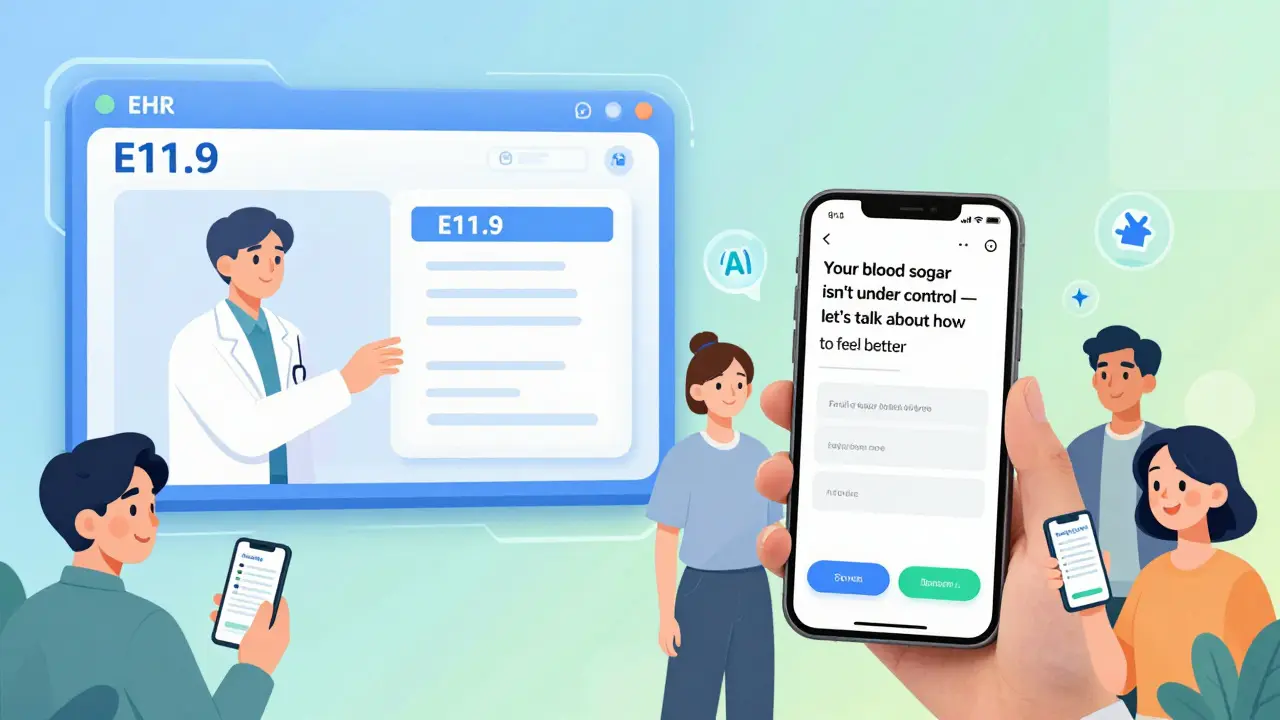
What You Can Do Today
You don’t have to wait for technology to fix this. Here’s what you can do right now:- Ask: "Can you say that in plain English?"
- Request a copy of your notes before you leave. Read them. Write down questions.
- If you see a term you don’t understand, don’t pretend you do. Say: "I’m not sure what that means. Can you explain it?"
- Use patient portals to your advantage. If your provider offers plain-language notes, turn them on.
- Bring someone with you to appointments. A second set of ears helps.
What Providers Can Do
If you’re a clinician, here’s what matters:- Stop assuming your patient knows what "DM" or "HTN" means. Even if they’ve had it for years, they might still be guessing.
- Use the teach-back method. Don’t ask, "Do you understand?" Ask, "Can you tell me how you’ll take this medicine?"
- Advocate for plain-language templates in your EHR. If your system doesn’t have them, ask for them.
- When documenting, write for the person, not just the system. "Patient reports constant fatigue and increased thirst" is just as valid as "E11.9."
The Bigger Picture
This isn’t about better charts or smarter software. It’s about respect. For over a century, medical records were built for efficiency, billing, and legal protection-not for understanding. But patient-centered care isn’t a buzzword. It’s a requirement. CMS now ties 2% of hospital reimbursements to how well patients say they were communicated with. And patients are speaking up. The future of healthcare isn’t just about who has the best technology. It’s about who can speak the clearest language-not just to each other, but to the people they’re trying to help.Why do doctors use medical terms patients don’t understand?
Doctors use standardized medical terms like ICD-10 and CPT codes because they’re required for billing, insurance claims, and national health data tracking. These codes ensure consistency across providers and systems. But they weren’t designed for patients. The problem isn’t intent-it’s legacy systems that haven’t caught up to patient-centered care.
Can I ask my doctor to rewrite my medical notes in plain language?
Yes. Under the 21st Century Cures Act, you have the right to access your clinical notes. While providers aren’t required to rewrite them, many hospitals now offer plain-language versions automatically in patient portals like MyChart. You can also ask your provider or medical records department if they offer this option.
What’s the difference between ICD-10 and patient-friendly labels?
ICD-10 is a coding system used by providers to classify diseases for billing and research. For example, "E11.9" means "Type 2 Diabetes Mellitus without complications." A patient-friendly label would say "Type 2 Diabetes" or even "high blood sugar condition." The code is precise for systems; the plain term is clear for people.
How do I know if my doctor’s notes are accurate?
You can request a copy of your medical records at any time. Review them for accuracy-especially diagnoses, medications, and symptoms. If something doesn’t match your experience, bring it up at your next visit. You have the right to request corrections under HIPAA. Many clinics now allow you to add comments directly in your patient portal.
Are there tools that help translate medical jargon?
Yes. Many patient portals now offer plain-language toggles. Apps like MedlinePlus and Healthline offer free medical term translators. Some EHRs, like Epic and Cerner, are rolling out AI tools that auto-convert clinical notes into simple language. Google’s Med-PaLM 2 can translate notes with 72% accuracy, and more tools are coming.

Ian Glover
My name is Maxwell Harrington and I am an expert in pharmaceuticals. I have dedicated my life to researching and understanding medications and their impact on various diseases. I am passionate about sharing my knowledge with others, which is why I enjoy writing about medications, diseases, and supplements to help educate and inform the public. My work has been published in various medical journals and blogs, and I'm always looking for new opportunities to share my expertise. In addition to writing, I also enjoy speaking at conferences and events to help further the understanding of pharmaceuticals in the medical field.
More Articles
Clonidine in Dentistry: Uses, Benefits, and Practical Guide
Explore how clonidine improves dental procedures by reducing pain, anxiety, and bleeding. Learn dosage, safety, benefits, and practical tips for dentists.
Antiretroviral Therapy and Common Medications: High-Risk Interactions
Antiretroviral therapy saves lives, but dangerous drug interactions with common medications can cause serious harm. Learn which HIV drugs clash with statins, painkillers, and herbal supplements - and what to do about it.
How to Use Patient Counseling to Catch Dispensing Mistakes in Community Pharmacies
Patient counseling catches 83% of dispensing errors before they reach patients-more than barcode scans or double-checks. Learn how asking the right questions, checking pill appearance, and using teach-back methods can prevent deadly mistakes in community pharmacies.