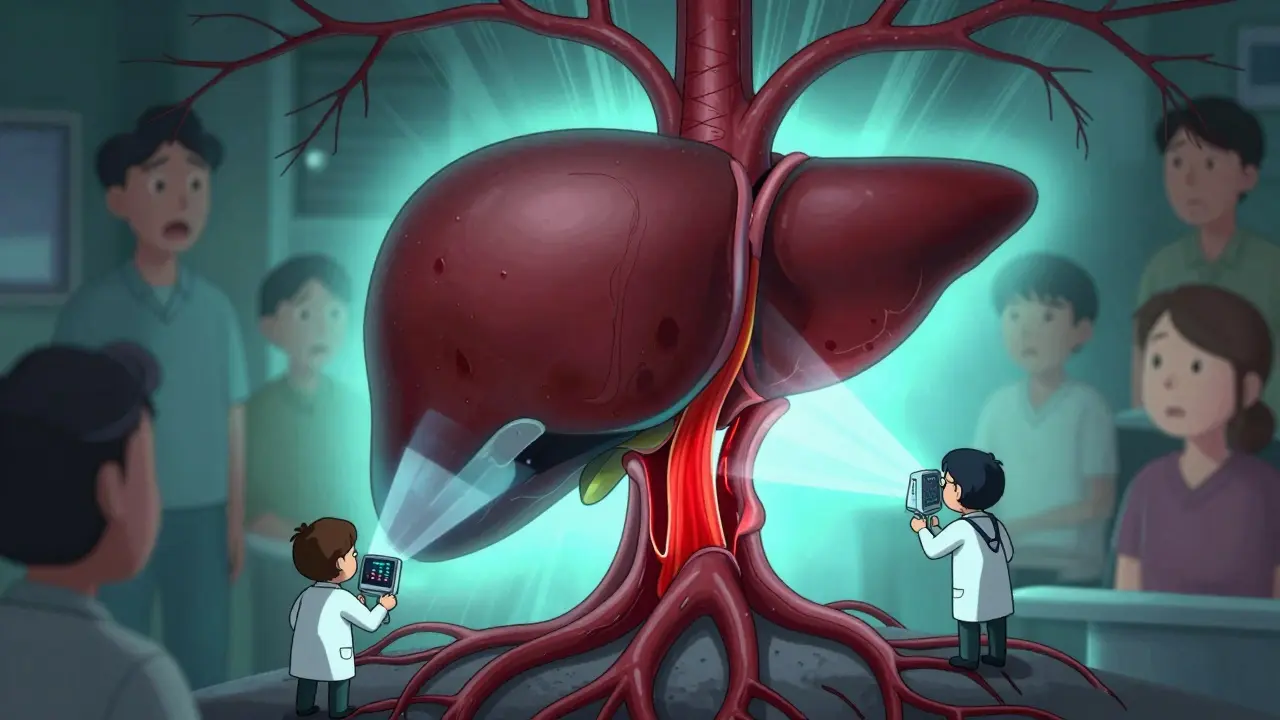
What Is Portal Vein Thrombosis?
Portal vein thrombosis (PVT) happens when a blood clot blocks the portal vein - the main vessel that carries blood from your intestines to your liver. It’s not rare, especially in people with liver disease, cancer, or inherited blood clotting disorders. The clot can be partial or complete, and it can show up suddenly (acute) or develop slowly over time (chronic). Acute PVT is more treatable. If left alone, it can lead to serious problems like intestinal damage, worsening liver scarring, or even life-threatening bleeding.
First described in 1868, PVT follows Virchow’s triad: slow blood flow, damaged vessel walls, and blood that clots too easily. Today, we know that cirrhosis is the most common cause - but not the only one. Other triggers include abdominal infections, pancreatitis, recent surgery, or even pregnancy. In people without liver disease, up to 30% have an underlying clotting disorder like Factor V Leiden. That’s why testing for these conditions matters.
How Is Portal Vein Thrombosis Diagnosed?
Ultrasound is the first and most important test. It’s quick, safe, and detects PVT with 89-94% accuracy. A Doppler ultrasound doesn’t just show the clot - it shows if blood is still flowing through the vein. If the portal vein looks blocked and there’s no flow, that’s a clear sign of PVT. In some cases, the body builds new tiny blood vessels around the clot, a pattern called cavernous transformation. That usually means the clot has been there for a while.
If the ultrasound is unclear, doctors turn to CT or MRI scans with contrast. These give a detailed 3D view of the portal system and help decide how much of the vein is blocked. Is it 50%? 90%? Completely closed? The level of blockage affects treatment choices. A clot that’s just started (within two weeks) has a much better chance of dissolving than one that’s been there for months.
But diagnosis isn’t just about imaging. You also need to know why it happened. That means checking liver function with Child-Pugh and MELD scores, screening for varices (swollen veins in the esophagus) with an endoscopy, and running blood tests for clotting disorders. Skipping these steps can lead to dangerous mistakes - like giving anticoagulants to someone who’s about to bleed.
Why Anticoagulation Is the Standard Treatment
For years, doctors were unsure whether to treat PVT with blood thinners - especially in cirrhotic patients. But the data now is clear: anticoagulation saves lives. A 2023 study showed that patients treated early had an 85% five-year survival rate. Those who weren’t treated? Far worse.
The goal isn’t just to prevent the clot from getting bigger. It’s to dissolve it, restore blood flow, and stop complications like intestinal ischemia or worsening portal hypertension. Recanalization - when the vein reopens - happens in 65-75% of cases if treatment starts within six months. Delay treatment, and that number drops to 16-35%.
Guidelines from the American Association for the Study of Liver Diseases (AASLD) and the European Association for the Study of the Liver (EASL) now say: if you don’t have a high bleeding risk, treat PVT with anticoagulation - even if you have cirrhosis. That’s a big shift from just five years ago.
Which Blood Thinners Work Best?
Not all anticoagulants are the same for PVT. The choice depends on your liver health and whether you have other risks.
Low molecular weight heparin (LMWH) - like enoxaparin - is often the first choice, especially in cirrhosis. It’s given as a daily injection. Dosing is based on weight: 1 mg/kg twice a day or 1.5 mg/kg once daily. It’s preferred because it’s easier to control than warfarin in people with liver disease. Studies show it leads to recanalization in 55-65% of Child-Pugh A/B patients.
Warfarin (a VKA) used to be the go-to. But it’s tricky. It needs constant blood tests (INR checks) to stay between 2.0 and 3.0. In cirrhotic patients, it’s less effective - only 30-40% recanalization - and harder to manage because the liver can’t make clotting factors properly.
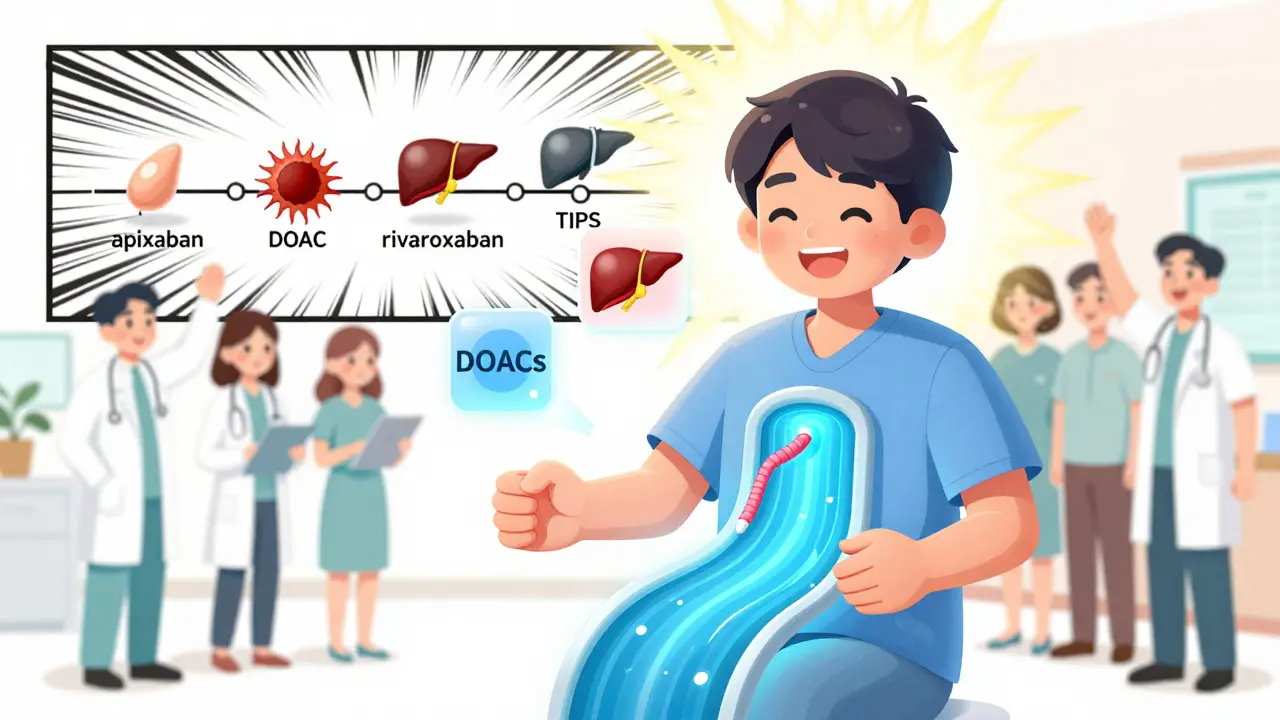
Direct oral anticoagulants (DOACs) - like rivaroxaban, apixaban, and dabigatran - are now preferred for non-cirrhotic patients. They don’t need regular blood tests. In studies, rivaroxaban achieved 65% recanalization, apixaban 65%, and dabigatran 75%. They’re simpler, safer, and more effective than warfarin in people with healthy livers.
But DOACs aren’t for everyone. They’re not approved for Child-Pugh C cirrhosis. The FDA warns against using them in severe liver impairment. For Child-Pugh B patients, newer data from the 2024 AASLD update shows DOACs are now considered safe - as long as you’re monitored closely.

When Not to Use Anticoagulation
Anticoagulation isn’t risk-free. In cirrhotic patients, bleeding is the biggest concern. About 5-12% of these patients will have a major bleed while on blood thinners. Most of those bleeds come from varices - swollen veins in the esophagus.
That’s why endoscopic screening is mandatory before starting anticoagulation in anyone with cirrhosis. If varices are found, they need to be treated with band ligation first. At UCLA, this step cut major bleeding from 15% to just 4%.
Anticoagulation is also avoided if:
- You’ve had a variceal bleed in the last 30 days
- You have uncontrolled ascites (fluid in the belly)
- Your liver function is Child-Pugh C (severe cirrhosis)
In these cases, the risk of bleeding outweighs the benefit. Some doctors still debate whether to treat asymptomatic PVT in cirrhotic patients without cancer. But the trend is clear: if you’re stable and have a chance at recanalization, treat it.
What About Surgery or Other Options?
Anticoagulation is first-line. But if it fails, or if the clot is massive and causing intestinal damage, other options exist.
TIPS (Transjugular Intrahepatic Portosystemic Shunt) creates a tunnel inside the liver to reroute blood. It works in 70-80% of cases. But it comes with risks - 15-25% of patients develop hepatic encephalopathy (brain fog from liver toxins). It’s not a cure for PVT, just a way to manage pressure.
Percutaneous thrombectomy uses a catheter to physically break up the clot. It gives immediate results in 60-75% of cases. But it’s only available at major transplant centers. It’s expensive, invasive, and not for everyone.
Surgical shunts are rarely used now. They’re more dangerous and have longer recovery times.
For transplant candidates, treating PVT is critical. At UCSF, anticoagulation cut the number of patients disqualified from transplant lists from 22% to just 8%. Without treatment, a clot can make you ineligible for a new liver.
How Long Do You Need to Stay on Blood Thinners?
It depends on why you got the clot.
If it was triggered by something temporary - like surgery or infection - and that cause is gone, you usually take anticoagulants for 6 months. After that, you stop, as long as the vein reopened and no clotting disorder was found.
If you have a genetic clotting disorder (like Factor V Leiden), you’ll likely need lifelong treatment. The same goes for people with active cancer. For those with cirrhosis and no clear trigger, treatment is often long-term - sometimes indefinite - because the risk of new clots never fully disappears.
Follow-up imaging at 3 and 6 months is standard. If the vein is still blocked after 6 months of treatment, you may need to keep anticoagulation going, even if you’re not sure why.
Real-World Challenges and Success Stories
Managing PVT isn’t just about picking the right drug. It’s about coordination. At Mayo Clinic, patients treated within 30 days of diagnosis had a 78% recanalization rate. Those treated later? Only 42%. Delay matters.
At Johns Hopkins, a team approach - involving hepatologists, radiologists, and transplant surgeons - cut complications by 35%. One patient, a 58-year-old with cirrhosis and a new PVT, had varices treated with banding, then started on apixaban. Six months later, his portal vein was fully open. He’s now on the transplant list.
But failures happen too. At Massachusetts General, 22% of patients who presented with intestinal ischemia died. Most of them had waited weeks to get diagnosed. Early detection saves lives.
Community doctors still struggle. Only 35% of general gastroenterologists feel confident managing PVT anticoagulation. That’s why resources like the American Liver Foundation’s patient toolkit and AASLD’s case discussions are so important.
What’s Next for PVT Treatment?
The future is promising. In 2023, the FDA approved andexanet alfa - a drug that can reverse the effects of rivaroxaban and apixaban in emergencies. That’s a game-changer for bleeding control.
New drugs like abelacimab are in early trials. They target clotting differently and might be safer for liver patients. The PROBE trial showed DOACs are as safe as LMWH in Child-Pugh A/B patients - and that’s changing practice.
By 2025, DOACs could be used in 75% of non-cirrhotic PVT cases and 40% of compensated cirrhotic cases. Genetic testing is also becoming part of routine care. If you have Factor V Leiden, your chance of recanalization with long-term anticoagulation jumps to 80%.
One thing won’t change: anticoagulation remains the cornerstone. Whether you’re a young person with a clotting disorder or an older adult with cirrhosis, timely, tailored treatment makes all the difference.
Frequently Asked Questions
Can portal vein thrombosis go away on its own?
Sometimes, yes - but rarely. Small, partial clots may dissolve without treatment, especially if the trigger (like an infection) resolves. But in most cases, especially with complete blockage or underlying liver disease, the clot won’t disappear without anticoagulation. Waiting increases the risk of chronic PVT, which is harder to treat and can lead to long-term complications like portal hypertension or liver failure.
Is anticoagulation safe if I have cirrhosis?
It can be - but only if you’re carefully selected. For Child-Pugh A or B cirrhosis, anticoagulation is now recommended if you have acute PVT, especially if you’re not actively bleeding. LMWH or DOACs (like apixaban) are preferred. But if you have Child-Pugh C, active bleeding, or uncontrolled ascites, anticoagulation is usually avoided. Always get screened for varices first - treating them reduces bleeding risk by up to 75%.
Do I need lifelong anticoagulation for PVT?
Not always. If your PVT was caused by a temporary issue - like recent surgery or pancreatitis - and you’ve had successful recanalization, 6 months of treatment is usually enough. But if you have a genetic clotting disorder, cancer, or chronic liver disease with no clear trigger, lifelong anticoagulation is often needed. Your doctor will use follow-up scans and blood tests to decide.
Can I take DOACs if I’m on other liver medications?
Most DOACs are safe with common liver meds, but interactions matter. Rivaroxaban and apixaban are processed by the liver and can be affected by drugs like rifampin or certain antifungals. Always tell your doctor what you’re taking - including supplements. DOACs are generally preferred over warfarin because they have fewer interactions, but they’re not risk-free. Your liver function will be monitored closely.
What’s the biggest mistake doctors make with PVT?
Delaying diagnosis and treatment. Many patients are misdiagnosed as having just “abdominal pain” or “worsening cirrhosis.” If you have cirrhosis and new abdominal discomfort, a Doppler ultrasound should be done immediately. Another big mistake is starting anticoagulation without checking for varices. That’s like lighting a match near gasoline - it can trigger fatal bleeding.
How do I know if my anticoagulation is working?
You won’t feel it. The only way to know is through imaging. A follow-up ultrasound or CT scan at 3-6 months will show if the clot has shrunk or disappeared. Blood tests like INR or anti-Xa levels help monitor dose, but they don’t tell you if the clot is resolving. Recanalization is the real goal - not just a number on a lab report.

Ian Glover
My name is Maxwell Harrington and I am an expert in pharmaceuticals. I have dedicated my life to researching and understanding medications and their impact on various diseases. I am passionate about sharing my knowledge with others, which is why I enjoy writing about medications, diseases, and supplements to help educate and inform the public. My work has been published in various medical journals and blogs, and I'm always looking for new opportunities to share my expertise. In addition to writing, I also enjoy speaking at conferences and events to help further the understanding of pharmaceuticals in the medical field.
15 Comments
-
Tiffany Machelski
December 16, 2025 AT 02:34this post is so helpful i didnt even know about cavernous transformation till now thanks for sharing
-
SHAMSHEER SHAIKH
December 17, 2025 AT 19:26The scientific rigor presented here is commendable. Anticoagulation protocols, especially the nuanced distinctions between LMWH, VKAs, and DOACs, reflect a paradigm shift in hepatology that must be disseminated to community practitioners globally.
-
James Rayner
December 19, 2025 AT 11:44It's wild how something so internal can be so life-altering. I keep thinking about how much we take blood flow for granted... until it's not flowing. The fact that a clot can silently turn into a portal to liver failure... it's humbling.
-
Souhardya Paul
December 20, 2025 AT 12:29I'm a med student and this is one of the clearest summaries I've seen. The part about varices before anticoagulation? That's huge. So many providers skip that step because it's not 'sexy' like imaging.
-
anthony epps
December 21, 2025 AT 03:13so if you got a clot from surgery you just take blood thinners for 6 months and thats it?
-
Andrew Sychev
December 21, 2025 AT 06:52They're pushing DOACs because Big Pharma wants you hooked on expensive pills. LMWH is cheaper, proven, and doesn't need a PhD to manage. They're lying about safety in cirrhosis. Wait until the lawsuits start.
-
Dan Padgett
December 22, 2025 AT 17:27Man this reminds me of how our ancestors used to say the body has rivers inside - and when one river dries up, the whole land suffers. PVT is like a dammed river in your belly. You don't ignore it. You fix it before the crops die.
-
Hadi Santoso
December 24, 2025 AT 11:08i live in a small town and no one here even knows what pvt is. my cousin got diagnosed last year and the dr just said 'watch and wait'... we got lucky she found this info online
-
Joanna Ebizie
December 25, 2025 AT 11:12Ugh I hate when doctors treat cirrhosis patients like they're disposable. If you're gonna let them die, at least be honest about it.
-
Elizabeth Bauman
December 27, 2025 AT 10:37This is why we need to stop trusting European guidelines. The FDA knows what's best for Americans. DOACs are dangerous for our population - especially with all the junk food and obesity. Stick to LMWH.
-
Dylan Smith
December 27, 2025 AT 16:27Why is everyone so scared of bleeding? If you're not treating PVT you're just delaying the inevitable. My dad had cirrhosis and they didn't treat his clot - he died in 6 months. This isn't risk management. It's cowardice.
-
Mike Smith
December 28, 2025 AT 16:25The data presented here is unequivocal. Early intervention with appropriately selected anticoagulation regimens significantly improves portal vein recanalization rates and transplant eligibility. This is not merely a clinical preference - it is a standard of care.
-
Ron Williams
December 29, 2025 AT 02:08I'm just glad we're finally moving past the 'don't touch cirrhosis patients with blood thinners' era. It's like we used to think the liver was too fragile to heal - turns out it just needed a chance.
-
Aditya Kumar
December 30, 2025 AT 23:54Too much info. Just tell me what to do.


Write a comment
More Articles
Buy Fildena Online: Secure Your ED Medication Easily
Hey everyone, have you heard of Fildena? It’s this amazing solution I found to manage erectile dysfunction (ED), and guess what? You can buy it online! With just a few clicks, you can get Fildena delivered right to your doorstep. It’s convenient, discreet, and simply a game-changer. As someone who has struggled with ED, finding Fildena has been a huge relief. Trust me, if you're looking for a hassle-free way to get your ED meds, buying Fildena online is the way to go. Don't let ED control your life anymore, take the step and check out the options online.

Iron Supplements with Levothyroxine: How to Time Them Right to Avoid Binding
Taking iron with levothyroxine can cut thyroid medication absorption by up to 39%. Learn the 4-hour rule, real-life dosing schedules, and how to avoid silent treatment failure.

Medications and Athletes: How Common Drugs Affect Performance and Health
Performance-enhancing drugs may boost strength and recovery, but they come with severe, often irreversible health risks-including heart damage, infertility, and mental health collapse. Most users are not elite athletes-they’re everyday gym-goers unaware of the dangers.
sue spark
December 15, 2025 AT 21:08I never realized how much timing matters with PVT. My uncle waited too long and ended up with chronic issues. Early ultrasound could have changed everything.