Warfarin & Dong Quai Risk Checker
Important Safety Information
This tool is for educational purposes only. Never stop or change your warfarin dosage without consulting your doctor. This tool does not replace medical advice or regular INR monitoring.
Warfarin requires careful monitoring. Dong Quai contains natural compounds that can significantly increase bleeding risk when taken with warfarin. Your INR (International Normalized Ratio) is critical for safety.
Risk Assessment Form
Your Risk Assessment
What to do next:
- Contact your doctor immediately if you're taking both medications
- Do not stop warfarin abruptly
- Check your INR within 24-48 hours if you've recently started Dong Quai
- Review all supplements with your healthcare provider
If you're taking warfarin to prevent blood clots, and you're also using Dong Quai for menopause, cramps, or just because you think it's "natural"-you need to stop and listen. This isn't a hypothetical risk. People have ended up in the hospital because of this combo. The numbers don't lie: one in five people on blood thinners in some countries are also using herbal supplements. And Dong Quai is one of the top offenders.
What Is Dong Quai, Really?
Dong Quai, or Angelica sinensis, is a root used in traditional Chinese medicine for over 2,000 years. It’s often called "female ginseng" and marketed for menstrual pain, hot flashes, and hormonal balance. You’ll find it in capsules, teas, tinctures, and even beauty products. But here’s the catch: it’s not harmless. Dong Quai contains compounds like ferulic acid and osthole-both of which interfere with how blood clots.
It doesn’t just affect your hormones. It affects your blood. Studies show it stops platelets from sticking together, which is exactly what you don’t want if you’re already on a drug designed to thin your blood. And unlike prescription meds, there’s no standard dose. One bottle of Dong Quai might have 10 times more active ingredient than another. The US Pharmacopeia found variations of up to 8-fold between brands. That’s not a typo. Eight times. No way to predict how it’ll hit your system.
How Warfarin Works-and Why It’s Already Risky
Warfarin has been around since 1954. It’s cheap, effective, and used by over 30 million people in the U.S. alone. But it’s also one of the most dangerous drugs you can take if not monitored closely. Your INR (International Normalized Ratio) needs to stay between 2 and 3 for most conditions. Go above 4? Your risk of internal bleeding jumps dramatically. Go below 2? You’re at risk of stroke or clotting.
Even small changes in diet, other meds, or supplements can throw your INR off. That’s why you get blood tests every few weeks. But when you add Dong Quai into the mix, you’re not just making a small change-you’re adding another anticoagulant on top of one. It’s like turning up the volume on a sound system that’s already at max.
The Science Behind the Danger
There are two ways Dong Quai makes warfarin more dangerous.
First, it works the same way. Dong Quai has natural coumarins-chemical cousins of warfarin. They both block vitamin K’s role in clotting. When you take them together, the effect isn’t just added-it’s multiplied. A 2014 study showed Dong Quai increased prothrombin time (a measure of clotting speed) in animals, even when warfarin levels stayed the same. That means it’s not just changing how your body processes the drug-it’s directly making your blood thinner.
Second, it might slow down how your body breaks down warfarin. Lab studies suggest Dong Quai inhibits liver enzymes (CYP2C9 and CYP3A4) that clear warfarin from your blood. If those enzymes are blocked, warfarin sticks around longer. Your INR could creep up without you even changing your dose. And since warfarin’s half-life is already 20-60 hours, any delay can push you into danger zone.
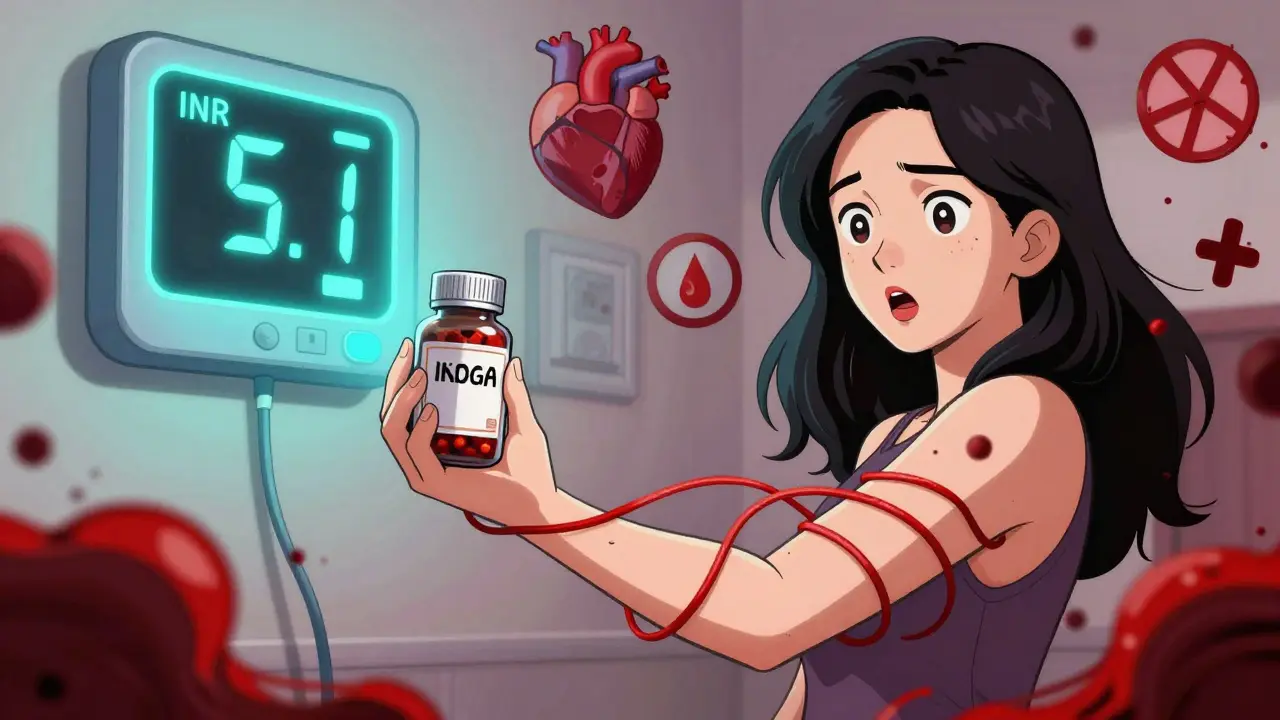
Real-world cases back this up. One Reddit user reported their INR shot from 2.8 to 5.1 after starting Dong Quai for hot flashes. They ended up in the ER. HealthUnlocked forums have 23 documented cases between 2020 and 2023 where patients had unexplained INR spikes-all traced back to Dong Quai. The average increase? 1.7 points. That’s not a glitch. That’s a medical emergency waiting to happen.

What the Experts Say
Major medical institutions don’t mince words.
- The Cleveland Clinic says: "Avoid Dong Quai in warfarin-treated patients due to lack of data."
- The University of California San Diego lists Dong Quai under "Increased Risk of Bleeding"-right next to ginkgo, garlic, and fish oil.
- The Memorial Sloan Kettering Cancer Center warns that Dong Quai may stimulate estrogen-sensitive cancers, adding another layer of risk for women with breast or uterine cancer.
- The American Heart Association calls it a "high-risk herb" for anticoagulant users.
- Dr. Catherine Ulbricht, a top pharmacist at Massachusetts General, says it can push INR from 2.5 to over 4.0-enough to cause life-threatening bleeding.
Even the European Medicines Agency is acting. Starting January 2025, all Dong Quai products sold in the EU must carry a warning label about warfarin interactions. That’s not happening by accident. It’s happening because people got hurt.
What Should You Do?
If you’re on warfarin, here’s what you need to do right now:
- Stop taking Dong Quai. Even if you think it’s "natural" or "safe." Natural doesn’t mean harmless. The most dangerous drug interactions often come from supplements.
- Tell your doctor. If you’ve been taking it, let them know. They’ll want to check your INR immediately.
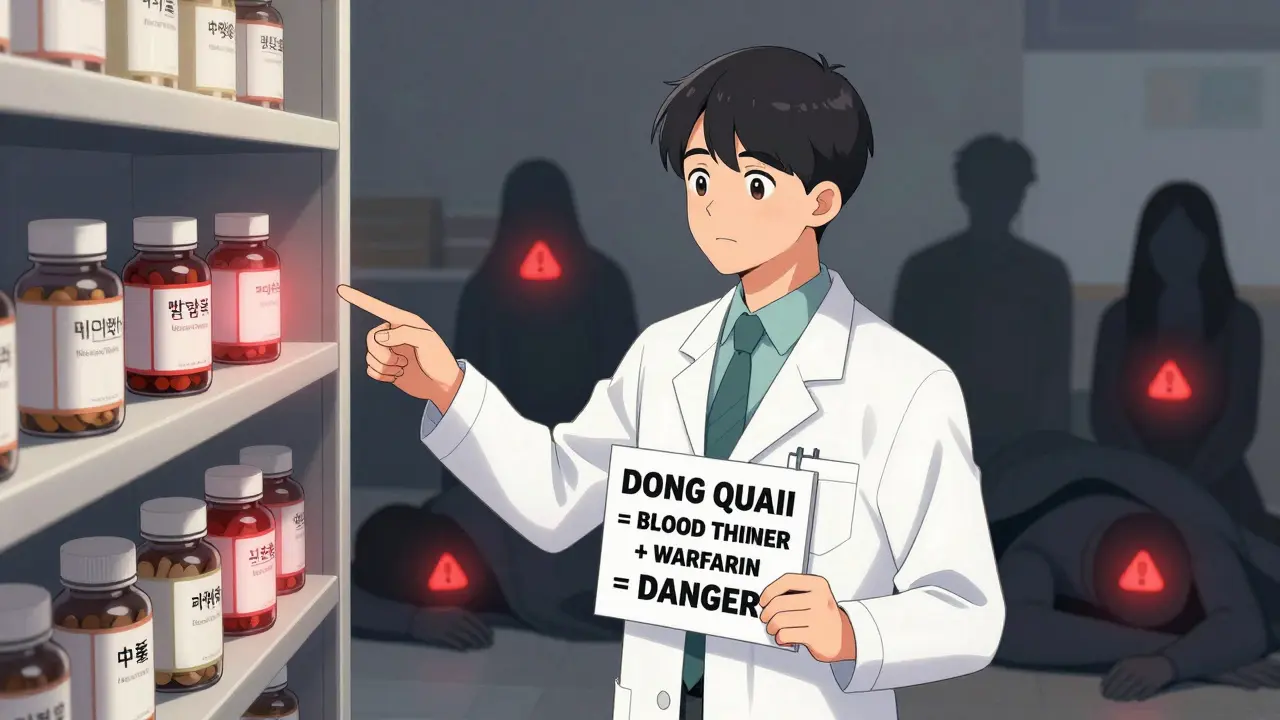
- Check all your supplements. Dong Quai is often hidden in blends labeled "women’s health formula," "hormone balance," or "Chinese herbal tonic." Read the fine print.
- Don’t replace it with another herb. Ginkgo, garlic, ginger, turmeric, and fish oil? They’re just as risky. There’s no safe herbal swap for warfarin users.
If your doctor insists you need something for menopause or cramps, ask about FDA-approved alternatives. Low-dose estrogen patches, SSRIs for hot flashes, or even acupuncture have proven safety data. Dong Quai doesn’t.
Why Do People Keep Using It?
Because they don’t know any better. A 2022 survey found 68% of warfarin users had no idea Chinese herbs could interact with their medication. But here’s the good news: 82% said they’d stop if their doctor warned them.
That’s the real problem-not the herb itself, but the lack of communication. People trust their herbalist, their Amazon reviews, or their friend’s cousin who "swears by it." But no one’s checking their INR when they start a new supplement. And that’s how bleeding happens-in silence, slowly, until it’s too late.
What’s Changing?
There’s new research coming. The NIH funded a $2.1 million study at the University of Illinois to track exactly how Dong Quai affects warfarin in humans. Results are due in late 2024. But waiting for science isn’t an option if you’re already on the drug.
The market is growing anyway. Dong Quai sales hit $342 million in 2022, up 9.7% from 2020. The FDA has received over 140 reports of herbal-anticoagulant reactions since 2018. And under current law, companies don’t have to prove safety before selling these products. That’s the loophole the Dietary Supplement Health and Education Act created in 1994-and it’s still in place.
So don’t rely on regulation. Don’t rely on labels. Don’t rely on "it’s always been used this way." Your blood doesn’t care about tradition. It only responds to chemistry.
Bottom Line
Dong Quai and warfarin don’t mix. Not even a little. The risk isn’t theoretical. It’s documented, repeated, and deadly. There is no safe dose. No "just a little." No "I’ve been taking it for years and nothing happened." That’s luck-not safety.
If you’re on warfarin, your safest move is to avoid Dong Quai entirely. Period. There are better, proven ways to manage symptoms without risking a stroke, a bleed, or a trip to the ICU. Your doctor can help you find them. Don’t gamble with your blood.

Ian Glover
My name is Maxwell Harrington and I am an expert in pharmaceuticals. I have dedicated my life to researching and understanding medications and their impact on various diseases. I am passionate about sharing my knowledge with others, which is why I enjoy writing about medications, diseases, and supplements to help educate and inform the public. My work has been published in various medical journals and blogs, and I'm always looking for new opportunities to share my expertise. In addition to writing, I also enjoy speaking at conferences and events to help further the understanding of pharmaceuticals in the medical field.
10 Comments
-
Gabrielle Panchev
January 6, 2026 AT 02:02Let me just say-this isn’t about ‘natural’ vs. ‘pharmaceutical’-it’s about ignorance masquerading as wellness culture. People think ‘herbal’ means ‘safe,’ and then they wonder why they’re bleeding out in the ER. And don’t get me started on Amazon reviews that say ‘this helped my cramps!’-with zero context, zero lab values, zero medical supervision. It’s a public health disaster wrapped in lavender-scented packaging. The FDA doesn’t regulate supplements because Congress was bribed by the ‘wellness’ lobby in 1994-and here we are. People are dying because we prioritized marketing over science. And no, I’m not being dramatic. I’ve seen the charts. The data is horrifying.
-
Venkataramanan Viswanathan
January 6, 2026 AT 05:21In India, we have similar herbs like Ashwagandha and Turmeric. Many patients on anticoagulants take them without telling doctors. The issue is not cultural-it is systemic. Lack of education, poor communication between traditional practitioners and allopathic physicians. I work in a hospital in Chennai. Last month, a 68-year-old woman came in with a subdural hematoma. She had been taking Ashwagandha for ‘stress’ and warfarin for atrial fibrillation. Her INR was 6.3. This is not unique. We need mandatory counseling for patients on blood thinners. Not optional. Mandatory.
-
Kiran Plaha
January 7, 2026 AT 05:05I’ve been on warfarin for 7 years. Never touched Dong Quai. But I do take fish oil for heart health. Should I stop that too? I’ve heard mixed things. Just want to know if it’s as risky as this article says.
-
Matt Beck
January 8, 2026 AT 16:48Think about it: we live in a world where you can buy a 1000mg capsule of ‘natural blood thinner’ on Amazon for $12, but you need a 10-step approval process to get a prescription for a real anticoagulant. That’s not freedom. That’s capitalism exploiting fear and hope. 🤔🩸
And yet, people still think the ‘system’ is the problem. Nah. The problem is we outsourced our health to influencers and bottle labels. We stopped asking ‘why?’ and started asking ‘where’s the discount code?’ -
Kelly Beck
January 9, 2026 AT 21:03Hey, if you’re reading this and you’re on warfarin-don’t panic. You’re not alone. And you’re not failing. This isn’t your fault. The system is broken, not you.
But here’s the good news: you have power. You can ask your doctor for alternatives. You can read labels. You can say ‘no’ to ‘natural’ marketing. You can share this post with your mom, your aunt, your friend who swears by her herbal tea.
One person stopping Dong Quai could save a life. Maybe even yours. 💪❤️
And if you’re scared to talk to your doctor? Bring this article. Print it. Highlight it. They’ll thank you later. -
Katie Schoen
January 10, 2026 AT 17:22So… let me get this straight. I can buy a bottle of Dong Quai at Whole Foods next to the kombucha, but I can’t legally buy a vape without ID? Who’s running this country again? 😅
Also, ‘female ginseng’? That’s a marketing term, not a medical one. Someone needs to slap a ‘THIS IS NOT A TOY’ sticker on these supplements. -
Tiffany Adjei - Opong
January 11, 2026 AT 07:38Okay but have you considered that maybe the problem isn’t Dong Quai-it’s that warfarin is an ancient, finicky drug that shouldn’t be first-line anymore? Why are we still using a 1954 chemical when we have DOACs that don’t need INR monitoring? This whole thing feels like blaming the herb instead of fixing the system.
Also, the article says ‘no safe dose’-but what if someone takes 100mg a day for 5 years and their INR never budged? Maybe it’s not universal? Maybe it’s just a subset? Science doesn’t always generalize, you know. -
Ryan Barr
January 12, 2026 AT 21:17Stop. Just stop. Dong Quai + warfarin = bad. End of story. No nuance needed. You don’t need a 2000-word essay to understand that two anticoagulants don’t mix.
Go read the label. Don’t be an idiot. -
Cam Jane
January 13, 2026 AT 15:59For anyone wondering about fish oil, garlic, or turmeric-yes, they’re risky too. But here’s the key: it’s about dose and duration. A daily 1000mg fish oil capsule? Probably fine for most. But 3000mg? Or taking 6 garlic pills a day? That’s where the danger starts.
Bottom line: if you’re on warfarin, every supplement needs to be vetted. Not by Reddit. Not by Amazon reviews. By your pharmacist. Call them. They’re paid to know this stuff. Ask: ‘Does this interact with warfarin?’
And if they say ‘I don’t know’-find a new pharmacist. This isn’t optional. It’s your life.


Write a comment
More Articles

How Fungal Bioluminescence Works: The Science Explained
Explore the chemistry, species and ecological role of fungal bioluminescence, and discover how scientists are turning glowing mushrooms into sustainable light sources.
Diabetic Gastroparesis: How to Cope with Nausea and Vomiting
Diabetic Gastroparesis can be a challenging condition to deal with, as it often causes nausea and vomiting. To cope with these symptoms, I've found that eating smaller, more frequent meals throughout the day helps prevent overloading my stomach. Additionally, sticking to easily digestible foods and avoiding high-fat or high-fiber options has made a noticeable difference. Drinking plenty of water and staying hydrated is also essential in managing symptoms. Lastly, consulting with my healthcare provider about medication options has been beneficial in reducing nausea and improving my overall quality of life.
Jeane Hendrix
January 6, 2026 AT 01:02Wow, this post literally saved my life. I was taking Dong Quai for hot flashes and didn’t realize it was messing with my INR. My last blood test was 4.9-I thought I was just stressed. Turned out, I was one week away from a GI bleed. Stopped it immediately and my INR dropped back to 2.6 in 10 days. Doctors need to talk about this more. Seriously.
Also, side note: my supplement bottle didn’t even list Dong Quai-it just said ‘Women’s Hormonal Blend.’ I had to Google the ingredients. Scary stuff.