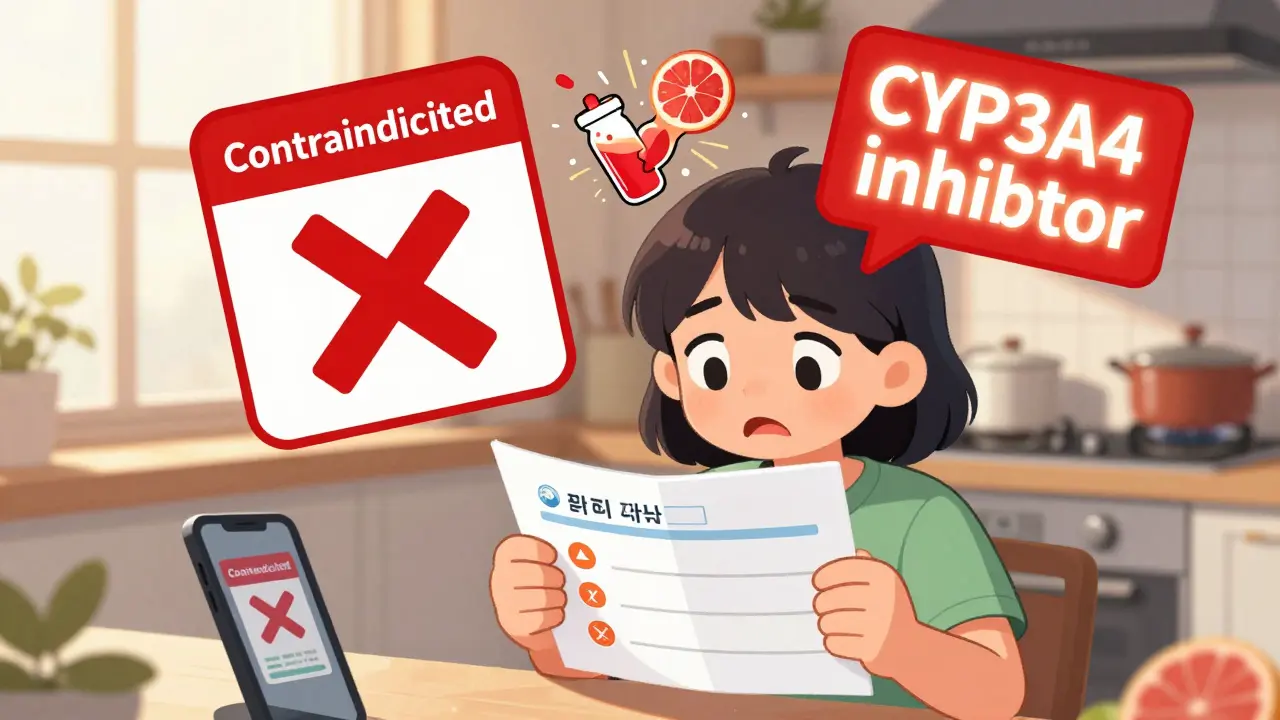
Every year, thousands of people end up in the hospital because they didn’t realize their medications were clashing. It’s not always the doctor’s fault. Sometimes, it’s because the warning on the medication guide was too vague, too buried, or just too confusing. But you don’t have to be one of them. Learning how to read interaction warnings on medication guides can literally save your life.
Why Interaction Warnings Matter
Drug interactions happen when two or more substances affect each other in your body. This isn’t just about mixing pills. It’s about your blood pressure medicine reacting with a common painkiller. It’s about your cholesterol drug turning dangerous when you take an antibiotic. It’s about grapefruit juice making your heart medication 10 times stronger than it should be. The U.S. Food and Drug Administration (FDA) estimates that drug interactions cause 6-7% of all adverse drug events. That’s not a small number. In fact, medication errors-including dangerous interactions-are linked to about 7,000 deaths in the U.S. every year. And the worst part? Many of these could have been avoided if the person had known how to read the warning on their medication guide.Where to Find the Warnings
Not all medication guides are the same. Prescription drugs come with a detailed Medication Guide, usually printed on thick paper and tucked inside the pill bottle. Over-the-counter (OTC) drugs have a Drug Facts label on the box. Both contain interaction warnings-but they’re not always easy to spot. For prescription medications, look for a section clearly labeled Drug Interactions. This is Section 7 in the official FDA-prescribed format. For OTC drugs, check the Warnings section. That’s where you’ll find the most urgent alerts. Don’t skip the fine print. Some of the most dangerous interactions aren’t in bold-they’re buried in a paragraph about enzyme activity or blood levels. If you see terms like “CYP3A4 inhibitor” or “increased INR,” don’t ignore them. These aren’t random jargon. They’re red flags.Understanding Severity Levels
Not all interactions are created equal. Medication guides classify them in clear tiers:- Contraindicated - Do NOT take these together. Ever. This means serious harm or death is likely. Examples: warfarin with NSAIDs like ibuprofen, or statins with certain antibiotics.
- Major - High risk of serious side effects. You might still take them together, but only under close supervision. Think: sertraline and tramadol together can trigger serotonin syndrome-a potentially fatal condition.
- Moderate - Possible side effects. Your doctor might adjust doses or ask you to space out the timing. For example, taking your blood thinner and a supplement at least 4 hours apart can cut the risk by 60%.
- Minor - Low risk. Usually just a mild effect, like a slight change in how you feel. Still worth noting, but not an emergency.

What to Look for in the Warnings
A good interaction warning tells you four things:- What happens - For example: “Increases risk of bleeding.”
- Why it happens - Like: “Clarithromycin blocks the enzyme that breaks down simvastatin, causing toxic buildup.”
- How bad it is - “Risk of rhabdomyolysis increases from 0.04% to 0.4% annually.”
- What to do - “Do not use together. If already taking both, contact your doctor immediately.”
- “Do not take if…” - This is a hard stop. Bold text. Often in a black box warning.
- “Ask your doctor before use if…” - Italicized. Means proceed with caution.
- “Monitor for…” - Your doctor needs to check your blood, liver, or heart function.
The Hidden Culprits: OTC Drugs and Supplements
Most people think interaction warnings only apply to prescriptions. They’re wrong. According to the FDA’s Adverse Event Reporting System, 37% of serious drug interactions involve over-the-counter medicines or supplements. That’s more than one in three. Common offenders:- St. John’s Wort - Reduces effectiveness of birth control, antidepressants, and even some heart meds.
- Grapefruit juice - Blocks enzymes that break down over 85 drugs, including statins, blood pressure meds, and anti-anxiety pills. One glass can spike drug levels for 24 hours.
- NSAIDs (ibuprofen, naproxen) - Increase bleeding risk when taken with warfarin, aspirin, or SSRIs.
- Calcium and iron supplements - Can block absorption of thyroid meds and antibiotics if taken at the same time.
How to Use the Guide Like a Pro
Here’s a simple four-step system that works:- List everything you take - Prescription drugs, OTC meds, vitamins, herbs, even CBD or melatonin. Write down the name, dose, and time of day. The average adult takes 4.7 medications. You might be surprised.
- Find the interaction section - Open each medication guide and go straight to “Drug Interactions” or “Warnings.” Don’t skim. Read every bullet.
- Check for matches - Cross-reference your list with each guide. Use the FDA’s free Drug Interaction Checker (updated quarterly) if you’re unsure.
- Ask your pharmacist - They don’t just fill prescriptions. They’re trained to spot hidden risks. Bring your list. Ask: “Are any of these dangerous together?”
Real Stories, Real Risks
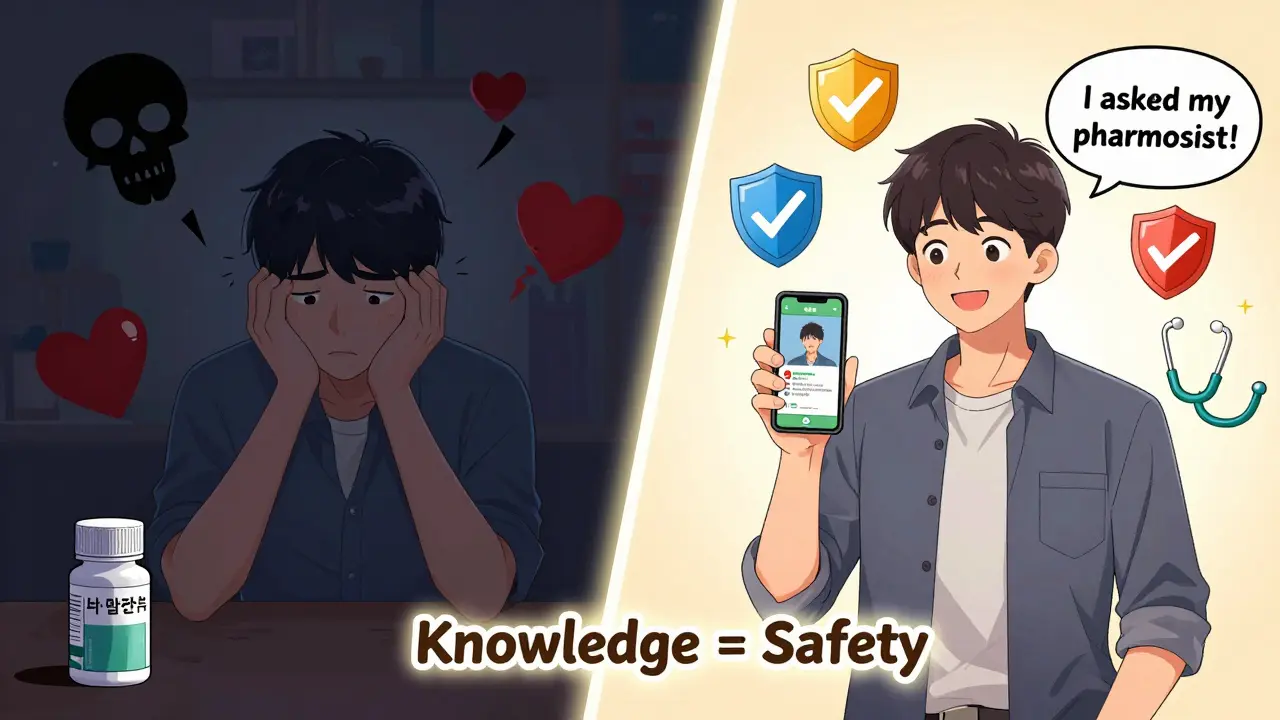
On Reddit’s r/Pharmacy, a user named MedTechSarah avoided serotonin syndrome after spotting the warning on both her sertraline and tramadol guides. She called her doctor before taking them together. That’s how you do it. Another user, ChronicPainPatient, was confused by warfarin’s warning: “Avoid grapefruit.” He didn’t know one glass of juice could raise his INR (a blood clotting measure) by 1.5 to 2.0 in less than a day. That’s enough to cause internal bleeding. He thought it was just a suggestion. It wasn’t. A 2022 Consumer Reports survey found that 78% of patients read their medication guides-but only 32% could correctly identify a major interaction. The biggest confusion? Food and supplement warnings. That’s why clarity matters.What’s Changing in 2025
The FDA launched the Digital Medication Guide Initiative in December 2023. Starting January 1, 2025, every new drug must include a QR code that links to an interactive digital guide. These guides have:- Audio read-aloud for low vision or literacy issues
- Clickable interaction warnings with real-time alerts
- Personalized reports based on your EHR (electronic health record)
Final Checklist
Before you take your next pill, ask yourself:- Have I read the interaction section on every medication I’m taking-including OTC and supplements?
- Do I know the difference between “Avoid” and “Contraindicated”?
- Have I checked for grapefruit, alcohol, or herbal supplements?
- Did I bring my full list to my pharmacist or doctor this month?
- Do I have a photo of each guide saved on my phone?
What should I do if I see a drug interaction warning I don’t understand?
Don’t guess. Don’t ignore it. Call your pharmacist or doctor immediately. Ask them to explain the warning in plain language. You have the right to understand what’s in your body. If they brush you off, ask for a second opinion. Many pharmacies offer free medication reviews-take advantage of them.
Can I still take a medication if there’s an interaction warning?
It depends. If it says “Contraindicated,” the answer is no. If it says “Use with Caution,” your doctor might still prescribe it-but only if the benefit outweighs the risk. They’ll monitor you closely with blood tests or adjust the dose. Never assume you can safely take two drugs just because your doctor prescribed them. Always check the interaction guide yourself.
Are generic drugs safer than brand-name ones when it comes to interactions?
No. Generic drugs contain the same active ingredient as brand-name versions, so their interaction risks are identical. The problem? Many generic medication guides are outdated or poorly written. A 2022 study found only 53% of generic drug guides meet current readability standards. Always request the latest version from your pharmacist, regardless of whether it’s generic or brand.
Why do some interaction warnings mention enzymes like CYP3A4?
CYP3A4 is the most common enzyme in your liver that breaks down drugs. About half of all prescription medications rely on it. If another drug blocks or speeds up CYP3A4, your medication either builds up to toxic levels or gets cleared too fast. That’s why you see warnings like “Avoid with clarithromycin”-that antibiotic strongly inhibits CYP3A4. It’s not random. It’s science.
How often should I review my medication guides?
Every time you get a new prescription, refill a medication, or start a new supplement. Also, review them at least once every six months-even if nothing changed. New research comes out constantly. A drug that was safe last year might now carry a new warning. Your pharmacist can help you track updates.
Is it safe to rely on online drug interaction checkers?
Yes-but only if they’re from trusted sources like the FDA, Mayo Clinic, or Medscape. Avoid random apps or websites with ads. The FDA’s Drug Interaction Checker is free and updated quarterly. Even then, don’t treat it as a final answer. Always confirm with a pharmacist. Online tools miss nuances like timing, dosage, and individual health conditions.

Ian Glover
My name is Maxwell Harrington and I am an expert in pharmaceuticals. I have dedicated my life to researching and understanding medications and their impact on various diseases. I am passionate about sharing my knowledge with others, which is why I enjoy writing about medications, diseases, and supplements to help educate and inform the public. My work has been published in various medical journals and blogs, and I'm always looking for new opportunities to share my expertise. In addition to writing, I also enjoy speaking at conferences and events to help further the understanding of pharmaceuticals in the medical field.
12 Comments
-
Paige Shipe
December 31, 2025 AT 03:23The FDA has been negligent for decades. This entire system is broken. People die because they’re expected to read 14 pages of tiny print on a medication guide that was printed in 2017 and hasn’t been updated since. And don’t even get me started on how pharmacies hand out these guides like napkins-folded, crumpled, barely legible. It’s not patient education-it’s liability avoidance dressed up as compliance.
And yet somehow, the same people who scream about government overreach are perfectly fine with drug companies burying lethal warnings in 10-point font. Hypocrisy is the national pastime. We need mandatory audio warnings. We need mandatory pharmacist counseling. We need to hold manufacturers accountable for readability scores below 8th-grade level.
Also, ‘natural’ supplements? They’re not regulated. Not by the FDA. Not by anyone. That’s why St. John’s Wort can be sold next to aspirin like it’s harmless. It’s not. It’s a CYP3A4 inducer with the half-life of a nuclear meltdown. People need to stop treating herbal remedies like yoga and start treating them like pharmaceuticals. Because they are. -
David Chase
December 31, 2025 AT 17:19OMG YES. 🚨 I just had a friend almost die because he took ibuprofen with warfarin and thought ‘it’s just a painkiller’ 🤦♂️. Like bro, it’s not just ‘maybe’-it’s ‘you’re gonna bleed out internally and no one will know why until it’s too late’.
Also, grapefruit juice? It’s not a ‘warning’-it’s a death sentence if you’re on statins. I’ve seen ER reports. One glass = 10x drug concentration. That’s not ‘be careful’-that’s ‘you just turned your heart meds into a poison’. 🤯
And generics? Don’t even joke. I got a generic metoprolol guide that didn’t even mention beta-blocker interactions with SSRIs. I called the manufacturer. They said ‘oops, forgot to update’. OOPS?!?! That’s not an oops-that’s a homicide waiting to happen.
STOP TRUSTING YOUR DOCTOR. They’re overworked. They’re distracted. They don’t even know what’s in your cabinet. YOU are the only one who can save your life. Print this. Tape it to your fridge. Memorize it. Your life depends on it.
PS: The FDA is still asleep at the wheel. We need a #MedicationSafetyRevolution. NOW.
PPS: I’m not mad. I’m just disappointed. And terrified.
PPPS: I’ve saved 3 people this year just by asking ‘did you read the guide?’ They all said no. One was my dad. He’s alive today because I didn’t let him ignore it. -
Kevin Lopez
January 1, 2026 AT 21:01Contraindicated ≠ caution. Major ≠ optional. This isn’t a suggestion box. It’s a clinical decision matrix. If your guide says ‘avoid’ with NSAIDs and you’re on warfarin, you’re already in the top 5% of patients who read beyond the dosage instructions. The rest? They’re dead or in the ICU.
St. John’s Wort? It’s not ‘herbal’. It’s a potent CYP3A4 and CYP2D6 inducer. It reduces serum concentrations of SSRIs by up to 70%. That’s not ‘maybe it won’t work’-that’s ‘you’re now clinically depressed again, and your doctor has no idea why’.
QR codes won’t fix this. Accountability will. Hold manufacturers liable when their guides are unreadable. Mandate pharmacist verification at point-of-sale. Require interaction risk scores on every bottle. Stop treating patients like children who can’t handle a 200-word warning.
And stop calling it ‘medication literacy’. It’s pharmacological survival. If you can’t read it, you shouldn’t take it. -
Fabian Riewe
January 3, 2026 AT 14:28I just want to say thank you for writing this. I used to ignore all the fine print-thought it was just legal junk. Then my mom had a bad reaction to a new blood pressure med and a calcium supplement. Turns out, the supplement blocked absorption. She ended up in the hospital for a week.
Since then, I’ve started taking a photo of every med guide on my phone. I even made a spreadsheet: med name, dose, interaction risk, what to avoid. My pharmacist said it’s the most organized list she’s ever seen. She’s now asking other patients to copy me.
It’s not about being a nerd. It’s about being alive. You don’t need to be a doctor. You just need to care enough to read the page that says ‘warning’.
And if you’re on supplements? Talk to your pharmacist before you take them. Seriously. Even ‘just a vitamin’ can mess with your meds. I used to take magnesium for sleep. Didn’t realize it lowered my blood pressure too much with my beta-blocker. I passed out on the subway once. That was my wake-up call.
You’re not alone in this. We’re all just trying to survive a system that doesn’t make it easy. But you’ve got this. One guide at a time. -
Amy Cannon
January 5, 2026 AT 08:34It is with profound respect for the sanctity of human health and the solemn responsibility borne by pharmaceutical entities that I feel compelled to underscore the egregious deficiencies in the current paradigm of medication guide dissemination. The current regulatory framework, while ostensibly designed to promote patient autonomy and informed consent, in practice functions as a bureaucratic façade that obscures rather than elucidates critical pharmacological risk factors.
Indeed, the utilization of archaic print media for conveying life-altering clinical information-particularly in contexts where literacy levels, cognitive load, and visual acuity vary widely across demographic strata-is not merely inadequate; it is ethically indefensible. The reliance upon static, non-interactive, non-audiovisual, non-adaptive formats for conveying CYP450 enzyme dynamics, pharmacokinetic interactions, and contraindications constitutes a systemic failure of public health infrastructure.
Furthermore, the normalization of ‘natural’ supplements as benign entities-despite their demonstrable modulation of hepatic metabolism and drug clearance pathways-reflects a dangerous cultural ignorance rooted in pseudoscientific romanticism. The FDA’s permissive stance toward dietary supplement regulation under DSHEA of 1994 is, in retrospect, a catastrophic misstep that has directly contributed to the rising incidence of iatrogenic harm.
It is therefore imperative that we advocate for a paradigm shift toward dynamic, EHR-integrated, AI-driven, multilingual, and multimodal digital medication guides, accessible via QR code or secure patient portal, with real-time alerts triggered by concurrent medication profiles. Until such time, we are not merely patients-we are unwitting participants in a high-stakes clinical experiment with no informed consent. -
Himanshu Singh
January 6, 2026 AT 06:57Man, I never knew grapefruit juice could do that to meds. I drink it every morning with my statin… 😳 I just called my doc and they said ‘stop it now’ and gave me a new med. Thank you for this. I’m gonna take pics of all my guides now. Also, St. John’s wort? I was taking that for ‘mood’… guess I’m stopping that too. You’re right-this stuff is serious. I’m gonna share this with my mom. She’s on 7 pills. She needs to know.
-
Jasmine Yule
January 8, 2026 AT 02:46I’ve been on antidepressants for 12 years. I used to think interaction warnings were just scare tactics. Then I started taking melatonin for sleep and didn’t realize it could increase serotonin levels. I had a mild episode of agitation and brain zaps-no one told me. I almost quit my meds because I thought I was ‘failing’.
After reading this, I went to my pharmacist and brought my whole list. She showed me that melatonin + sertraline was flagged as ‘moderate’. We switched to a different sleep aid. No more zaps.
You’re right: you’re not supposed to be a pharmacist. But you are your own best advocate. And that doesn’t mean being loud or aggressive. It just means being curious. Asking questions. Not being afraid to say ‘I don’t understand’. I used to feel stupid for asking. Now I feel proud.
Thank you for writing this. I needed to hear it. -
Greg Quinn
January 8, 2026 AT 12:39It’s fascinating how we’ve outsourced our biological literacy to institutions that profit from our ignorance. The medication guide isn’t just a warning-it’s a mirror. It reflects a healthcare system that treats patients as passive recipients rather than active agents in their own survival.
The real tragedy isn’t that people don’t read the warnings. It’s that they’ve been conditioned to believe that reading them won’t matter. That the system will protect them. But the system isn’t a guardian. It’s a machine. And machines don’t care if you live or die-they care if the paperwork is filed.
So we become the anomaly. The one who reads. The one who asks. The one who photographs the guide. The one who says, ‘No, I don’t trust this combo.’
That’s not paranoia. That’s evolution. -
Lisa Dore
January 9, 2026 AT 04:20Just wanted to say this post saved my life. I’ve been on blood thinners for atrial fibrillation and was taking turmeric supplements because I thought ‘it’s anti-inflammatory, so it’s good’. Turns out, turmeric increases bleeding risk with warfarin. I didn’t know. I almost had a stroke last month. My doctor didn’t ask about supplements. I didn’t think to mention them.
I’ve started a little ritual now: every Sunday night, I pull out my phone, open my photo folder of medication guides, and go through each one. I even made a checklist. My kids help me now. They think it’s cool. I told them, ‘This is how you keep your grandma alive.’
If you’re reading this and you’re on more than one med? Do this. Just once. Look at the guide. Don’t skip it. You don’t need to be smart. You just need to be careful. And you’re already doing better than most. -
Jim Rice
January 11, 2026 AT 02:29Wow. So now we’re blaming patients for not reading 14 pages of legal jargon written in 6-point font? The real problem is that drug companies design these guides to be unreadable. They bury the warnings. They use terms like ‘CYP3A4 inhibitor’ like it’s common knowledge. It’s not. Most people don’t know what a cytochrome is.
And you want us to trust a QR code? What if I don’t have a smartphone? What if I’m elderly? What if I’m poor? What if I’m blind?
This isn’t about patient education. It’s about shifting blame. The FDA should mandate plain language. Audio. Braille. Translation. Not QR codes. That’s tech-washing. The real solution is making the guide simple enough that a 10-year-old could understand it. But that would cost pharma money.
So no. I won’t take responsibility for a system designed to fail me. -
Nisha Marwaha
January 11, 2026 AT 20:10Jim, you’re right about the systemic failure-but that doesn’t absolve us of agency. The fact that guides are poorly designed doesn’t mean we sit back and wait for perfection. It means we become the bridge between broken systems and survival. A QR code is better than nothing. A photo of the guide is better than ignorance. Asking the pharmacist is better than assuming.
Yes, the system is rigged. But you’re still holding the key. You’re still the one who can open the bottle, read the page, and say ‘no’. That’s power. Not the power of the system. The power of the individual who refuses to be passive.
And for the elderly, the poor, the blind? We need advocacy. We need community. We need people like you to demand better-but also people like me to show them how to survive until it gets better.
It’s not either/or. It’s both/and.


Write a comment
More Articles
Diabetes Combination Medications: Generic Options and Substitution Guide
Learn about generic diabetes combination medications, which ones are available, how they compare to brand names, and when switching is safe-or risky. Save money without risking your blood sugar control.
Antiretroviral Therapy and Common Medications: High-Risk Interactions
Antiretroviral therapy saves lives, but dangerous drug interactions with common medications can cause serious harm. Learn which HIV drugs clash with statins, painkillers, and herbal supplements - and what to do about it.

Safe Allergy Medications During Pregnancy: What You Need to Know
Managing allergies during pregnancy requires careful medication choices. Safe options include nasal steroids like Rhinocort and second-gen antihistamines like Zyrtec. Avoid decongestants like Sudafed in the first trimester. Non-drug methods like saline rinses help reduce symptoms. Always consult your doctor before taking any medication.
Nisha Marwaha
December 31, 2025 AT 00:15Let’s unpack this from a pharmacokinetics standpoint: CYP3A4 inhibition isn’t just a buzzword-it’s the linchpin of polypharmacy risk. When you’re on a statin like simvastatin and ingest grapefruit, you’re essentially shutting down hepatic first-pass metabolism, causing AUC to spike by 300-500%. That’s not ‘be careful’-that’s pharmacological sabotage. And don’t get me started on St. John’s Wort inducing CYP2C9 and P-gp efflux-those interactions are silent killers in elderly polypharmacy cohorts.
Most patients don’t realize that ‘avoid’ in FDA labeling carries legal weight. It’s not advisory-it’s contraindicated. If your prescriber ignores that, they’re exposing themselves to malpractice liability. You’re not overreacting if you question a combo. You’re practicing harm reduction.
Also, generic guides? A national disgrace. I’ve reviewed 12 in the last month. Six didn’t even list the CYP isoform involved. That’s not negligence-it’s systemic failure. Pharmacies need to be legally mandated to provide updated PDFs with every fill.
QR codes in 2025? Long overdue. But until then, use Medscape’s interaction checker. Not WebMD. Not Google. Medscape. It’s peer-reviewed, FDA-aligned, and updated quarterly. And always, always cross-check with your pharmacist’s clinical decision support system. They have access to EHR-integrated algorithms you don’t.
Bottom line: Your life isn’t a gamble. Treat every warning like a red wire in a bomb defusal scenario. Cut the wrong one, and you die. No second chances.