
Putting old pills in the trash might seem harmless-until a child finds them, a teen steals them, or a relative digs through the bin looking for a buzz. Every year, thousands of accidental poisonings and overdoses happen because people dispose of powerful medications the wrong way. The flush list from the FDA isn’t a suggestion. It’s a lifesaving rule. If your medicine is on it, tossing it in the trash could cost someone their life.
Why Some Medications Can’t Go in the Trash
Not all medications are created equal when it comes to disposal. Most can be safely thrown away after mixing them with coffee grounds or cat litter. But a small group of drugs is so dangerous that even one pill or one patch can kill. These are the ones that must be flushed immediately. Why? Because they’re highly addictive, extremely potent, and often targeted by people looking to misuse them. The FDA created the flush list after seeing how easily unused painkillers ended up in the hands of kids and addicts. In 2020, over 91,000 people in the U.S. died from drug overdoses. A big chunk of those were from prescription opioids. And according to the Substance Abuse and Mental Health Services Administration, more than half of people who misused painkillers got them from friends or family-often by rummaging through their trash. Fentanyl, for example, is 50 to 100 times stronger than morphine. A single patch, if pulled from the trash and stuck on the skin, can stop someone’s breathing in minutes. That’s not a hypothetical risk. In February 2023, a child in Ohio was hospitalized after finding fentanyl patches in a neighbor’s garbage. The same thing happened with oxymorphone (OPANA ER) in 2021, leading to a teenager’s death and new local laws requiring special disposal for these drugs.The FDA Flush List: Exact Medications to Flush
The FDA’s flush list is short but deadly serious. If your medication contains any of these active ingredients, flush it down the toilet right away-don’t wait, don’t throw it away, don’t hide it in a jar. Here’s the full list:- Buprenorphine (brands: Suboxone, Zubsolv, Belbuca, Butrans)
- Fentanyl (brands: Duragesic, Actiq, Fentora, Abstral, Onsolis)
- Hydromorphone (brand: Exalgo)
- Meperidine (brand: Demerol)
- Methadone (brands: Dolophine, Methadose)
- Morphine (brands: MS Contin, Kadian, Avinza, Embeda, Morphabond ER, Arymo ER, Oramorph SR)
- Oxymorphone (brands: Opana, Opana ER)
- Tapentadol (brands: Nucynta, Nucynta ER)
- Sodium oxybate (brands: Xyrem, Xywav)
- Diazepam rectal gel (brands: Diastat, Diastat Acudial)
- Methylphenidate transdermal system (brand: Daytrana)
What About the Environment? Isn’t Flushing Bad for Water?
You’ve probably heard that flushing medicine pollutes rivers and drinking water. That’s true-for most drugs. But here’s the catch: the FDA only recommends flushing for these 11 high-risk medications. For everything else, they say: don’t flush. Environmental scientists confirm that wastewater plants remove only 30% to 90% of pharmaceuticals. Some drugs, like carbamazepine, barely get filtered out at all. But the EPA and FDA agree: for fentanyl, methadone, or oxymorphone, the danger of leaving them in the trash outweighs the risk to water. Dr. John Scott from the EPA put it plainly in a 2022 congressional hearing: “The environmental impact of flushing one fentanyl patch is negligible compared to the potential for multiple fatalities if that patch is found in the trash.” It’s a tough trade-off. But when a child can die from touching one patch, the choice is clear. The FDA’s position isn’t about ignoring pollution-it’s about prioritizing immediate human life.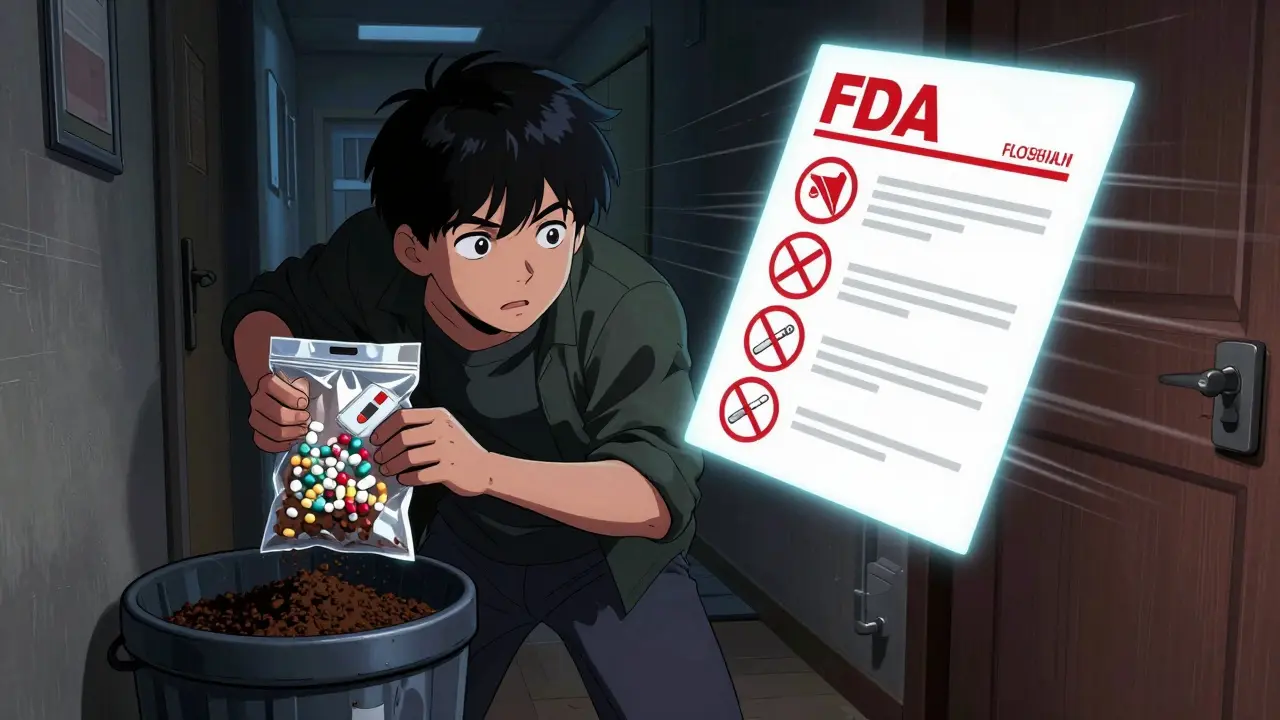
How to Dispose of Medications That Aren’t on the Flush List
Most of your pills, creams, and liquids don’t belong in the toilet. For those, follow the FDA’s safe disposal steps:- Take the medicine out of its original bottle.
- Don’t crush pills or open capsules-just leave them as they are.
- Mix them with something unappetizing: used coffee grounds, kitty litter, dirt, or even spoiled food.
- Pour the mixture into a sealable plastic bag or container.
- Throw the sealed bag in your household trash.
What About Take-Back Programs?
If you want to avoid flushing or trash altogether, take-back programs are your best bet. Walgreens has over 2,000 disposal kiosks across the U.S. CVS has nearly 1,800. Many police stations and pharmacies offer drop boxes for unused meds. These are free, secure, and environmentally safe. But here’s the problem: only about 15% of people use them. Why? Most don’t know where to go, or they think it’s too much trouble. If you’re unsure, call your local pharmacy or check your city’s waste management website. In places like Minnesota, there are over 300 drop-off locations. Some new products are making disposal easier. Companies like DisposeRx sell small packets of powder you add to water with your pills. It turns them into a gel that can’t be recovered. These are being used in over 1,200 pharmacies. But they’re not everywhere yet.
What If You’re Not Sure If Your Med Is on the List?
If you’re holding a bottle and wondering whether to flush or trash it, here’s what to do:- Check the active ingredient on the label. Look for any of the names on the FDA list above.
- Search “FDA flush list” on your phone. The FDA website has a downloadable PDF.
- Call your pharmacist. They’ve seen this a hundred times. Ask: “Is this on the flush list?”
- If you’re still unsure, don’t flush. Mix it with coffee grounds and throw it in the trash.
Real Consequences of Getting It Wrong
This isn’t theoretical. In 2022, the American Association of Poison Control Centers reported nearly 9,000 cases of single-exposure fentanyl poisoning. Over 40% of those involved children under five. One child swallowed a fentanyl tablet from a grandparent’s trash can. Another inhaled dust from crushed pills found in a drawer. Both ended up in the ICU. And it’s not just kids. Teens are the biggest group stealing prescription drugs from homes. A 2019 survey found that 53% of teens who misused opioids got them from a relative’s medicine cabinet or trash. That’s why some states are passing laws requiring special disposal instructions for Schedule II drugs. The message is simple: if you’re not using it, don’t keep it. And if it’s on the flush list, don’t wait. Flush it now.Final Rule: When in Doubt, Flush the Strong Ones
There’s no perfect solution. Take-back bins aren’t everywhere. Flushing worries environmentalists. Trash disposal leaves room for error. But for these 11 medications, the FDA’s rule is the only one that saves lives. Here’s your quick checklist:- Check the label for fentanyl, methadone, oxymorphone, buprenorphine, or sodium oxybate.
- If yes → flush immediately.
- If no → mix with coffee grounds or cat litter, seal in a bag, toss in trash.
- Always remove personal info from empty bottles.
- Use a take-back bin if you can-especially for non-flush meds.
Can I flush all my old pills down the toilet?
No. Only medications on the FDA’s flush list should be flushed. For all other pills, creams, or liquids, mix them with coffee grounds or cat litter, seal them in a plastic bag, and throw them in the trash. Flushing non-listed drugs can harm water supplies.
What if I don’t have a toilet? Can I still flush?
If you live in a home without a toilet (like a mobile home or cabin), you still need to dispose of flush-list medications safely. Contact your local pharmacy, health department, or police station. Many offer take-back services even if you don’t have a toilet. Never leave these drugs in the open-store them securely until you can turn them in.
Are over-the-counter drugs safe to throw in the trash?
Most OTC meds like ibuprofen, acetaminophen, or antihistamines are safe to throw away after mixing with an unappealing substance like coffee grounds or dirt. But never crush pills. Always remove personal info from the packaging. If you’re unsure, check the label for active ingredients and compare them to the FDA flush list.
Why doesn’t the FDA just ban these drugs instead of asking people to flush them?
These medications are still medically necessary. Fentanyl saves lives in hospitals. Methadone helps people recover from opioid addiction. Buprenorphine is used for chronic pain and addiction treatment. Banning them would hurt patients who need them. The goal isn’t to stop use-it’s to stop misuse by making sure unused drugs can’t be found in the trash.
What should I do if I find someone else’s medication in the trash?
Don’t touch it. If it’s a strong painkiller or sedative, assume it’s dangerous. Call your local poison control center or non-emergency police line. They can advise you on safe pickup or disposal. If you’re worried about someone using it, talk to a family member or healthcare provider. Never try to dispose of unknown drugs yourself.

Ian Glover
My name is Maxwell Harrington and I am an expert in pharmaceuticals. I have dedicated my life to researching and understanding medications and their impact on various diseases. I am passionate about sharing my knowledge with others, which is why I enjoy writing about medications, diseases, and supplements to help educate and inform the public. My work has been published in various medical journals and blogs, and I'm always looking for new opportunities to share my expertise. In addition to writing, I also enjoy speaking at conferences and events to help further the understanding of pharmaceuticals in the medical field.
9 Comments
-
Jacob Hill
January 20, 2026 AT 14:20This is such a critical public health issue, and I’m so glad the FDA has clear guidelines… But honestly, most people don’t even know this exists. I’ve seen neighbors just toss pills into the trash, or worse-leave them in the bathroom cabinet with the kids’ toys. I printed out the FDA list and taped it to my fridge. If you’re reading this and you’ve got any of those meds, just flush them. Don’t wait. Don’t rationalize. Do it now.
-
Jackson Doughart
January 21, 2026 AT 07:43While the environmental implications of pharmaceutical runoff are not negligible, the moral calculus here is unambiguous: human life must supersede abstract ecological concerns. The FDA’s directive, though counterintuitive to those trained in environmental science, represents a pragmatic, utilitarian prioritization of immediate, preventable harm. The data on pediatric exposure and opioid misuse is unequivocal. One life lost is an existential failure; one microgram of fentanyl in a watershed, a manageable risk.
-
Erwin Kodiat
January 22, 2026 AT 10:50Man, I’ve been holding onto some old methadone bottles since my cousin’s rehab. Never thought twice about it. But after reading this, I just drove to the Walgreens kiosk and dropped them off. Took 5 minutes. Felt good. Like I did something right for once. Also, if you’re in a rural area and don’t have a toilet? Call your local clinic. They’ll help. Seriously. Don’t just leave it in a drawer.
-
Jake Rudin
January 24, 2026 AT 05:55Think about it: we’ve spent decades criminalizing addiction, demonizing users, building prisons… while the real villain was sitting in plain sight-in the medicine cabinet, in the trash can, in the hands of a curious 4-year-old. The system failed us by making these drugs accessible, then blaming people for wanting them. Flushing isn’t the solution-it’s a bandage on a bullet wound. But if it saves one kid? Then it’s the least we can do. And maybe, just maybe, it forces us to ask: why were these drugs so easy to get in the first place?
-
Astha Jain
January 25, 2026 AT 15:46so like… i had no idea about this flush list?? i just threw all my old meds in the bin… like i do with expired ibuprofen… but now i’m like… oh god what if i killed someone?? like… i’m from india and we just toss stuff… but this is wild. i’m gonna flush my dad’s morphine now… rip environment but i’d rather be a polluter than a murderer lol
-
Lydia H.
January 26, 2026 AT 17:38I’ve been quietly doing this for years-flushing the big ones, mixing the rest with coffee grounds. But I never talked about it because I thought people would think I was weird. Then I saw a neighbor’s kid playing with a pill bottle in the yard. I didn’t say anything. Just went home, grabbed my list, and left it on their porch with a note: ‘Check your meds. They’re more dangerous than you think.’ No drama. Just care. If this post saves one child, it’s already worth it.
-
Phil Hillson
January 28, 2026 AT 08:38Okay so here’s the real issue nobody’s talking about-why the hell are we still prescribing fentanyl patches to grandma with back pain?? These drugs should be locked in a vault under armed guard. Flushing is just damage control. The real crime is that doctors hand out these death capsules like candy. And now we’re supposed to feel good about flushing them like they’re toilet paper? This is a broken system and we’re just cleaning up the mess while the factory keeps running
-
Josh Kenna
January 29, 2026 AT 16:43just flushed my last buprenorphine patch after reading this and honestly i feel like a hero. i used to be addicted and now i’m clean. but i kept the patches because i thought i might need them again. stupid. now i know better. if you’re reading this and you’re holding onto anything on that list-flush it. don’t be a coward. don’t be lazy. your kid, your neighbor’s kid, your cousin’s kid-they’re all one trash can away from a nightmare. i’m not gonna let that happen on my watch. #flushthem


Write a comment
More Articles

Online Lasix Prescription: Insights and Essential Guide
This article provides a comprehensive guide to obtaining a Lasix prescription online, along with detailed insights into the medication itself. It covers the medical and side effects, drug interactions of Lasix and its active substance, Furosemide. Furthermore, it offers guidance on the most common dosages and recommendations for those considering Lasix as a treatment option. It aims to equip readers with the knowledge they need to make informed decisions about using Lasix safely and effectively.
Malikah Rajap
January 18, 2026 AT 18:43Wow, I never realized how many of my grandma’s painkillers were on that list-she had a fentanyl patch in her nightstand drawer for ‘emergencies,’ and I just thought it was weird she never threw it out… Now I’m going through every medicine cabinet in the house like a detective. Also, I just flushed my last unused oxymorphone. It felt weird. Like I was flushing a piece of my family’s pain away. But honestly? Worth it. No one’s touching that stuff.