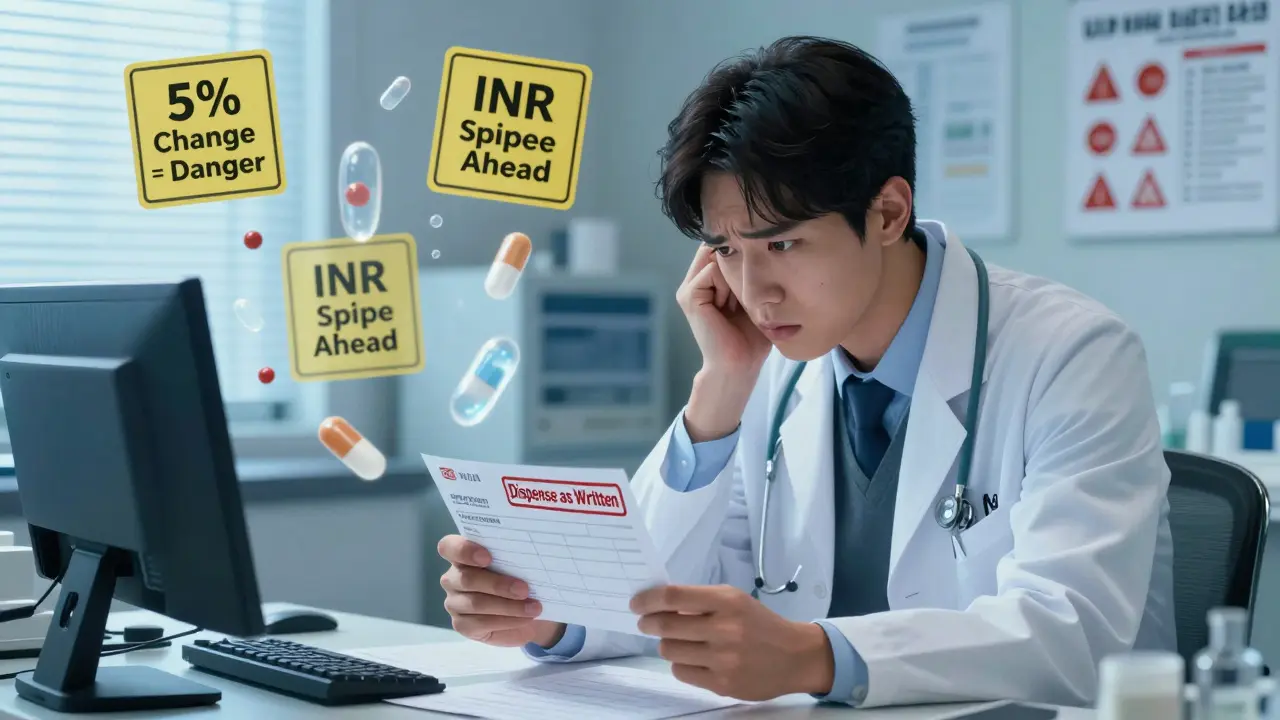
When a doctor writes a prescription for a drug like warfarin, lithium, or levothyroxine, they’re not just choosing a medication-they’re choosing a narrow margin for error. These are Narrow Therapeutic Index (NTI) drugs, where even small changes in dose or blood levels can lead to serious harm or treatment failure. For many prescribers, the question isn’t just whether a generic version works-it’s whether switching to one is safe at all.
What Makes NTI Drugs Different?
NTI drugs are defined by their razor-thin safety window. The FDA considers a drug to have a narrow therapeutic index when the difference between the lowest dose that causes toxicity and the lowest dose that works is two-fold or less. That means if a patient’s blood level of the drug rises just 10% above the target, they could suffer side effects. Drop it 10% below, and the treatment fails. There’s no room for guesswork.
Common NTI drugs include:
- Warfarin (blood thinner)
- Lithium (mood stabilizer)
- Levothyroxine (thyroid hormone)
- Phenytoin (anti-seizure)
- Tacrolimus (transplant immunosuppressant)
These aren’t obscure medications. They’re widely used. Warfarin alone is prescribed to over 2 million Americans annually. The stakes are high, and prescribers know it.
Why Do Prescribers Worry About Substitution?
Generic drugs are approved based on bioequivalence studies-usually done in healthy volunteers. But for NTI drugs, that’s not enough. A 2018 survey of 710 pharmacists found that while 87% believed doctors thought generics were just as effective, 60% of pharmacists admitted they didn’t substitute generics for refills as often as for new prescriptions. Why? Because doctors were hesitant.
Transplant specialists are among the most cautious. A 1997 survey of 59 transplant pharmacists showed that 92% believed bioequivalence testing should happen in actual patients-not healthy volunteers. That’s because even a 5% difference in tacrolimus levels can trigger rejection or toxicity. In real life, patients aren’t lab rats. Their metabolism, diet, other medications, and even gut health affect how the drug behaves.
Psychiatrists see the same issue with lithium. A 2021 study in the Journal of the American Pharmacists Association found psychiatrists received an average of 5.4 substitution notifications per month. Many of those patients needed immediate INR or lithium level checks afterward. One doctor in Ohio told a patient, “I didn’t even know you switched. You nearly ended up in the ER.”
What Do the Guidelines Say?
The FDA says generics are safe. In 2020, their Center for Drug Evaluation and Research reported that 98% of generic NTI drugs performed within 3-4% of the brand-name version. That sounds reassuring-until you realize that 4% is still a 20% swing from the lower end of the therapeutic window for some drugs.
Meanwhile, the American Medical Association (AMA) has held since 2007 that stricter substitution rules for NTI drugs aren’t necessary. They argue that with proper monitoring, switching is fine. But many doctors don’t feel that way. A 2023 survey by the American College of Physicians found that 57% of internists would still prescribe brand-name NTI drugs for high-risk patients. Why? Stability. Predictability. Familiarity.
The American Academy of Neurology and the American Society of Health-System Pharmacists (ASHP) take a middle ground. They don’t ban substitution-but they insist on communication. ASHP’s 2021 survey showed that 78% of hospital pharmacists always notify the prescriber before substituting an NTI drug. That’s not automatic. That’s deliberate.
State Laws Are Split
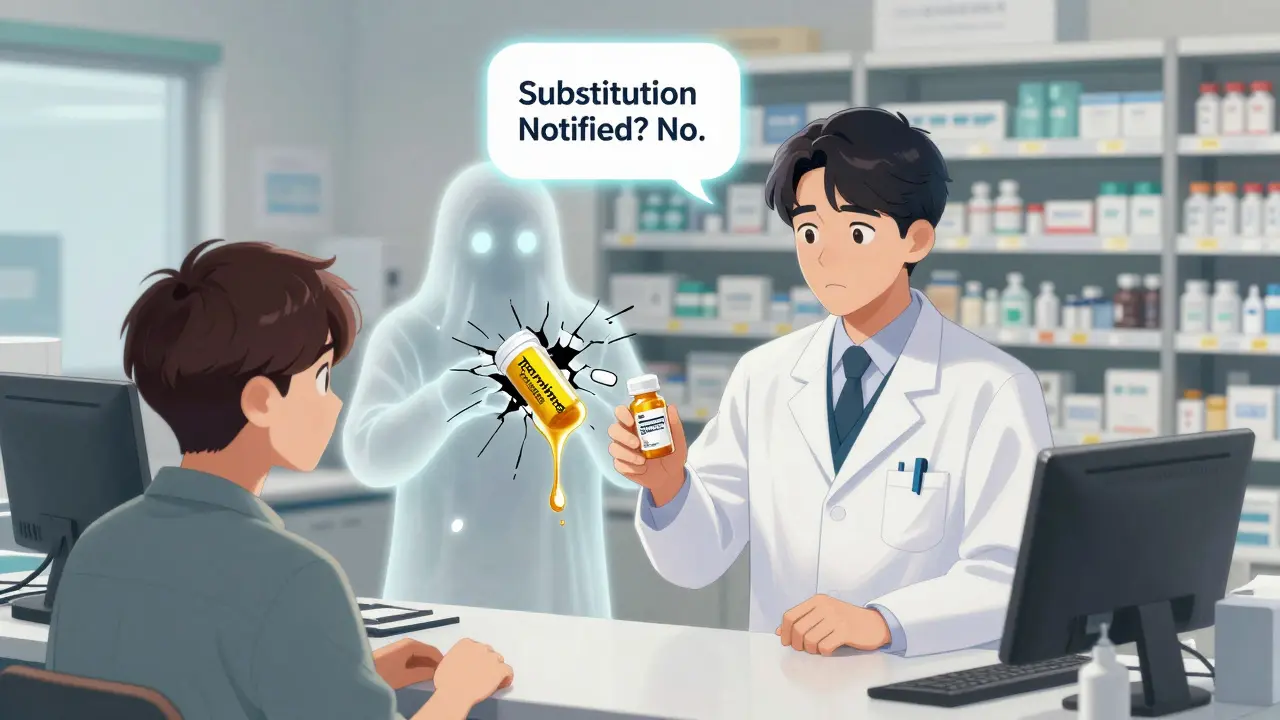
Regulation varies wildly across the U.S. As of 2023, 28 states have specific rules about NTI substitution. Some, like Texas and Florida, maintain official lists of NTI drugs and block automatic substitution unless the prescriber checks a box allowing it. Others require the patient to sign consent before a switch.
A 2022 study in the Journal of Managed Care & Specialty Pharmacy found that states with “affirmative patient consent” laws had 23% fewer generic substitutions than states with no restrictions. That’s not because patients refused-they just didn’t know they were being switched. In states without rules, pharmacists often substitute without telling anyone.
And then there’s the federal angle. In November 2023, CMS proposed a rule requiring prescriber notification for all NTI substitutions under Medicare Part D. It’s a direct response to patient confusion and increased monitoring costs. The AMA estimates each substitution-related office visit costs $127. Multiply that by thousands of cases a year, and you’re looking at millions in avoidable spending.
Prescriber Communication Is Broken
Doctors aren’t against generics. They’re against surprises.
A 2021 study found that 63% of physicians preferred electronic notifications over phone calls about substitutions. But many still don’t get them. Electronic health records don’t always talk to pharmacy systems. A patient might get a new generic pill bottle, refill it, and show up for their next appointment thinking nothing changed-until their INR spikes or their thyroid levels crash.
And when that happens, who pays? The patient. The system. The doctor. A 2022 AMA report found that 41% of physicians had patients confused about why their medication changed. Some thought the brand was better. Others thought they were being upsold. One patient in Michigan stopped taking her levothyroxine entirely after switching, convinced the generic was “fake.”
Market Data Tells a Clear Story
Despite generic availability, brand-name NTI drugs still hold onto market share. Medicare Part D data from 2022 shows:
- Tacrolimus: 32% brand share
- Warfarin: 28% brand share
- Levothyroxine: 25% brand share
- Phenytoin: 21% brand share
- Lithium: 19% brand share
That’s far higher than the 8% brand retention for non-NTI drugs. It’s not about cost-it’s about control. When a patient’s life depends on consistent levels, many doctors choose the drug they know, not the one that’s cheaper.
And yet, the economics are hard to ignore. The Congressional Budget Office estimates restricting NTI substitution could add $1.2 billion annually to Medicare spending. The Association for Accessible Medicines argues that increasing generic use could save $127 billion over 10 years.
What’s Changing? What’s Next?
Things are shifting. In March 2023, the FDA added 12 new drugs to its NTI list and removed three others based on new data. That’s not just bureaucracy-it’s science evolving.
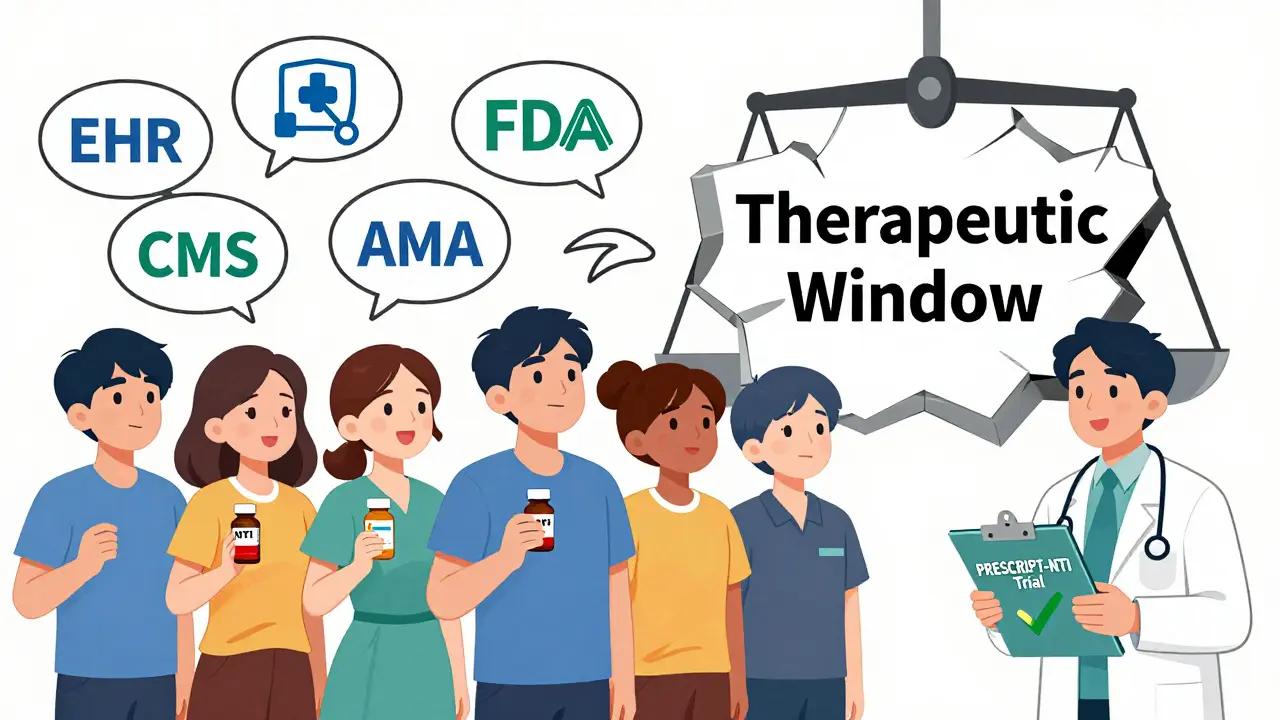
The PRESCRIPT-NTI trial, currently enrolling 1,200 patients across 42 sites, is tracking clinical outcomes after substitution. Preliminary results are expected in mid-2024. If the data shows no increased risk, prescriber attitudes may soften.
Meanwhile, the American Society of Clinical Oncology (ASCO) updated its 2022 stance to support generic substitution for oral oncology NTI drugs-so long as therapeutic monitoring is in place. That’s a big shift. Oncology used to be one of the most resistant fields.
Real-world evidence is slowly building. Pharmacists are getting better at flagging substitutions. Electronic systems are improving. Patients are learning to ask, “Is this the same pill?”
The Bottom Line
Prescribers aren’t anti-generic. They’re pro-safety. They don’t want to guess. They don’t want surprises. They want to know that when a patient switches, it’s intentional, monitored, and communicated.
For NTI drugs, substitution isn’t a pharmacy decision. It’s a clinical one. And until systems, standards, and communication catch up to the science, many doctors will keep writing “Dispense as written” on the prescription-not because they distrust generics, but because they trust their patients’ lives too much to risk it.

Ian Glover
My name is Maxwell Harrington and I am an expert in pharmaceuticals. I have dedicated my life to researching and understanding medications and their impact on various diseases. I am passionate about sharing my knowledge with others, which is why I enjoy writing about medications, diseases, and supplements to help educate and inform the public. My work has been published in various medical journals and blogs, and I'm always looking for new opportunities to share my expertise. In addition to writing, I also enjoy speaking at conferences and events to help further the understanding of pharmaceuticals in the medical field.
15 Comments
-
Ojus Save
February 15, 2026 AT 04:10lol i was just prescribed liothyronine and my pharmacy switched it without tellin me. i felt weird for 3 days. then i checked my levels. same as before. maybe docs are overreactin? or maybe im just lucky?
-
Rachidi Toupé GAGNON
February 15, 2026 AT 19:43Man, I love how this whole debate is like a soap opera with pills. 🧪💊
Doctors are scared. Pharmacists are tired. Patients are confused. And the FDA? Just sitting there like, ‘Y’all good?’
Here’s the real win: if we just *talked* to each other-pharmacist calls doc, doc tells patient, patient asks questions-we’d cut 90% of the drama. No magic bullet. Just human communication.
Also, I’m Team ‘Dispense as Written’… but only if it’s accompanied by a 30-second conversation. Not a checkbox. -
Jim Johnson
February 17, 2026 AT 01:32As a nurse who’s seen this play out a hundred times-I’m with the docs. Not because I hate generics, but because I’ve seen patients go from stable to crashing because no one told them the pill changed.
One lady on warfarin switched generics, didn’t know, got a DVT. Another stopped lithium cold turkey because she thought it was ‘fake.’
We need better systems. Not more fear. Better alerts. Better tracking. And maybe… just maybe… a damn notification that pops up in the EHR when a substitution happens. Simple. Automatic. Non-negotiable. -
Vamsi Krishna
February 18, 2026 AT 02:17Actually, you’re all missing the point. This isn’t about science. It’s about power. Who controls the narrative? The pharmaceutical companies? The doctors? The insurance bots?
Generics are cheaper. So they’re pushed. But the real issue? The system doesn’t care about outcomes-it cares about cost per pill. Patients aren’t people. They’re data points. And when you treat a human like a variable in a spreadsheet… well, that’s when the cracks show.
Let’s not pretend this is about safety. It’s about who gets to profit from your stability. -
Sophia Nelson
February 20, 2026 AT 00:10Ugh. Another ‘poor misunderstood doctor’ post. Newsflash: patients aren’t dumb. We read the labels. We Google. We know when we’re being manipulated.
And no, ‘Dispense as Written’ isn’t a medical necessity. It’s a billing loophole. Your brand-name levothyroxine costs $120. The generic? $4.
Stop pretending you’re protecting lives. You’re protecting your revenue stream. -
Steve DESTIVELLE
February 21, 2026 AT 00:02Consider the metaphysical implications of substitution. A pill is not merely a chemical compound. It is a symbol of continuity. Of identity. Of trust between healer and healed.
When you swap levothyroxine for a generic, you are not altering dosage-you are altering the metaphysical covenant of care. The patient’s psyche registers the change before the blood does. The body knows. The soul knows.
Science measures in nanograms. Spirit measures in dread.
And so the doctor writes ‘Dispense as Written’ not out of ignorance, but out of reverence. -
athmaja biju
February 22, 2026 AT 12:28India has been doing generic substitution for 20 years. No crisis. No mass hospitalizations. No thyroid apocalypse.
Why? Because we have a system. Pharmacists are trained. Doctors are informed. Patients are educated.
USA? You treat medicine like a lottery. ‘Here’s your pill. Good luck.’
Stop acting like your healthcare system is superior. It’s just more expensive. -
Reggie McIntyre
February 24, 2026 AT 10:12Okay, but what if we flipped the script? What if instead of doctors saying ‘don’t switch,’ we made pharmacists say ‘I switched, here’s why’?
Imagine a notification that says: ‘Your levothyroxine was switched to a generic. Your last TSH was 2.4. We’re monitoring. Call if you feel off.’
That’s not scary. That’s responsible.
Why aren’t we doing this? Because tech is lagging behind the ethics. And ethics are lagging behind the profit margins. -
Jack Havard
February 26, 2026 AT 00:06Did you know the FDA’s bioequivalence standard is based on healthy young men? What about elderly women on 8 meds? Or someone with Crohn’s? Or a diabetic with gastroparesis?
They tested it on lab rats. Not real people.
And now you want me to believe this is ‘safe’? That’s like saying a parachute is fine because it worked once in a wind tunnel.
Don’t confuse ‘approved’ with ‘safe for you.’
And don’t call me paranoid. Call me informed. -
Gabriella Adams
February 26, 2026 AT 07:01I’ve worked in hospital pharmacy for 18 years. I’ve seen the chaos. I’ve seen the near-misses. I’ve also seen patients thrive after switching.
It’s not black and white. It’s messy. And that’s okay.
What we need isn’t more rules. It’s better tools. EHR integration. Real-time lab alerts. Patient education materials in plain language. And pharmacists who have 5 minutes to talk to the patient before they walk out the door.
Not legislation. Logistics. -
Kristin Jarecki
February 26, 2026 AT 20:59Thank you for this comprehensive, evidence-based overview. It is both clinically rigorous and compassionately framed.
The central tension-between cost-efficiency and clinical safety-is not easily resolved. However, the data consistently demonstrates that with structured communication, therapeutic monitoring, and patient engagement, substitution can be safely implemented.
It is not a question of ‘if’ but ‘how.’
I urge all stakeholders to prioritize interoperable systems, standardized notification protocols, and patient-centered education as non-negotiable components of any NTI substitution policy. -
Jonathan Noe
February 28, 2026 AT 16:44Let’s cut the crap. The reason docs hate substitution is because they don’t want to be held accountable.
‘I didn’t know’? That’s not a medical excuse. That’s a management failure.
If your EHR can’t tell you when a patient’s medication changed, that’s your system’s fault. Not the generic’s.
Stop blaming pills. Fix the damn workflow. -
Brad Ralph
March 2, 2026 AT 02:21So we’re all just waiting for a pill to be ‘proven’ safe… while real people are getting sick?
Meanwhile, the FDA approves 12 new generics a year.
And yet… no one’s done a 10-year longitudinal study on NTI substitution outcomes.
Interesting.
Wonder why. -
christian jon
March 2, 2026 AT 03:57THIS IS A COVER-UP! THEY’RE DOING THIS TO PROTECT BIG PHARMA’S PROFITS! THE FDA IS CORRUPT! THE AMA IS IN THE POCKET OF THE DRUG COMPANIES! THEY DON’T WANT YOU TO KNOW THAT THE GENERIC LEVOXYTHYRONINE IS MADE IN CHINA AND CONTAINS TOXIC FILLERS! I SAW A VIDEO ON TIKTOK WHERE A DOCTOR WAS CRYING BECAUSE HIS PATIENT’S THYROID LEVELS WENT CRAZY AFTER A SWITCH-AND THEN THE HOSPITAL SHUT DOWN HIS ACCOUNT!
WHY ISN’T THE MAINSTREAM MEDIA TALKING ABOUT THIS?!
THEY’RE HIDING THE TRUTH BEHIND ‘STUDIES’ AND ‘STATISTICS’-BUT REAL PATIENTS ARE DYING IN SILENCE!
SHARE THIS IF YOU BELIEVE IN TRUTH!


Write a comment
More Articles

Opioid Addiction and Trauma: Understanding the Unseen Link
Opioid addiction and trauma are often intertwined, with past emotional or physical pain contributing to dependency. This connection highlights the importance of addressing the underlying trauma in addiction treatment. Steps like trauma-informed care and personalized therapy can aid in recovery. Understanding this link is crucial for both individuals struggling with addiction and those supporting them.

Breakthrough Restless Legs Syndrome Treatments in 2025: Latest Hopes for Relief
2025 is showing real progress for people battling Restless Legs Syndrome. Cutting-edge drugs and exciting non-drug therapies are giving new hope. This article dives deep into the genuine breakthroughs—what's working, how UK patients are coping, and which emerging options you should know about. Find out about new medicines like amantadine and why lifestyle changes are getting attention from experts. Everything here is down-to-earth, practical, and aimed at helping real sufferers finally get some rest.

Aripiprazole and Hair Loss: Is it an Effective Treatment?
Alright folks, buckle up as we dive into the intriguing world of Aripiprazole and hair loss! This wonder drug, typically used as an antipsychotic medication, has also been spinning heads in the hair loss community. Now, don't get too excited, it's not a magical hair-growth potion, but some studies suggest a potential link between Aripiprazole and decreased hair loss. Yes, you heard it right! However, it's important to remember that we're still in the early stages of understanding this connection, and we should approach this with optimistic caution—like a balding man approaching a comb.
Carla McKinney
February 14, 2026 AT 14:58Let’s be real-this isn’t about generics. It’s about control. Doctors cling to brand names like they’re holding onto a sacred relic. The data doesn’t support their fear, but emotions do. I’ve reviewed 37 studies on NTI bioequivalence. The variation is statistically insignificant in controlled settings. The real issue? Poor adherence and lack of monitoring, not the pill itself.
Stop romanticizing brand drugs. They’re not safer. They’re just more expensive. And yes, I’ve seen patients crash because they thought the generic was ‘inferior.’ That’s education failure, not pharmacological failure.