Prescription Transfer Eligibility Checker
Determine if your prescription can be transferred between pharmacies based on current federal and state rules. This tool reflects the 2023 DEA changes and state-specific requirements.
Switching pharmacies isn’t as simple as walking into a new store and asking for your meds. If you’re taking any controlled substances - like painkillers, ADHD meds, or sleep aids - the rules are strict, and the paperwork matters. A single missing detail can delay your transfer by days. And if you’re switching across state lines? That adds another layer of complexity. The good news? You don’t need to go back to your doctor every time you move or change pharmacies. Since August 2023, federal rules changed to make electronic transfers easier - but only under specific conditions.
What You Must Give the New Pharmacy
At minimum, you’ll need to give the new pharmacy your full legal name, date of birth, and current address. These aren’t just formalities - they’re required to match your prescription records exactly. Even a typo in your middle name or an outdated zip code can trigger a hold. If you’re transferring multiple prescriptions, list them all clearly: medication name, dosage, and how many refills are left. Don’t assume they’ll find it. Pharmacists don’t have magic eyes - they need the details you have.
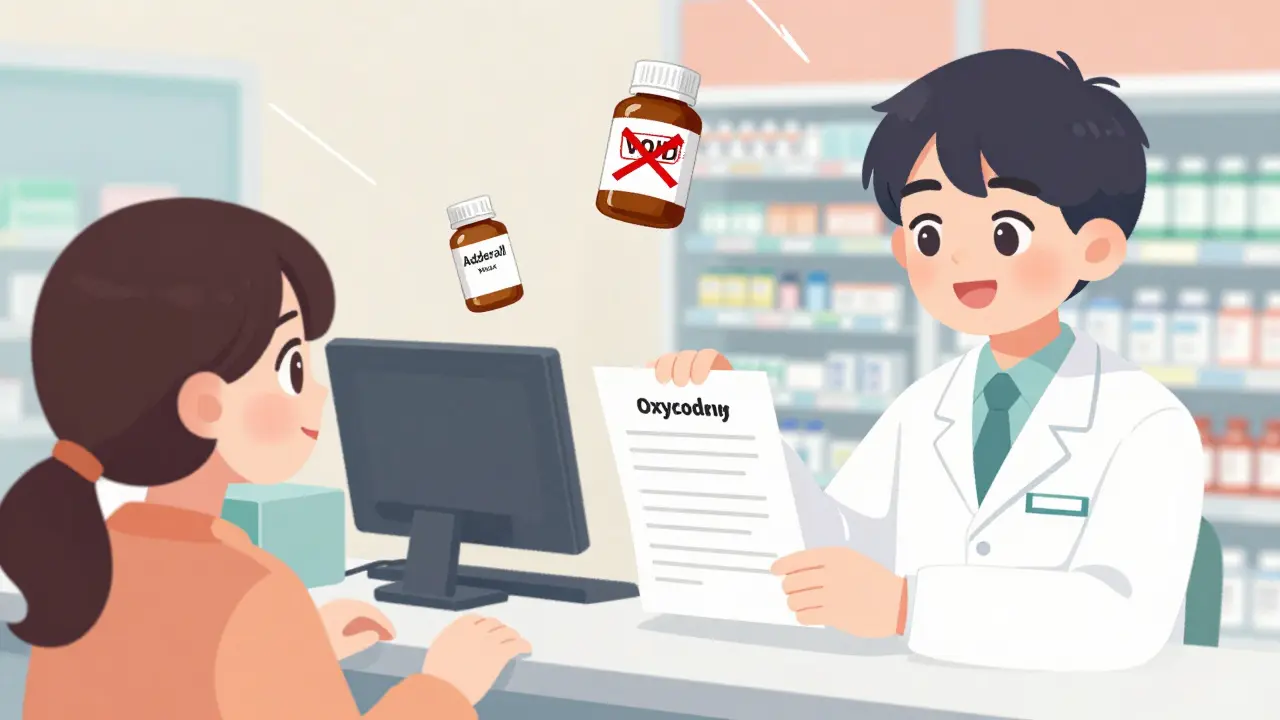
For non-controlled medications (like blood pressure pills, statins, or antibiotics), that’s usually enough. Most pharmacies can transfer those with a quick phone call or secure message between them. But if you’re taking anything classified as a Schedule III, IV, or V controlled substance - think oxycodone, Adderall, or Xanax - the process changes completely.
Controlled Substances: One-Time Only Rule
Under the DEA’s 2023 Final Rule, you can transfer a prescription for a Schedule III-V controlled substance only once between pharmacies. That means if you switch from Pharmacy A to Pharmacy B, you can’t later move that same prescription to Pharmacy C. Once it’s transferred, the original is voided. If you need to switch again, you’ll need a new prescription from your doctor.
This rule applies even if both pharmacies are owned by the same company - say, CVS to CVS. It also applies per prescription, not per patient. So you can transfer your Adderall to one pharmacy and your Xanax to another, but each one counts as its own one-time transfer.
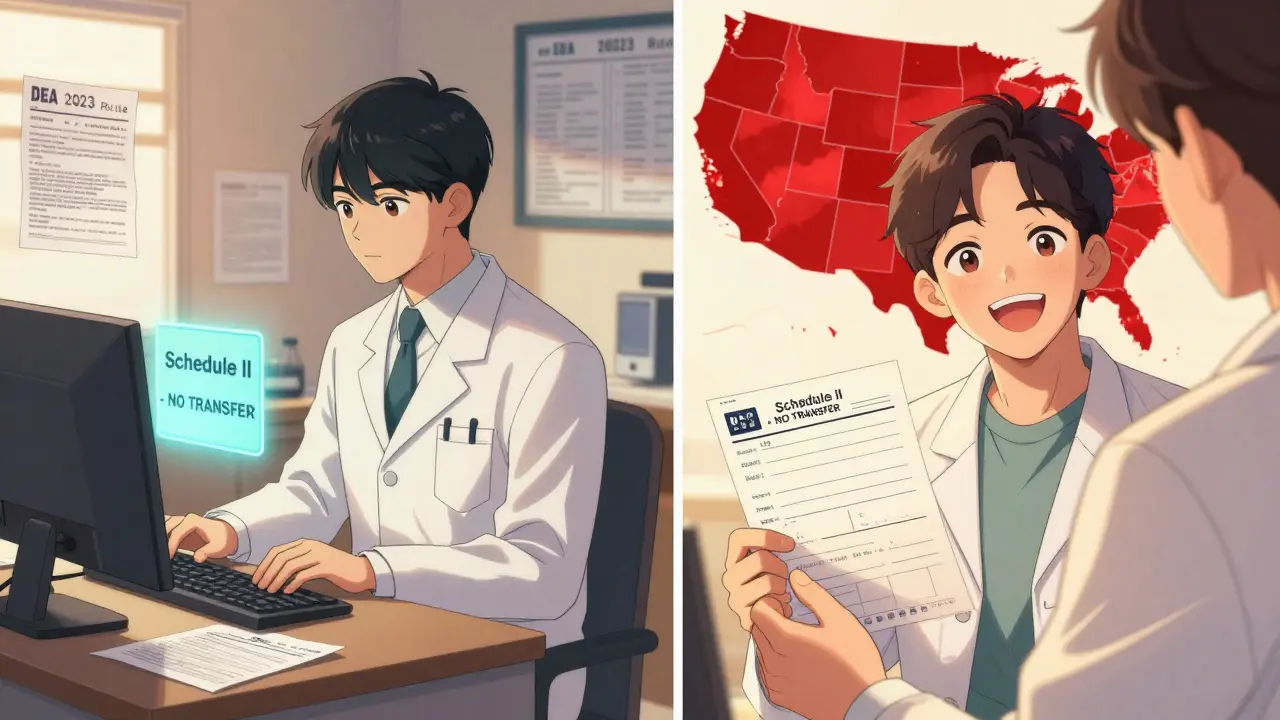
And here’s the hard part: Schedule II drugs - like fentanyl patches, hydrocodone combinations, or methadone - cannot be transferred at all. Not by phone. Not by fax. Not electronically. If you’re on one of these, you must get a new prescription from your prescriber. No exceptions. No workarounds. This isn’t a pharmacy policy - it’s federal law.
What Happens Behind the Scenes
When you ask a new pharmacy to transfer your meds, they don’t just call and ask for your script. They follow a strict electronic protocol. The transferring pharmacy must send the full prescription data - including the prescriber’s DEA number, the original fill date, remaining refills, and the prescription number - in an unaltered electronic format. The receiving pharmacy must then mark the prescription as “transferred,” record the name and DEA number of the pharmacist who sent it, and log the date of transfer.
Both pharmacies must keep these records for at least two years. That’s why it’s important to get a receipt or confirmation when you initiate the transfer. If something goes wrong later, you’ll need proof you requested it.
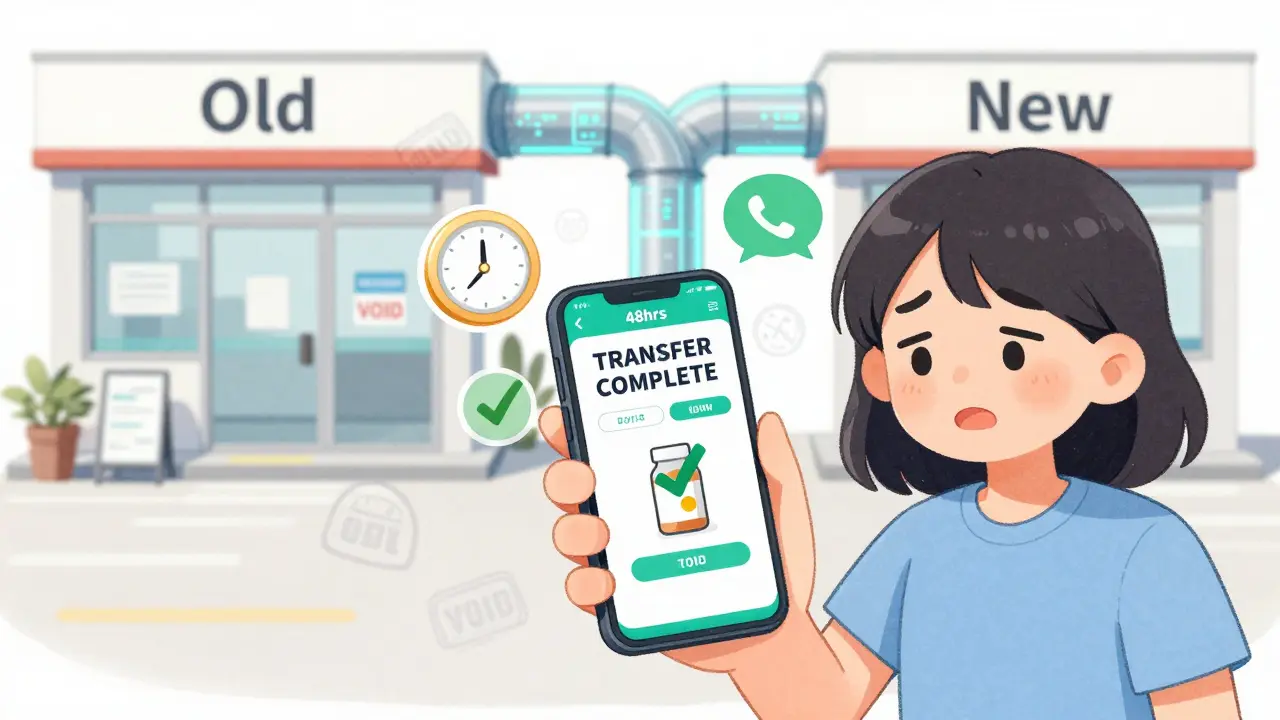
Many patients don’t realize the transferring pharmacy is legally required to mark the original prescription as “VOID” after the transfer. If you still have a paper copy at home, you’ll see “VOID” stamped on it. If you use a digital app, you’ll see the status change. That’s not a glitch - it’s the system working as intended.
Why Transfers Get Stuck
Most delays aren’t because the pharmacy is slow - they’re because something’s missing. According to a 2023 Consumer Reports survey, 42% of failed transfers involved controlled substances, and 31% were due to incomplete or incorrect information. Common mistakes:
- Providing only the medication name without dosage (e.g., “Adderall” instead of “Adderall 20mg”)
- Forgetting to confirm if the prescription still has refills
- Not giving the correct prescriber’s name or DEA number
- Trying to transfer a Schedule II drug
- Asking to transfer a prescription that’s already used up all refills
Some pharmacies refuse transfers outright if they’re unsure about state laws. For example, states like New York and California have added extra documentation steps beyond federal rules. Rural pharmacies with older systems may not support electronic transfers yet. If you’re denied, ask for the reason in writing. Pharmacies are required to explain - even if they don’t have to fix it.
How Long Does It Take?
For non-controlled prescriptions, expect 24 to 48 hours. Most chain pharmacies like CVS or Walgreens can complete these transfers within a day if your old pharmacy is also electronic. Controlled substance transfers take longer - often 48 to 72 hours - because pharmacists must verify more data and sometimes call the previous pharmacy directly to confirm details.
Don’t wait until your last pill is gone to start the process. Plan ahead. If you’re moving, changing insurance, or switching providers, begin the transfer at least 5-7 days before you need your next refill. Pharmacies aren’t required to rush you, and holidays or weekends can delay things further.
What to Do If Your Transfer Is Denied
If your new pharmacy says no, ask: “What’s the specific reason?” Write it down. Common answers:
- “Your prescription has no refills left.” → You need a new script from your doctor.
- “This is a Schedule II drug.” → You need a new prescription. No transfer allowed.
- “We can’t verify the transferring pharmacy’s DEA number.” → Call your old pharmacy and ask them to re-send the info.
- “Our system doesn’t support transfers.” → Try another pharmacy. About 87% of U.S. pharmacies now use compliant systems.
If you’re told it’s a “state law issue,” ask for the exact regulation. Some states require a signed patient consent form or limit transfers to in-state pharmacies. You’re entitled to know why.
Pro Tips for a Smooth Switch
- Call your new pharmacy first - ask if they accept electronic transfers and if they’ve processed controlled substance transfers since August 2023.
- Have your old pharmacy’s name, address, and phone number ready. Don’t rely on memory.
- Keep a list of all your current prescriptions, including dosage, refill count, and prescriber. Use your phone’s notes app.
- Don’t assume your insurance will handle the transfer. Insurance and pharmacy systems are separate.
- For controlled substances, confirm with both pharmacies that the transfer was completed before picking up your first fill.
What’s Changing Soon?
The DEA is monitoring the one-time transfer rule closely. The first official review is due in Q3 2024. Industry experts believe the rule may be expanded to allow multiple transfers for controlled substances within the next 2-3 years, especially as more pharmacies adopt unified digital systems. For now, though, the one-time limit stays.
Also watch for updates from your state pharmacy board. Forty-two states have already updated their rules to match the DEA’s 2023 changes, but others are still catching up. If you live in a border town or frequently travel, check your state’s website for the latest transfer policies.
Bottom line: Switching pharmacies is doable - but only if you know what you’re dealing with. For most medications, it’s easy. For controlled substances, it’s a tightrope walk between convenience and regulation. Be prepared. Be specific. And don’t guess.
Can I transfer my prescription if I’ve used all my refills?
No. If your prescription has no refills left, you cannot transfer it - even if it’s non-controlled. You must get a new prescription from your doctor. Pharmacies are not allowed to refill expired prescriptions, and transfer rules only apply to active, refillable prescriptions.
Can I transfer a Schedule II drug like oxycodone to a new pharmacy?
No. Federal law prohibits the transfer of any Schedule II controlled substance between pharmacies. These include opioids like oxycodone, hydrocodone combinations, and stimulants like Adderall XR. You must obtain a new prescription from your prescriber if you switch pharmacies.
How long do pharmacies keep transfer records?
Pharmacies must keep records of all prescription transfers for at least two years from the date of the last refill. Some states require longer retention - for example, New York requires five years. These records include the names of both pharmacists, DEA numbers, transfer dates, and prescription details.
Do I need to go to the pharmacy in person to start a transfer?
No. You can request a transfer by phone, online through a patient portal, or in person. Many pharmacies let you start the process via their app or website. But you’ll still need to provide your full name, date of birth, and prescription details. The actual transfer happens electronically between pharmacists - you don’t need to be there.
What if my old pharmacy won’t release my prescription?
Your old pharmacy is legally required to transfer the prescription if you request it and the transfer is allowed under federal and state law. If they refuse without a valid reason - like no refills left or a Schedule II drug - ask for the reason in writing. You can also contact your state pharmacy board to file a complaint. Most refusals are due to administrative errors, not legal barriers.

Ian Glover
My name is Maxwell Harrington and I am an expert in pharmaceuticals. I have dedicated my life to researching and understanding medications and their impact on various diseases. I am passionate about sharing my knowledge with others, which is why I enjoy writing about medications, diseases, and supplements to help educate and inform the public. My work has been published in various medical journals and blogs, and I'm always looking for new opportunities to share my expertise. In addition to writing, I also enjoy speaking at conferences and events to help further the understanding of pharmaceuticals in the medical field.
13 Comments
-
christy lianto
January 8, 2026 AT 08:46Ugh. I had to wait 5 days because my zip code was off by one digit. FIVE DAYS. I’m on a schedule and my pharmacist didn’t even apologize. This system is broken. You’d think after 2023 they’d fix the basics. I’m not asking for magic-just accurate data entry.
-
Donny Airlangga
January 9, 2026 AT 22:30I’ve been through this twice now-once when I moved across state lines and again when I switched insurance. The worst part isn’t the rules, it’s the silence. You call, you get automated voicemail, you email, you get no reply. Then you’re out of meds and panicking. Pharmacies need to do better with communication, not just compliance.
-
Molly Silvernale
January 10, 2026 AT 04:50It’s like the DEA and the pharmacies are playing a game of Jenga with people’s lives-pull one block (a single missing DEA number) and the whole tower collapses. And we’re the ones left holding the pieces. Why is convenience such a threat to bureaucracy? Why does ‘safety’ always mean ‘inconvenience’? The system doesn’t protect patients-it protects paperwork.
-
Kristina Felixita
January 11, 2026 AT 11:52Y’all not gonna believe this-I tried to transfer my Xanax from Walgreens to CVS and they said ‘we don’t do out-of-state transfers’… so I called my doc and they just reissued it. Felt like I was playing phone tag with a robot. But hey, at least I didn’t miss a dose. Pro tip: keep a screenshot of your refills. Saved my life.
-
Joanna Brancewicz
January 12, 2026 AT 17:27DEA Schedule III-V transfer = one-time only. That’s the regulatory baseline. Non-compliance = federal violation. Pharmacies are bound by 21 CFR §1306.25. No wiggle room. Don’t blame the pharmacist-they’re just the enforcers.
-
Evan Smith
January 12, 2026 AT 23:49So let me get this straight-I can’t move my hydrocodone to a pharmacy 2 miles away unless I get a new script? And this is ‘progress’? I thought we were supposed to be tech-savvy now. Can’t we just text a barcode? I’d rather have a chatbot than this 1998 paper trail.
-
Lois Li
January 13, 2026 AT 22:42I used to think pharmacies were just places you picked up pills. Now I realize they’re the last line of defense in a broken system. I’m grateful for the pharmacists who take the time to double-check everything-even if it takes forever. But we need better tech. And empathy. Not just rules.
-
Ken Porter
January 14, 2026 AT 17:07Why are we letting the government micromanage my medicine? This is America. I paid for my prescription. I should be able to take it wherever I want. If you can’t handle the tech, get a new job. Not my problem.
-
Annette Robinson
January 15, 2026 AT 16:10For anyone struggling: call your old pharmacy first. Ask them to initiate the transfer. It’s faster than you waiting for the new one to reach out. And always ask for a transfer confirmation number. I learned this the hard way after a 3-day gap in my meds. Don’t be me.
-
Luke Crump
January 16, 2026 AT 05:42This whole system is a cult. The DEA doesn’t care about you-they care about control. You think they’re protecting you? No. They’re protecting the pharmaceutical industry’s monopoly. One-time transfers? That’s not safety. That’s profit. You’re not a patient-you’re a data point in a ledger.
-
Aubrey Mallory
January 18, 2026 AT 03:14My mom got stuck because she didn’t know her prescriber’s DEA number. She’s 72. She doesn’t have a computer. We had to drive to the old pharmacy to get a printout. This isn’t healthcare-it’s a scavenger hunt. We need better support for elderly patients. Not just rules.
-
Dave Old-Wolf
January 19, 2026 AT 14:34I transferred my blood pressure meds and my Adderall at the same time. One worked in 2 hours. The other took 72. Why? Because one’s ‘just a pill’ and the other’s ‘dangerous.’ But both keep me alive. That’s the real injustice.


Write a comment
More Articles

How Environmental Factors Contribute to Bacterial Eye Infections
Bacterial eye infections can be influenced by various environmental factors. This article explores how elements such as pollution, contact with contaminated water, and seasonal changes can contribute to the spread and severity of these infections. It also offers practical tips for prevention and maintaining good eye health.

The Importance of Self-Care for Breast Cancer Survivors
As a breast cancer survivor, I cannot stress enough the importance of self-care in our journey to recovery. Taking care of our physical, emotional, and mental well-being is crucial in helping us regain our strength and confidence. By engaging in regular exercise, maintaining a healthy diet, and seeking emotional support, we can significantly improve our overall health and reduce the risk of recurrence. Surrounding ourselves with positive influences and seeking professional help when needed also plays a vital role in our healing process. Remember, self-care is not selfish; it is an essential part of our journey to becoming strong, resilient survivors.
swati Thounaojam
January 8, 2026 AT 00:29lol i just tried to transfer my adderall and they said nope. thought it was gonna be easy. guess not.